-
Use Cases
-
Resources
-
Pricing
The Terracotta Army is a collection of thousands of life-sized clay soldiers, horses, and chariots buried near the tomb of Qin Shi Huang, the first Emperor of China, in Lintong District, Xi'an. Created to protect the emperor in the afterlife, it was discovered by local farmers in 1974 and is now a UNESCO World Heritage Site. More Less
300 BC
% complete
In extant archaeology, only rare and very small terracotta warrior figurines are known from the end of the Zhou dynasty in the 4th–3rd century BCE, such as the Taerpo horserider, the first known representation of a cavalryman in China, from a military tomb near Xianyang in the Qin state.
Image source: Terracotta Army
210 BCE
% complete
The Terracotta Army figures were created in the late 200s BCE to accompany the first Qin emperor, Qin Shi Huang, in the afterlife. Thousands of life-sized soldiers, chariots, and horses were crafted and buried near his mausoleum at Mount Li.
90 BC
% complete
The historian Sima Qian (145–90 BCE) described the construction of the tomb in the Records of the Grand Historian, the first of China's 24 dynastic histories, written a century after the mausoleum's completion.
Image source: Records of the Grand Historian
500
% complete
Geographer Li Daoyuan, writing six centuries after the first emperor's death, recorded in Shui Jing Zhu that Mount Li was favoured for its auspicious geology: 'famed for its jade mines, its northern side was rich in gold, and its southern side rich in beautiful jade; the first emperor, covetous of its fine reputation, therefore chose to be buried there'.
Image source: Commentary on the Water Classic
1600
% complete
For centuries before the formal discovery, occasional reports surfaced of pieces of terracotta figures and fragments of the Qin necropolis, including roofing tiles, bricks, and chunks of masonry.
1700 - 1899
% complete
During excavations near the Mount Li burial mound, archaeologists found several graves dating from the 18th and 19th centuries, where diggers had apparently struck terracotta fragments long before the army's official discovery.
Mar 29, 1974
% complete
The Terracotta Army was discovered on 29 March 1974 by farmers Yang Zhifa, his five brothers, and neighbour Wang Puzhi, who were digging a well approximately 1.5 km east of the Qin Emperor's tomb mound at Mount Li, a region riddled with underground springs and watercourses.
1998 - 2006
% complete
Duan Qingbo served as site chief archaeologist from 1998 to 2006. He noted that the only thing in extant archaeology which may hold a close similarity to the figures in artistic style is that of the later 1st century BCE Central Asian Khalchayan statuary.
1999
% complete
Excavations in Pit K9901 uncovered in 1999 a series of associated terracotta sculptures dubbed 'The Acrobats', which have been remarked to display an advanced understanding of human anatomy.
2003
% complete
A grave pit discovered and excavated in 2003 yielded 121 skeletons identified by scholars as attributable to the site workers who built the mausoleum complex.
2007
% complete
Estimates from 2007 were that the three pits containing the Terracotta Army hold more than 8,000 soldiers, 130 chariots with 520 horses, and 150 cavalry horses, the majority of which remain in situ.
1982
% complete
The first exhibition of the Terracotta Army figures outside of China was held at the National Gallery of Victoria (NGV) in Melbourne, Australia in 1982, introducing international audiences to the ancient warriors.
2003 - 2004
% complete
An exhibition tour of 120 real-size replicas of Terracotta statues was displayed in the German cities of Frankfurt am Main, Munich, Oberhof, Berlin (at the Palace of the Republic), and Nuremberg between 2003 and 2004.
May 9, 2004 - Sep 26, 2004
% complete
Warriors and other artifacts were exhibited to the public at the Forum de Barcelona in Barcelona between 9 May and 26 September 2004.
Oct 2004 - Jan 2005
% complete
The same exhibition was presented at the Fundación Canal de Isabel II in Madrid between October 2004 and January 2005, becoming their most successful ever.
Jun 15, 2006 - Sep 17, 2006
% complete
Between 15 June and 17 September 2006 the exhibition entitled 'Los Guerreros de Terracota: Un Ejercito Inmortal' ('The Chinese Terracotta Army: An Immortal Army'), composed of 73 objects, was displayed at the National Museum of Colombia in Bogotá.
Sep 13, 2007 - Apr 2008
% complete
A collection of 120 objects from the mausoleum and 12 terracotta warriors were displayed at the British Museum in London as its special exhibition 'The First Emperor: China's Terracotta Army' from 13 September 2007 to April 2008.
2008
% complete
The First Emperor exhibition made 2008 the British Museum's most successful year and made it the United Kingdom's top cultural attraction between 2007 and 2008, bringing the most visitors since the King Tutankhamun exhibition in 1972.
Image source: British Museum
Jul 2008 - Nov 16, 2008
% complete
In Italy, from July 2008 to 16 November 2008, five warriors of the Terracotta Army were displayed in Turin at the Museum of Antiquities.
Dec 2009 - May 2010
% complete
From December 2009 to May 2010, the exhibition was shown in the Centro Cultural La Moneda in Santiago de Chile.
Apr 16, 2010 - Sep 5, 2010
% complete
From 16 April 2010 to 5 September 2010, nine statues including officials, lancers, and an archer were displayed at the Royal Palace in Milan at the exhibition entitled 'The Two Empires'.
Aug 28, 2010 - Jan 20, 2011
% complete
Subsequently, the exhibition traveled to Sweden and was hosted in the Museum of Far Eastern Antiquities between 28 August 2010 and 20 January 2011.
Image source: Museum of Far Eastern Antiquities, Stockholm
Dec 2, 2010 - Mar 13, 2011
% complete
An exhibition entitled 'The First Emperor – China's Entombed Warriors', presenting 120 artifacts, was hosted at the Art Gallery of New South Wales between 2 December 2010 and 13 March 2011.
Image source: Art Gallery of New South Wales
Feb 11, 2011 - Jun 26, 2011
% complete
An exhibition entitled 'L'Empereur guerrier de Chine et son armée de terre cuite' ('The Warrior-Emperor of China and his terracotta army'), featuring artifacts including statues from the mausoleum, was hosted by the Montreal Museum of Fine Arts from 11 February 2011 to 26 June 2011.
Image source: Montreal Museum of Fine Arts
Mar 15, 2013 - Nov 17, 2013
% complete
Soldiers and related items were on display from 15 March 2013 to 17 November 2013 at the Historical Museum of Bern in Switzerland.
Image source: Bern Historical Museum
Apr 3, 2017 - Jul 16, 2017
% complete
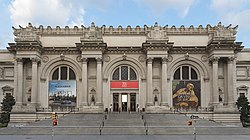
Several Terracotta Army figures were on display, along with many other objects, in an exhibit entitled 'Age of Empires: Chinese Art of the Qin and Han Dynasties' at The Metropolitan Museum of Art in New York City from 3 April 2017 to 16 July 2017.
Image source: Metropolitan Museum of Art
Apr 8, 2017 - Mar 4, 2018
% complete
An exhibition featuring ten Terracotta Army figures and other artifacts, 'Terracotta Warriors of the First Emperor,' was displayed at the Pacific Science Center in Seattle from 8 April to 4 September 2017, then traveled to The Franklin Institute in Philadelphia from 30 September 2017 to 4 March 2018 with augmented reality additions.
Image source: Pacific Science Center
Feb 9, 2018 - Oct 28, 2018
% complete
An exhibition entitled 'China's First Emperor and the Terracotta Warriors' was held at the World Museum in Liverpool from 9 February 2018 to 28 October 2018.
Image source: World Museum
Jun 2025 - Feb 2026
% complete
The exhibition 'Legacy of the First Emperor' took place in the Western Australian Museum in Perth between June 2025 and February 2026.
Image source: Western Australian Museum
Nov 2025 - May 2026
% complete
An exhibition took place in the Museum of Fine Arts in Budapest, Hungary entitled 'The Guardians of Eternity' between November 2025 and May 2026.
Image source: Museum of Fine Arts (Budapest)
1986
% complete
Art historian German Hafner was the first to speculate on a possible Hellenistic link to the sculptures due to their unusual naturalism relative to general Qin era sculpture, stating: 'the art of the terracotta army originated from Western contact'.
2006
% complete
Since 2006, an international team of researchers at the UCL Institute of Archaeology has been using analytical chemistry techniques to uncover more details about the production techniques employed in the creation of the Terracotta Army.
2007
% complete
Scientists at Stanford University and the Advanced Light Source facility in Berkeley reported that powder diffraction experiments combined with energy-dispersive X-ray spectroscopy and micro-X-ray fluorescence analysis showed that Chinese purple dye (barium copper silicate) used on the figures derived from knowledge gained by Taoist alchemists attempting to synthesize jade ornaments.
Image source: Han purple and Han blue
2019
% complete
Some weapons had been coated with a 10–15 micrometer layer of chromium dioxide believed to have protected them from decay for 2200 years; however, research in 2019 indicated that the chromium was merely contamination from nearby lacquer, not a means of protecting the weapons.
2021
% complete
In 2021, morphological studies showed a strong resemblance between the statues and the modern inhabitants of the local region, leading some scholars to theorize that the high level of stylistic realism stems from the figures being modelled on actual soldiers.
2022
% complete
According to a 2022 study, there is statistically no difference between the facial features of terracotta warriors and contemporary Chinese populations, particularly northern and western Chinese populations.
Or browse the full history timeline directory, with more than 2,000 topics.
This Terracotta Army timeline was generated with the help of AI, using information found on the internet.
We work hard to keep these timelines accurate, but mistakes do get through. If you spot one, email us at [email protected] and we'll fix it for future visitors.
Generate yours with AI or build it from scratch, for free.
Export your timeline, add your own events, edit or remove AI-generated events, and much more
No credit card required.
Cancel anytime.
Cancel anytime.
You can create an unlimited number of timelines with up to 10 events on each one, customize how they look, export them to PDF, PNG, PowerPoint, CSV, and Excel, and share them with a link. Paid plans raise the event limit and add features like spreadsheet imports and collaborators.
Yes. You can cancel your subscription from your account page at any time, and you will not be charged again. Your subscription stays active for the rest of the period you already paid for.
Yes. We will email you a reminder before the annual renewal, and we will also email you a receipt.
Yes. You can email us within 15 days of any payment, and we will issue you a full refund.
Check out our pricing docs or send us an email anytime: [email protected].