-
Use Cases
-
Resources
-
Pricing
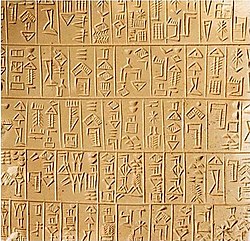
Sumerian Civilization was an ancient Mesopotamian culture that emerged in southern Mesopotamia (modern-day Iraq) and is widely regarded as the world's first civilization. The Sumerians pioneered writing with cuneiform script, built the first cities such as Uruk and Ur, developed irrigation agriculture, created early legal codes, and made advances in mathematics, astronomy, and literature, including the Epic of Gilgamesh. More Less
5700 BC - 4900 BC
% complete
The Samarra period culture (c. 5700 – c. 4900 BC) in northern Mesopotamia were the first to practice a primitive form of irrigation agriculture along the middle Tigris River and its tributaries. Ubaid period pottery of southern Mesopotamia has been connected to it via Choga Mami transitional ware.
Image source: Sumer
5500 BC - 3300 BC
% complete
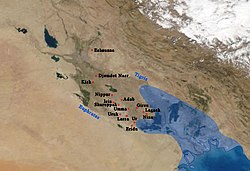
Most historians have suggested that Sumer was first permanently settled between c. 5500 and c. 3300 BC by a West Asian people who spoke the Sumerian language, a non-Semitic and non-Indo-European agglutinative language isolate.
5300 BC - 4700 BC
% complete
The archaeological record shows clear uninterrupted cultural continuity from the time of the early Ubaid period (5300–4700 BC, C-14) settlements in southern Mesopotamia, marking the earliest settled phase of what would become Sumerian civilization.
Image source: Ubaid period
5000 BC - 4500 BC
% complete
The Sumerians adopted an agricultural lifestyle perhaps as early as c. 5000 – c. 4500 BC, transitioning from earlier subsistence patterns to systematic farming that would underpin the growth of cities.
4100 BC - 2900 BC
% complete
By the Uruk period (c. 4100 – c. 2900 BC), trade goods moved along canals and rivers facilitated the rise of large, stratified, temple-centered cities with populations over 10,000, where centralized administrations employed specialized workers.
Image source: Uruk period
3200 BC - 2900 BC
% complete
The end of the Uruk period coincided with the Piora oscillation, a dry period from c. 3200 – c. 2900 BC that marked the end of the Holocene climatic optimum, a long wetter, warmer climate period.
2100 BC - 1700 BC
% complete
During the Akkadian and Ur III phases there was a shift from wheat to more salt-tolerant barley, but this proved insufficient: from 2100 to 1700 BC the population declined by nearly three-fifths due to salinization.
4000 BC
% complete
The Sumerians developed a complex system of metrology around c. 4000 BC, creating standardized units of measurement for length, area, volume, and weight that supported trade and administration.
2700 BC - 2300 BC
% complete
The period c. 2700 – c. 2300 BC saw the first appearance of the abacus and a table of successive columns delimiting the orders of magnitude of their sexagesimal number system.
2600 BC
% complete
From c. 2600 BC onwards, the Sumerians wrote multiplication tables on clay tablets and dealt with geometrical exercises and division problems.
4000 BC - 2500 BC
% complete
A long period of proto-writing occurred between c. 4000 – c. 2500 BC, preceding the world's earliest known texts which come from the Sumerian cities of Uruk and Jemdet Nasr.
3500 BC
% complete
The necessity to manage temple accounts with increasingly complex administrative organization led to the development of writing around c. 3500 BC, one of humanity's most consequential inventions.
3350 BC - 2500 BC
% complete
The world's earliest known texts come from the Sumerian cities of Uruk and Jemdet Nasr, dating to between c. 3350 – c. 2500 BC, following the earlier proto-writing period.
2800 BC
% complete
The Eastern Semitic Akkadian language is first attested in proper names of the kings of Kish c. 2800 BC, preserved in later king lists.
Image source: Akkadian language
2600 BC
% complete
Several centuries after the invention of cuneiform, the use of writing expanded beyond debt certificates and inventory lists about 2600 BC to messages and mail delivery, history, legend, mathematics, astronomical records and other pursuits.
2500 BC
% complete
There are texts written entirely in Old Akkadian dating from c. 2500 BC, showing the language had become fully literate alongside Sumerian.
2334 BC - 2279 BC
% complete
Use of Old Akkadian was at its peak during the rule of Sargon of Akkad (c. 2334–2279 BC), but even then most administrative tablets continued to be written in Sumerian, the scribes' language.
2300 BC
% complete
Although Sumerian written history reaches back to the 27th century BC and before, the historical record remains obscure until Early Dynastic III (c. 23rd century BC), when decipherment becomes easier and contemporary inscriptions can be read.
1800 BC
% complete
Akkadian and Sumerian coexisted as vernacular languages for about a thousand years, but by around 1800 BC, Sumerian was becoming more of a literary language familiar mainly only to scholars and scribes.
Image source: Sumerian language
2900 BC
% complete
The dynastic period begins c. 2900 BC with a shift from temple rule by council of elders led by a priestly En toward more secular Lugal rulers, including legendary patriarchs Dumuzid, Lugalbanda and Gilgamesh.
2350 BC
% complete
Inscriptions describing the reforms of Urukagina of Lagash (c. 2350 BC) say he abolished the former custom of polyandry, prescribing stoning for women who took multiple husbands.
Image source: Urukagina
2334 BC - 2154 BC
% complete
The Akkadian Empire (c. 2334–2154 BC, middle chronology) was founded by Sargon of Akkad and was the first state to successfully unite larger parts of Mesopotamia in the 23rd century BC. Sumer was conquered around 2270 BC (short chronology).
Image source: Akkadian Empire
2300 BC
% complete
The status of women deteriorated in the centuries after 2300 BC, reflecting broader social changes accompanying increasing militarization and centralized rule in Mesopotamia.
2218 BC - 2193 BC
% complete
Following the death of Akkad's last powerful ruler Shar-Kali-Sharri (c. 2218 – c. 2193 BC), the Gutians gradually took control of Akkadian centers, including the capital Akkad in 2193 BC.
Image source: Gutian rule in Mesopotamia
2154 BC
% complete
The eventual fall of the Akkadian Empire in 2154 BC marked the peak of Gutian strength, ushering in the Gutian period of dominance over southern Mesopotamia.
2112 BC - 2004 BC
% complete
Ur-Nammu (r. 2112–2094 BC) overthrew Utu-hengal's kingdom and established the Third Dynasty of Ur. Under Ur-Nammu and Shulgi (c. 2112 – c. 2004 BC), native Sumerian rule re-emerged for about a century, its power extending as far as southern Assyria.
Image source: Third Dynasty of Ur
2028 BC - 2004 BC
% complete
Following an Elamite invasion and sack of Ur during the rule of Ibbi-Sin (c. 2028 – c. 2004 BC), Sumer came under Amorite rule, introducing the Middle Bronze Age.
Image source: Ibbi-Sin
1800 BC - 1700 BC
% complete
The independent Amorite states of the 20th to 18th centuries, summarized as the Dynasty of Isin, ended with the rise of Babylonia under Hammurabi c. 1800 BC; the dynasty persisted until c. 1700 BC when Mesopotamia was united under Babylonian rule.
Image source: Dynasty of Isin
1225 BC
% complete
Later rulers who dominated Assyria and Babylonia occasionally assumed the old Sargonic title King of Sumer and Akkad, such as Tukulti-Ninurta I of Assyria after c. 1225 BC.
Image source: Tukulti-Ninurta I
2600 BC - 2450 BC
% complete
Carnelian beads imported from the Indus Valley were found in the Royal Cemetery at Ur, dating to 2600–2450 BC, evidence of long-distance trade networks reaching South Asia.
Image source: Royal Cemetery at Ur
2500 BC - 2000 BC
% complete
Objects made with shell species characteristic of the Indus coast, particularly Turbinella pyrum and Pleuroploca trapezium, have been found in Mesopotamian sites dating from around 2500–2000 BC.
Image source: Indo-Mesopotamia relations
2350 BC
% complete
Evidence for imports from the Indus to Ur can be found from around 2350 BC, during a flourishing era of exchange when the Indus civilization covered 1.2 million square kilometers.
2001 BC
% complete
The interest rate was set at 1/60 a month (one shekel per mina) some time before 2000 BC and remained at that level for about two thousand years.
2450 BC
% complete
The first war recorded in any detail was fought between Lagash and Umma in c. 2450 BC, commemorated on the Stele of the Vultures. Nearly constant city-state wars over two millennia drove military technology to a high level.
Image source: Stele of the Vultures
2119 BC - 2112 BC
% complete
The Gutian period ended with the rise of Utu-hengal of Uruk (c. 2119 – c. 2112 BC), who defeated the last Gutian king Tirigan and briefly established the short-lived 5th dynasty of Uruk.
Image source: Utu-hengal
Jan 17, 1869
% complete
Jules Oppert was the first scholar to publish the word Sumer, doing so in a lecture delivered on 17 January 1869, establishing the modern identification of the civilization.
1877
% complete
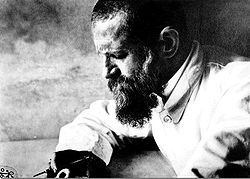
The first major excavations of Sumerian cities began in 1877 at Girsu by the French archeologist Ernest de Sarzec, opening the archaeological exploration of ancient Sumer.
Image source: Ernest de Sarzec
1884
% complete
Major publications of the early finds included Decouvertes en Chaldée par Ernest de Sarzec by Léon Heuzey in 1884, presenting Sarzec's discoveries at Girsu to the scholarly world.
Image source: Léon Heuzey
1889 - 1900
% complete
John Punnett Peters from the University of Pennsylvania conducted major excavations at Nippur between 1889 and 1900, recovering vast numbers of cuneiform tablets.
Image source: Nippur
1902 - 1903
% complete
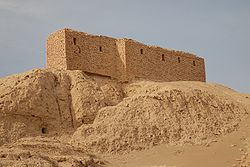
German archeologist Robert Koldewey carried out excavations at Shuruppak in 1902–1903, adding another major Sumerian site to the archaeological record.
Image source: Robert Koldewey
1905
% complete
François Thureau-Dangin published Les Inscriptions de Sumer et d'Akkad in 1905, a major compilation of the inscriptions recovered from Mesopotamian excavations.
1922 - 1934
% complete
Leonard Woolley discovered the spectacular tombs of the Royal Cemetery of Ur during excavations between 1922 and 1934, uncovering treasures such as the Standard of Ur and evidence of trade with distant lands.
1923
% complete
Arno Poebel published Grundzüge der sumerischen Grammatik in 1923, a foundational work on Sumerian grammar that advanced scholarly understanding of the language.
Image source: Arno Poebel
Or browse the full history timeline directory, with more than 2,000 topics.
This Sumerian Civilization timeline was generated with the help of AI, using information found on the internet.
We work hard to keep these timelines accurate, but mistakes do get through. If you spot one, email us at [email protected] and we'll fix it for future visitors.
Generate yours with AI or build it from scratch, for free.
Export your timeline, add your own events, edit or remove AI-generated events, and much more
No credit card required.
Cancel anytime.
Cancel anytime.
You can create an unlimited number of timelines with up to 10 events on each one, customize how they look, export them to PDF, PNG, PowerPoint, CSV, and Excel, and share them with a link. Paid plans raise the event limit and add features like spreadsheet imports and collaborators.
Yes. You can cancel your subscription from your account page at any time, and you will not be charged again. Your subscription stays active for the rest of the period you already paid for.
Yes. We will email you a reminder before the annual renewal, and we will also email you a receipt.
Yes. You can email us within 15 days of any payment, and we will issue you a full refund.
Check out our pricing docs or send us an email anytime: [email protected].