-
Use Cases
-
Resources
-
Pricing
The Tet Offensive was a coordinated series of surprise attacks launched by North Vietnamese and Viet Cong forces against South Vietnamese and American targets in late January 1968, during the Vietnamese lunar New Year (Tet). Though a military failure for communist forces, its scale shocked the American public and marked a turning point in U.S. involvement in the Vietnam War. More Less
1966 - 1967
% complete
Prior to 1967, the South Vietnamese constituent assembly was in the process of drafting a new constitution and setting eventual elections.
Feb 1966
% complete
In 1966, the leadership in South Vietnam, represented by Head of State Nguyễn Văn Thiệu and Prime Minister Nguyễn Cao Kỳ, were persuaded to commit to democratic reforms in an effort to stabilize the political situation during a conference in Honolulu.
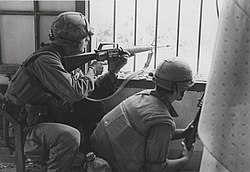
Image source: Tet Offensive
Oct 1966 - Apr 1967
% complete
From October 1966 through April 1967, a very public debate over military strategy took place in print and via radio between Thanh and his rival for military power, Giáp.
Jan 1, 1967 - Mar 31, 1968
% complete
Planning in Hanoi for a winter-spring offensive during 1968 had begun in early 1967 and continued until early the following year.
1967
% complete
During 1967 things had become so bad on the battlefield that Lê Duẩn ordered Thanh to incorporate aspects of protracted guerrilla warfare into his strategy.
1967
% complete
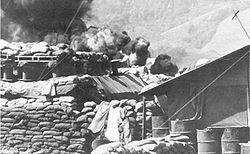
By the end of 1967, MACV had moved nearly half of its manoeuvre battalions to I Corps in anticipation of just such a battle.
Image source: Battle of Khe Sanh
Apr 1967
% complete
The operational plan for the general offensive and uprising originated as the "COSVN proposal" at Thanh's southern headquarters in April 1967 and was relayed to Hanoi the following month.
Jul 27, 1967
% complete
To "break the will of their domestic opponents and reaffirm their autonomy vis-à-vis their foreign allies", hundreds of pro-Soviet, party moderates, military officers, and intelligentsia were arrested on 27 July 1967, during what came to be called the Revisionist Anti-Party Affair.
Sep 3, 1967
% complete
After the 1967 South Vietnamese presidential election, the South Vietnamese political situation looked increasingly stable. The Thiệu/Kỳ ticket received only 24 percent of the popular vote, and a political rivalry re-emerged between Thiệu and Kỳ, who had been outmaneuvered in the election.
Oct 1967 - Jan 1968
% complete
In October, the Politburo decided on the Tet holiday as the launch date and met again in December to reaffirm its decision and formalize it at the 14th Plenary session of the Party Central Committee in January 1968.
Nov 21, 1967
% complete
At an address at the National Press Club on 21 November, Westmoreland reported that, as of the end of 1967, the communists were "unable to mount a major offensive ... I am absolutely certain that whereas in 1965 the enemy was winning, today he is certainly losing...We have reached an important point when the end begins to come into view."
Dec 1967
% complete
Although the decision had been made in December 1967 and Westmoreland was made Army Chief of Staff, many saw his relief as punishment for the entire Tet debacle.
Image source: William Westmoreland
Dec 1967
% complete
During the second half of 1967, the administration had become alarmed by criticism, both inside and outside the government, and by reports of declining public support for its Vietnam policies. The question of whether the U.S. had made a mistake by sending troops to Vietnam had risen from 25 percent in 1965 to 45 percent by December 1967.
1968
% complete
The Tet offensive would later be used in a textbook at West Point as an example of "an allied intelligence failure to rank with Pearl Harbor in 1941 or the Ardennes offensive in 1944." The name "Tet Offensive" usually refers to the January–February 1968 offensive, but can also be extended to cover all of the 21 weeks of intense combat after the initial attacks, including the "Mini-Tet" offensive in May and the Phase III offensive in August.
1968
% complete
The optimistic assessments made before the offensive by the administration and the Pentagon came under heavy criticism and ridicule as the "credibility gap" that had opened in 1967 widened into a chasm.
Jan 1968
% complete
By the end of 1967 the administration's approval rating had crept up by eight percent, but an early January Gallup poll indicated that forty-seven percent of the American public still disapproved of the President's handling of the war. Another January 1968 Gallup poll revealed 56 percent considered themselves hawks and 27 percent doves.
Feb 29, 1968
% complete
McNamara, the Secretary of Defense who had overseen the escalation of the war in 1964–1965, but who had eventually turned against it, stepped down from office.
Image source: Robert McNamara
Oct 1968
% complete
Shortly before the 1968 United States presidential election, Republican candidate and former vice president Richard Nixon discouraged South Vietnamese president Nguyễn Văn Thiệu from cooperating in the negotiations, to cast doubt on Johnson's ability to bring peace.
1968
% complete
One historian claims heavy losses inflicted on VC units struck into the heart of the infrastructure that had been built up for over a decade, claiming that 181,149 PAVN/VC troops had been killed during 1968. According to Max Hastings, the Tet Offensive, including the following "Mini-Tet" offensives in May and August of 1968, resulted in the deaths of 50,000 VC (total casualties drained 60–70% of their strength), while US forces lost 4,000 killed and ARVN 6,000 dead.
1968
% complete
As a result of the heavy fighting, 1968 went on to become the deadliest year of the war for US forces with 16,592 soldiers killed. It was also the deadliest year for the ARVN, with 27,915 men killed.
Feb 18, 1968
% complete
The shocks that reverberated from the battlefield continued to widen: on 18 February 1968 MACV posted the highest U.S. casualty figures of the war to date.
Dec 31, 1968
% complete
According to the best estimates by MACV intelligence officers, the combined Viet Cong and PAVN forces in South Vietnam numbered 262,000 at the end of 1967. Expansion for the Tet Offensive increased the figure to 287,000 by the end of January 1968. They were able to find replacements for some but not all of the losses, and at the end of 1968, Viet Cong and PAVN forces had an estimated strength of 251,000. By late 1968, approximately 70% of the main force troops in the south were from North Vietnam.
Dec 31, 1968
% complete
By the end of 1968, one of every twelve South Vietnamese was living in a refugee camp.
1969
% complete
In 1969, the year after the Tet battles, the US suffered 11,780 killed, the second highest annual total in the war.
1969
% complete
One official Vietnamese publication states that by the end of 1969, very little communist-held territory ("liberated zones") was held. In 1969 only 1,700 new soldiers could be recruited in Region 5 (compared with 8,000 in 1968), and in the lowlands of Cochin China only 100 new soldiers (compared with 16,000 in 1968). However, the PAVN had little difficulty making up the casualties inflicted by the offensive.
Jan 1969 - Jun 1969
% complete
During the first half of 1969, more than 20,000 PAVN/VC troops defected to allied forces, a threefold increase over the 1968 figure.
Apr 5, 1969
% complete
In line with the revamped strategy of Hanoi, on April 5, 1969, COSVN issued Directive 55 to all of its subordinate units: "Never again and under no circumstances are we going to risk our entire military force for just such an offensive."
Jan 21, 1968 - Apr 14, 1968
% complete
Westmoreland was most concerned with the situation at Khe Sanh, where, on 21 January 1968, a force estimated at 20,000–40,000 PAVN troops had besieged the U.S. Marine base. During the entire battle from 1 November 1967 to 14 April 1968, 730 U.S. Marines were killed. Khe Sanh Base was later closed on 5 July 1968 because the base was seen as having less strategic importance than before.
Jan 31, 1968 - Mar 3, 1968
% complete
In the aftermath of the recapture of the city, the discovery of several mass graves (the last of which were uncovered in 1970) of South Vietnamese citizens of Huế sparked a controversy that has not diminished with time.
Image source: Battle of Huế
Mar 2, 1968
% complete
On the morning of 2 March 1968, while patrolling 4 miles (6.4 km) north of Tan Son Nhut Air Base near the small village of Quoi Xuan to locate VC rocket sites, Company C, 4th Battalion, 9th Infantry Regiment walked into an ambush, losing 48 killed in eight minutes.
Jan 30, 1968 - Feb 1968
% complete
The North Vietnamese People's Army of Vietnam (PAVN) and the Viet Cong (VC) launched a surprise attack on 30 and 31 January 1968 against the forces of the South Vietnamese Army of the Republic of Vietnam (ARVN), the United States Armed Forces and their allies, targeting military and civilian command and control centers throughout South Vietnam. Phase I, scheduled to begin on 31 January, saw some attacks launched prematurely on 30 January, and was a countrywide assault on the cities, conducted primarily by VC forces.
Feb 1, 1968
% complete
The famous photograph, with the title Saigon Execution, won the 1969 Pulitzer Prize for Spot News Photography and is widely seen as a defining moment in the Vietnam War for its influence on U.S. public opinion.
Image source: Saigon Execution
Or browse the full history timeline directory, with more than 2,000 topics.
This Tet Offensive timeline was generated with the help of AI, using information found on the internet.
We work hard to keep these timelines accurate, but mistakes do get through. If you spot one, email us at [email protected] and we'll fix it for future visitors.
Generate yours with AI or build it from scratch, for free.
Export your timeline, add your own events, edit or remove AI-generated events, and much more
No credit card required.
Cancel anytime.
Cancel anytime.
You can create an unlimited number of timelines with up to 10 events on each one, customize how they look, export them to PDF, PNG, PowerPoint, CSV, and Excel, and share them with a link. Paid plans raise the event limit and add features like spreadsheet imports and collaborators.
Yes. You can cancel your subscription from your account page at any time, and you will not be charged again. Your subscription stays active for the rest of the period you already paid for.
Yes. We will email you a reminder before the annual renewal, and we will also email you a receipt.
Yes. You can email us within 15 days of any payment, and we will issue you a full refund.
Check out our pricing docs or send us an email anytime: [email protected].