-
Use Cases
-
Resources
-
Pricing
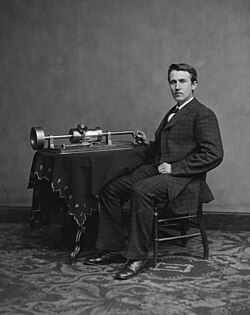
Thomas Alva Edison (1847–1931) was an American inventor and businessman, often called America's greatest inventor. He held 1,093 U.S. patents and developed innovations that shaped the modern world, including the practical incandescent light bulb, the phonograph, and early motion picture technology. He also founded General Electric and pioneered the industrial research laboratory. More Less
Feb 11, 1847
% complete
Thomas Alva Edison was born on February 11, 1847, in Milan, Ohio, the seventh and youngest child of Samuel Ogden Edison Jr. and Nancy Matthews Elliott. His birthplace, a modest canal town home, is now preserved as a historic site.
Image source: Thomas Edison
1854
% complete
Edison's family relocated to Port Huron, Michigan, where his father worked in the lumber business. Young Thomas spent much of his childhood there, developing an early curiosity about mechanical and chemical experiments.
Image source: Port Huron, Michigan
1855
% complete
Edison attended school for only about three months before a teacher deemed him 'addled.' His mother, a former schoolteacher, withdrew him and homeschooled him herself, nurturing his love of reading and science.
1859 - 1862
% complete
At age twelve, Edison began selling newspapers and candy aboard the Grand Trunk Railroad between Port Huron and Detroit. He reportedly set up a small laboratory in a baggage car and even printed his own newspaper, the Grand Trunk Herald.
1862
% complete
After saving a young boy from a runaway train car, Edison was rewarded by the child's father, a station agent, with lessons in Morse code and telegraphy. This skill launched his early career as a traveling telegraph operator.
Image source: Telegraphy
1863 - 1868
% complete
Edison roamed the Midwest and South working as a night-shift telegraph operator for various railroads and companies. During this period he honed his technical skills and began experimenting with improvements to telegraph equipment.
Image source: Telegraphist
Dec 25, 1871
% complete
Edison married sixteen-year-old Mary Stilwell, an employee at his Newark laboratory, on Christmas Day 1871. The couple had three children: Marion, Thomas Jr., and William.
Aug 9, 1884
% complete
Mary Stilwell Edison died at age twenty-nine, likely from a brain tumor or morphine overdose. Her death deeply affected Edison, who threw himself into his work during the following years.
Feb 24, 1886
% complete
Edison married Mina Miller, daughter of a wealthy Ohio industrialist, in Akron, Ohio. The couple moved into Glenmont, a grand estate in Llewellyn Park, West Orange, New Jersey, and had three children together.
Image source: Mina Miller Edison
Oct 13, 1868
% complete
Edison received his first patent for an electric vote recorder designed to speed up vote tallying in legislatures. When politicians rejected it as too efficient, Edison resolved to invent only things people would actually buy.
Image source: Thomas Edison
1874
% complete
Edison invented the quadruplex telegraph, which allowed two messages to be transmitted simultaneously in each direction over a single wire. The invention greatly increased telegraph capacity and became highly valuable commercially.
Image source: Quadruplex telegraph
1877
% complete
Edison developed the carbon-button transmitter, dramatically improving the clarity and volume of Alexander Graham Bell's telephone. It remained fundamental to telephone technology for decades.
Image source: Carbon microphone
Aug 12, 1877
% complete
Edison created the phonograph, the first machine capable of recording and reproducing sound, using tinfoil-wrapped cylinders. The device astonished the public when demonstrated that November and earned him the nickname 'The Wizard of Menlo Park.'
Image source: Phonograph
1878
% complete
After attending a demonstration of arc lighting, Edison announced he would create practical incandescent electric light. He formed the Edison Electric Light Company with backing from financiers including J.P. Morgan.
Image source: Incandescent light bulb
Oct 22, 1879
% complete
After testing thousands of materials, Edison's team produced a carbonized cotton thread filament lamp that burned for over thirteen hours. A public demonstration on New Year's Eve 1879 lit up Menlo Park and stunned visitors.
Image source: Incandescent light bulb
1880
% complete
While experimenting with lamps, Edison observed current flowing from a hot filament to a nearby electrode inside a vacuum bulb. Though he could not explain it, this 'Edison effect' later underpinned the development of vacuum tubes.
Image source: Thermionic emission
1887 - 1888
% complete
Returning to his earlier invention, Edison perfected an improved phonograph using durable wax cylinders and better reproducers. He founded the Edison Phonograph Company to commercialize both dictation machines and entertainment devices.
Image source: Phonograph cylinder
1891
% complete
Working with William Kennedy Dickson, Edison developed the kinetoscope, a peep-hole device for viewing short motion pictures. It premiered publicly in 1893 and helped launch the American film industry.
Image source: Kinetoscope
1901 - 1909
% complete
Edison spent nearly a decade perfecting a nickel-iron alkaline storage battery, enduring thousands of failed cells. The rugged battery found success powering mining lamps, trains, and early electric vehicles.
Image source: Nickel–iron battery
1908
% complete
Edison helped establish the Motion Picture Patents Company, known as the Edison Trust, which standardized 35mm film and dominated early American filmmaking until antitrust action dissolved it in the mid-1910s.
Image source: 35 mm movie film
1869
% complete
Arriving nearly penniless in New York City, Edison impressed officials at the Gold Indicator Company by repairing their stock ticker equipment. He soon became associated with Western Union and devoted himself full-time to invention.
Image source: Western Union
1870
% complete
Edison developed an improved stock ticker and sold his rights to it, earning roughly $40,000. With these funds he established his first workshop in Newark, New Jersey, employing machinists to develop new inventions.
Image source: Ticker tape
1876
% complete
Edison established his famous research laboratory at Menlo Park, New Jersey, one of the first industrial research facilities of its kind. It became known as the 'invention factory,' where he and his team pursued innovations systematically.
Image source: Menlo Park, New Jersey
Sep 4, 1882
% complete
Edison's Pearl Street Station in Manhattan began supplying direct-current electricity to customers in the surrounding district, becoming the first commercial central power plant in the United States and launching the electric utility industry.
Image source: Pearl Street Station
Nov 24, 1887
% complete
Edison opened a sprawling new laboratory complex in West Orange, New Jersey, several times larger than Menlo Park. Staffed by dozens of workers, it produced hundreds of inventions over the following decades.
Image source: Thomas Edison National Historical Park
Apr 15, 1892
% complete
Edison General Electric merged with Thomson-Houston Electric Company to form General Electric. Although Edison lost operational control of the company bearing his name, GE grew into one of the world's largest corporations.
Image source: General Electric
1893
% complete
Edison constructed the Black Maria, a tar-paper-covered rotating studio at West Orange, considered the nation's first motion picture production studio. It churned out short films featuring dancers, boxers, and vaudeville acts.
Image source: Edison's Black Maria
1899
% complete
Edison spent years and millions of dollars developing magnetic ore separation technology in northern New Jersey. Cheaper iron ore from the Mesabi Range doomed the venture, though its crushing machinery later proved useful in cement manufacturing.
1908 - 1917
% complete
Through the Edison Portland Cement Company, Edison promoted affordable cast-concrete houses, furniture, and even pianos. While single-pour concrete homes never caught on widely, Edison cement built Yankee Stadium and many roads.
Image source: Edison Portland Cement Company
1915 - 1918
% complete
Edison headed the Naval Consulting Board, advising the U.S. Navy on defense technology. He researched submarine detection, ship camouflage, and other wartime problems, though few of his proposals were adopted.
Image source: Naval Consulting Board
May 29, 1928
% complete
Congress awarded Edison the Congressional Gold Medal for his prolific contributions to American life, recognizing him as the holder of over one thousand patents and the father of industries employing millions.
Image source: Congressional Gold Medal
Oct 18, 1931
% complete
Thomas Edison died at age eighty-four from complications of diabetes at his home, Glenmont. On the night of his funeral, lights were dimmed nationwide in tribute. He left behind 1,093 U.S. patents and a transformed modern world.
Or browse the full history timeline directory, with more than 2,000 topics.
This Thomas Edison timeline was generated with the help of AI, using information found on the internet.
We work hard to keep these timelines accurate, but mistakes do get through. If you spot one, email us at [email protected] and we'll fix it for future visitors.
Generate yours with AI or build it from scratch, for free.
Export your timeline, add your own events, edit or remove AI-generated events, and much more
No credit card required.
Cancel anytime.
Cancel anytime.
You can create an unlimited number of timelines with up to 10 events on each one, customize how they look, export them to PDF, PNG, PowerPoint, CSV, and Excel, and share them with a link. Paid plans raise the event limit and add features like spreadsheet imports and collaborators.
Yes. You can cancel your subscription from your account page at any time, and you will not be charged again. Your subscription stays active for the rest of the period you already paid for.
Yes. We will email you a reminder before the annual renewal, and we will also email you a receipt.
Yes. You can email us within 15 days of any payment, and we will issue you a full refund.
Check out our pricing docs or send us an email anytime: [email protected].