-
Use Cases
-
Resources
-
Pricing
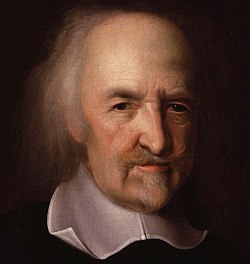
Thomas Hobbes (1588–1679) was an English philosopher best known for his work in political philosophy. His most famous work, Leviathan (1651), argued for a social contract and strong central authority to avoid the chaos of a state of nature. Living through the English Civil War, Hobbes developed ideas that profoundly shaped modern theories of government, sovereignty, and human nature. More Less
Apr 5, 1588
% complete
Thomas Hobbes was born on 5 April 1588 (Old Style) in Westport, now part of Malmesbury in Wiltshire, England. He would go on to become one of England's most influential philosophers and political theorists.
Image source: Thomas Hobbes
1601 - 1602
% complete
A good pupil, Hobbes went between 1601 and 1602 to Magdalen Hall, the predecessor to Hertford College, Oxford, where he was taught scholastic logic and mathematics.
Image source: Hertford College, Oxford
1608
% complete
Hobbes graduated from the University of Cambridge in 1608, receiving his degree by incorporation at St John's College.
Image source: University of Cambridge
1608
% complete
Hobbes first tutored an earlier William Cavendish, beginning a lifelong friendship and professional connection with the Cavendish family that would shape his career.
Image source: William Cavendish, 1st Earl of Devonshire
1610 - 1615
% complete
Hobbes became a companion to the younger William Cavendish, and they both took part in a grand tour of Europe between 1610 and 1615, exposing Hobbes to continental intellectual currents.
1612
% complete
During the grand tour, James I invited both men to England, reflecting the standing of the Cavendish family at court.
Image source: James VI and I
1615
% complete
When he returned to England in 1615, William Cavendish maintained correspondence with Micanzio and Sarpi, and Hobbes translated Sarpi's letters from Italian, which were circulated among the Duke's circle.
Image source: Paolo Sarpi
1626 - 1628
% complete
William Cavendish was elevated to the peerage on his father's death in 1626, holding it for two years before his death in 1628.
Jun 1628
% complete
In June 1628, Hobbes's employer Cavendish, then the Earl of Devonshire, died of the plague, and his widow, the countess Christian, dismissed Hobbes from service.
Image source: Christian Cavendish, Countess of Devonshire
1629 - Nov 1630
% complete
In 1629, Hobbes found work as a tutor to Gervase Clifton, the son of Sir Gervase Clifton, 1st Baronet, and continued in this role until November 1630.
Image source: Sir Gervase Clifton, 1st Baronet
1636
% complete
Hobbes visited Galileo Galilei in Florence while Galileo was under house arrest upon condemnation in 1636. He later became a regular debater in philosophic groups in Paris held together by Marin Mersenne.
Image source: Galileo Galilei
1637
% complete
Hobbes came back home from Paris in 1637, to a country riven with discontent, which disrupted him from the orderly execution of his philosophic plan.
Image source: Short Parliament
Nov 1640
% complete
When in November 1640 the Long Parliament succeeded the Short, Hobbes felt he was in disfavour due to the circulation of his treatise and fled to Paris.
Image source: Long Parliament
1644
% complete
As the royalist cause began to decline in mid-1644, many royalists came to Paris and were known to Hobbes, expanding his circle of acquaintances among exiles.
Image source: Cavalier
1645
% complete
Having built a good reputation in philosophic circles, Hobbes in 1645 was chosen with Descartes, Gilles de Roberval, and others to referee the controversy between John Pell and Longomontanus over the problem of squaring the circle.
Image source: Squaring the circle
1647 - 1648
% complete
In 1647, Hobbes took up a position as mathematical instructor to the young Charles, Prince of Wales, who had come to Paris from Jersey around July. The engagement lasted until 1648, when Charles went to Holland.
Image source: Charles II of England
1651
% complete
Hobbes appealed to the revolutionary English government for protection and fled back to London in winter 1651, leaving behind his life in Parisian exile.
1628
% complete
The outcome of Hobbes's careful study of classical Greek and Latin authors was, in 1628, his edition of Thucydides's History of the Peloponnesian War, the first English translation made directly from a Greek manuscript. He professed deep admiration for Thucydides as 'the most politic historiographer that ever writ.'
Image source: History of the Peloponnesian War
1640
% complete
By the end of the Short Parliament in 1640, Hobbes had written a short treatise called The Elements of Law, Natural and Politic, which circulated in handwritten copies without his permission.
1641
% complete
In Paris, Hobbes rejoined Mersenne's coterie and wrote a critique of Descartes's Meditations on First Philosophy, printed as third among the sets of 'Objections' appended, with 'Replies' from Descartes, in 1641.
Image source: Meditations on First Philosophy
Nov 1641
% complete
Hobbes finished the third section of his philosophical system, De Cive, in November 1641. It formed part of the trilogy that would also include De Corpore and De Homine.
Image source: De Cive
1642 - 1651
% complete
The English Civil War began in 1642, lasting until 1651 between Parliamentarians and Royalists. After returning to England from France in 1637, Hobbes witnessed its destruction and brutality, which heavily influenced his advocacy for governance by an absolute sovereign in Leviathan.
Image source: English Civil War
1644
% complete
Hobbes published little except a short treatise on optics (Tractatus opticus), included in the collection of scientific tracts published by Mersenne as Cogitata physico-mathematica in 1644.
Image source: Thomas Hobbes
1646
% complete
Printing of De Cive began in 1646 by Samuel de Sorbiere through the Elsevier press in Amsterdam, with a new preface and some new notes replying to objections.
1650
% complete
In 1650, a pirated edition of The Elements of Law, Natural and Politic was published, having initially been circulated only in handwritten copies without Hobbes's permission.
Image source: Thomas Hobbes
1651
% complete
In 1651, the translation of De Cive was published under the title Philosophical Rudiments concerning Government and Society.
1651
% complete
Leviathan, or the Matter, Forme, and Power of a Common Wealth, Ecclesiastical and Civil finally appeared in mid-1651. In it Hobbes expounded an influential formulation of social contract theory, arguing for an absolute sovereign as the solution to human conflict and societal breakdown.
Image source: Leviathan (Hobbes book)
1655
% complete
From 1655, the publishing date of De Corpore, Hobbes and John Wallis continued name-calling and bickering for nearly a quarter of a century, with Hobbes failing to admit his error to the end of his life.
1658
% complete
In 1658, Hobbes published De Homine, the final section of his philosophical system, completing the scheme he had planned more than 19 years before.
1668
% complete
The results of Hobbes's investigation were first announced in three short Dialogues added as an Appendix to his Latin translation of Leviathan, published in Amsterdam in 1668. The edition was printed abroad because he could not obtain the censor's licence in England.
1681
% complete
Other writings were not made public until after Hobbes's death, including Behemoth: the History of the Causes of the Civil Wars of England, published posthumously in 1681.
1647
% complete
In 1647, Hobbes suffered a near-fatal illness that disabled him for six months. On recovering, he resumed his literary task and completed it by 1650.
1654
% complete
In 1654 a small treatise, Of Liberty and Necessity, directed at Hobbes, was published by Bishop John Bramhall, igniting a famous debate on free will and determinism.
Image source: John Bramhall
1655
% complete
Bramhall countered in 1655, printing everything that had passed between him and Hobbes under the title A Defence of the True Liberty of Human Actions from Antecedent or Extrinsic Necessity.
1656
% complete
In 1656, Hobbes replied 'with astonishing force' to Bishop Bramhall in The Questions Concerning Liberty, Necessity and Chance.
1658
% complete
Bramhall returned to the charge in 1658 with Castigations of Mr Hobbes's Animadversions, including a bulky appendix entitled The Catching of Leviathan the Great Whale.
1666
% complete
In 1666, the House of Commons introduced a bill against atheism and profaneness, and on 17 October ordered the committee empowered to receive information touching books tending to atheism, blasphemy and profaneness — targeting works like Leviathan. The king was important in protecting Hobbes during this episode.
Image source: House of Commons of England
1672
% complete
Among Hobbes's final works was an autobiography written in Latin verse in 1672, reflecting on his long life of scholarship.
1673 - 1675
% complete
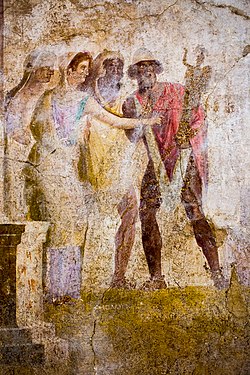
Hobbes translated four books of the Odyssey into 'rugged' English rhymes in 1673, which led to a complete translation of both Iliad and Odyssey by 1675.
Image source: Odyssey
Dec 4, 1679
% complete
In October 1679 Hobbes suffered a bladder disorder, and then a paralytic stroke, from which he died on 4 December 1679, aged 91, at Hardwick Hall, owned by the Cavendish family.
Image source: Hardwick Hall
Or browse the full history timeline directory, with more than 2,000 topics.
This Thomas Hobbes timeline was generated with the help of AI, using information found on the internet.
We work hard to keep these timelines accurate, but mistakes do get through. If you spot one, email us at [email protected] and we'll fix it for future visitors.
Generate yours with AI or build it from scratch, for free.
Export your timeline, add your own events, edit or remove AI-generated events, and much more
No credit card required.
Cancel anytime.
Cancel anytime.
You can create an unlimited number of timelines with up to 10 events on each one, customize how they look, export them to PDF, PNG, PowerPoint, CSV, and Excel, and share them with a link. Paid plans raise the event limit and add features like spreadsheet imports and collaborators.
Yes. You can cancel your subscription from your account page at any time, and you will not be charged again. Your subscription stays active for the rest of the period you already paid for.
Yes. We will email you a reminder before the annual renewal, and we will also email you a receipt.
Yes. You can email us within 15 days of any payment, and we will issue you a full refund.
Check out our pricing docs or send us an email anytime: [email protected].