-
Use Cases
-
Resources
-
Pricing
Westward Expansion refers to the 19th-century movement of settlers across North America, driven by the belief in Manifest Destiny. It involved territorial acquisitions like the Louisiana Purchase and Mexican Cession, the California Gold Rush, the construction of the Transcontinental Railroad, and profound impacts on Native American peoples. More Less
1776 - 1999
% complete
From thirteen colonies on the Atlantic coast to a transcontinental and global power, the story of American expansion spanned more than two centuries, encompassing purchases, wars, annexations, and diplomatic agreements that shaped the modern map of the United States.
Image source: Territorial evolution of the United States
Jul 4, 1776
% complete
Thirteen British colonies in North America declared independence from the British Empire on July 4, 1776, forming the United States of America. This bold act set the stage for a new nation that would grow dramatically across the continent over the following centuries.
Image source: United States Declaration of Independence
Mar 1, 1781
% complete
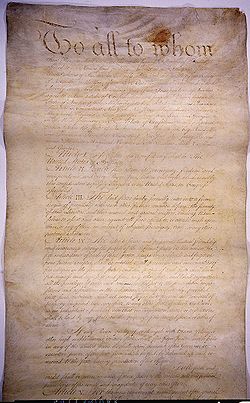
The union of the thirteen states was formalized in the Articles of Confederation, which came into force on March 1, 1781, after being ratified by all 13 states. This first governing framework held the young nation together during the final years of the Revolutionary War.
Image source: Articles of Confederation
Sep 3, 1783
% complete
American independence was recognized by Great Britain in the Treaty of Paris of 1783, which concluded the American Revolutionary War. The treaty established the Mississippi River as the new nation's western boundary, opening the door for future westward growth.
Image source: Treaty of Paris (1783)
1803 - 1821
% complete
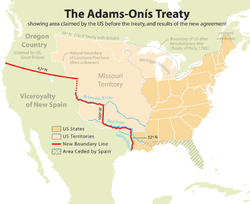
Although the Louisiana Purchase doubled the nation's size, the southeastern border with Spanish Florida remained the subject of much dispute for nearly two decades following the acquisition.
Image source: Adams–Onís Treaty
Jul 4, 1803
% complete
The first great expansion of the country came with the Louisiana Purchase of 1803, in which the United States acquired vast lands from France. The purchase doubled the country's territory and opened enormous tracts of land west of the Mississippi River to American settlement.
Image source: Louisiana Purchase
1821
% complete
In 1821, Spanish Florida and Spanish claims to the Oregon Country were ceded to the United States, finally resolving long-standing territorial disputes and securing the nation's southeastern border while extending its reach toward the Pacific Northwest.
1845
% complete
The annexation of the Republic of Texas in 1845 added a vast swath of land to the Union and led directly to war with Mexico, dramatically accelerating the pace of American continental expansion.
Image source: Texas annexation
1846
% complete
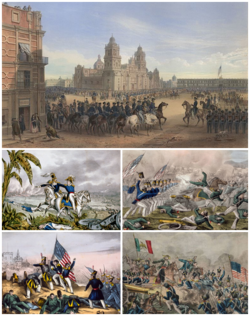
The annexation of Texas led directly to the Mexican–American War, a conflict between the United States and Mexico that would reshape the map of North America and fulfill much of the ideology of Manifest Destiny.
Image source: Mexican–American War
1848
% complete
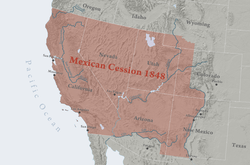
After the victorious United States defeated Mexico, it obtained the northern half of Mexico's territory, including what became the state of California. This massive acquisition completed the nation's reach to the Pacific Ocean.
Image source: Mexican Cession
Mar 30, 1867
% complete
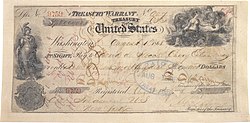
Alaska, the last major acquisition in North America, was purchased from Russia in 1867. Often called 'Seward's Folly' at the time, the purchase added an immense northern territory rich in natural resources.
Image source: Alaska Purchase
Feb 14, 1912
% complete
In 1912, Arizona was admitted as the last state established in the contiguous United States, completing the map of the lower 48 states that had been filled through decades of westward expansion.
Image source: Arizona
1856
% complete
The United States began expanding beyond North America in 1856 with the passage of the Guano Islands Act, causing many small and uninhabited, but economically important, islands in the Caribbean Sea and the Pacific Ocean to be claimed.
Image source: Guano Islands Act
1893
% complete
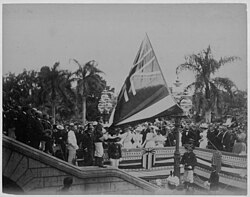
The government of Hawaii was overthrown five years before its annexation by the United States, setting in motion the islands' eventual incorporation into the American republic.
Image source: Overthrow of the Hawaiian Kingdom
1895 - 1898
% complete
Support for the independence of Cuba from the Spanish Empire grew among Americans in the late 1890s, building public pressure that would soon draw the United States into war with Spain.
Image source: Cuban War of Independence
1898
% complete
The Pacific expansion culminated in the annexation of Hawaii in 1898, after the overthrow of its government five years previously. The islands became a vital strategic outpost in the mid-Pacific.
Image source: Newlands Resolution
Feb 15, 1898
% complete
The sinking of the USS Maine in Havana harbor inflamed American public opinion against Spain and, together with support for Cuban independence, led directly to the Spanish–American War.
Image source: USS Maine (1890)
Apr 21, 1898 - Aug 13, 1898
% complete
The Spanish–American War of 1898 resulted in the United States gaining Puerto Rico, Guam, and the Philippines, and occupying Cuba for several years, marking America's emergence as a global power.
Image source: Spanish–American War
1900
% complete
American Samoa was acquired in 1900 after the end of the Second Samoan Civil War, extending American influence deeper into the South Pacific.
Image source: American Samoa
1904
% complete
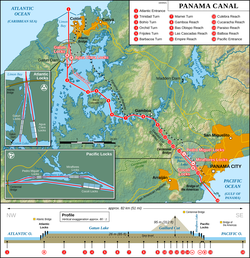
The last major international change began with the acquisition in 1904 of the Panama Canal Zone, an unincorporated US territory which controlled the Panama Canal, a critical link between the Atlantic and Pacific Oceans.
Image source: Panama Canal Zone
1917
% complete
The United States purchased the Virgin Islands from Denmark in 1917, adding strategic Caribbean territories to its growing overseas holdings.
Image source: Danish West Indies
Aug 21, 1959
% complete
In 1959, Hawaii became the 50th and most recent state admitted to the Union, transforming the formerly annexed Pacific territory into full statehood more than six decades after annexation.
Image source: Hawaii
1860 - 1861
% complete
Southern state governments proclaimed secession in 1860 and 1861, forming the Confederate States of America. The crisis fractured the expanding nation and threatened the future of its western territories.
Image source: Confederate States of America
1861 - 1865
% complete
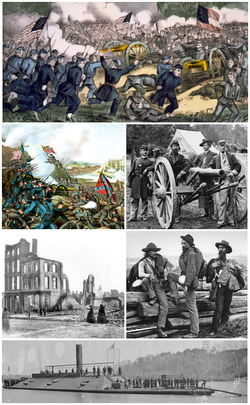
The American Civil War was fought between the Union and the Confederacy, ending in the defeat of the Confederacy in 1865. The war's outcome preserved the Union and allowed westward expansion to continue under a strengthened federal government.
Image source: American Civil War
1865
% complete
Following the defeat of the Confederacy in 1865, the southern states were eventually readmitted to the Congress during Reconstruction, restoring the full representation of the reunited nation.
Image source: Reconstruction era
1905
% complete
The Banco Convention of 1905 between the United States and Mexico allowed, in the event of sudden changes in the course of the Rio Grande (as by flooding), for the border to be altered to follow the new course.
Image source: Banco Convention of 1905
1910 - 1976
% complete
In all cases of these adjustments along the Rio Grande under the 1905 convention, the transferred land was minuscule, ranging from 1 acre to 646 acres, and uninhabited.
1910 - 1976
% complete
Border adjustments along the Rio Grande under the 1905 convention occurred on 37 different dates from 1910 to 1976, gradually refining the boundary between the two nations.
1979
% complete
The Panama Canal Zone, acquired in 1904, was returned to Panama in 1979, ending decades of American control over the territory surrounding the canal.
1999
% complete
The final transfer of formal control over the region to Panama was completed in 1999, closing the chapter on one of the most significant territorial arrangements in American history.
Image source: Panama Canal
Or browse the full history timeline directory, with more than 2,000 topics.
This Westward Expansion timeline was generated with the help of AI, using information found on the internet.
We work hard to keep these timelines accurate, but mistakes do get through. If you spot one, email us at [email protected] and we'll fix it for future visitors.
Generate yours with AI or build it from scratch, for free.
Export your timeline, add your own events, edit or remove AI-generated events, and much more
No credit card required.
Cancel anytime.
Cancel anytime.
You can create an unlimited number of timelines with up to 10 events on each one, customize how they look, export them to PDF, PNG, PowerPoint, CSV, and Excel, and share them with a link. Paid plans raise the event limit and add features like spreadsheet imports and collaborators.
Yes. You can cancel your subscription from your account page at any time, and you will not be charged again. Your subscription stays active for the rest of the period you already paid for.
Yes. We will email you a reminder before the annual renewal, and we will also email you a receipt.
Yes. You can email us within 15 days of any payment, and we will issue you a full refund.
Check out our pricing docs or send us an email anytime: [email protected].