-
Use Cases
-
Resources
-
Pricing
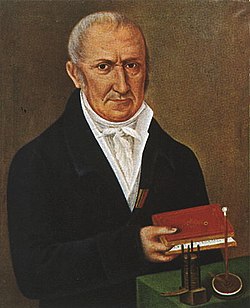
Alessandro Volta (1745–1827) was an Italian physicist and chemist best known for inventing the voltaic pile, the first electrical battery, in 1800. His groundbreaking work in electricity laid the foundation for the field of electrochemistry, and the unit of electric potential, the volt, is named in his honor. More Less
1745 - 1827
% complete
Over the course of his lifetime (18 February 1745 – 5 March 1827), Alessandro Volta established himself as an Italian chemist and physicist who was a pioneer of electricity and power, credited as the inventor of the electric battery and the discoverer of methane.
Image source: Alessandro Volta
1809
% complete
In 1809, Volta became an associated member of the Royal Institute of the Netherlands, further international recognition of his towering contributions to electrical science.
Image source: Royal Netherlands Academy of Arts and Sciences
1810
% complete
In honour of his work, Volta was made a count by Napoleon Bonaparte in 1810, recognizing his extraordinary contributions to science and his international renown.
Image source: Napoleon
Feb 18, 1745
% complete
Alessandro Giuseppe Antonio Anastasio Volta was born in Como, a town in northern Italy, on 18 February 1745. He would grow up to become an Italian chemist and physicist, a pioneer of electricity and power, credited as the inventor of the electric battery and the discoverer of methane.
1777
% complete
In 1777, Volta travelled through Switzerland, where he befriended the physicist and mountaineer Horace Bénédict de Saussure, expanding his scientific network across Europe.
Image source: Horace Bénédict de Saussure
1794
% complete
In 1794, Volta married an aristocratic lady also from Como, Teresa Peregrini, with whom he raised three sons: Zanino, Flaminio, and Luigi.
1794 - 1827
% complete
With his wife Teresa Peregrini, whom he married in 1794, Volta raised three sons: Zanino, Flaminio, and Luigi, balancing family life with his demanding scientific career.
1762
% complete
Although Volta is often credited with inventing the electrophorus, a machine operating on the same principle was described as early as 1762 by the Swedish experimenter Johan Wilcke. Volta's extensive promotion of the device led many to associate it with his name.
Image source: Johan Wilcke
1774
% complete
In 1774, Volta became a professor of physics at the Royal School in Como, beginning his formal academic career and establishing himself as a leading figure in the study of electricity.
1774
% complete
Volta promoted the electrophorus so extensively that he is often credited with its invention, even though a machine operating on the same principle had been described in 1762 by Swedish experimenter Johan Wilcke.
Image source: Electrophorus electricus
1776 - 1778
% complete
Between 1776 and 1778, Volta studied the chemistry of gases, conducting research that would lead to some of his most notable scientific discoveries.
Nov 1776
% complete
In November 1776, Volta found methane in the marshes of Angera on Lake Maggiore. This discovery established him as the discoverer of methane, a significant contribution to chemistry.
Image source: Methane
1778
% complete
By 1778, Volta managed to isolate methane, building upon his earlier discovery of the gas in the marshes of Angera on Lake Maggiore and solidifying his reputation as a pioneering chemist.
1779 - 1819
% complete
In 1779, Volta became a professor of experimental physics at the University of Pavia, a chair that he occupied for almost 40 years, during which he carried out much of his most important work.
Image source: University of Pavia
1779 - 1819
% complete
Volta occupied the chair of experimental physics at the University of Pavia for almost 40 years, from 1779 until his retirement in 1819, making it the center of his long scientific career.
1799
% complete
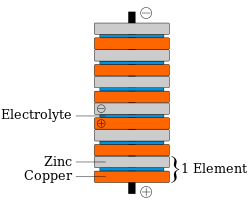
Volta invented the voltaic pile in 1799, the first electrical battery capable of producing a steady electric current, one of the most important inventions in the history of science.
Image source: Voltaic pile
1799 - 1800
% complete
The voltaic pile, invented in 1799 and publicized in 1800, was an early electric battery that produced a steady electric current for the first time, transforming the study of electricity and enabling countless subsequent discoveries.
1800
% complete
Volta reported the results of his experiments with the voltaic pile in a two-part letter to the president of the Royal Society in London, which was published in 1800, announcing his groundbreaking invention to the scientific world.
Image source: Royal Society
1800
% complete
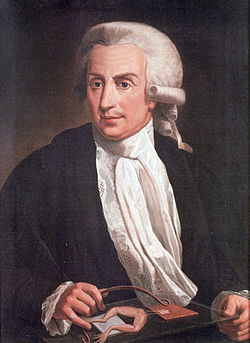
In 1800, as the result of a professional disagreement over the galvanic response advocated by Galvani, Volta invented the voltaic pile, an early electric battery which produced a steady electric current, resolving the debate through experiment.
Image source: Luigi Galvani
1787
% complete
In the University History Museum in Pavia, many scientific instruments that belonged to Volta are preserved and displayed, alongside the Aula Volta lecture hall built for him in the Old Campus, safeguarding his scientific heritage.
1787
% complete
In the Old Campus of the University of Pavia, there is the classroom (Aula Volta) commissioned by Emperor Joseph II to architect Leopoldo Pollack in 1787 for the lectures of Alessandro Volta. The university's History Museum holds many scientific instruments that belonged to him.
1827
% complete
The frazione of Camnago near Como, where Volta lived out his retirement and died, was later renamed 'Camnago Volta' in his honour, preserving the memory of his final home.
Image source: Como
1900
% complete
Briefe über thierische elektricität (Letters about animal electricity), a work connected to the debate between Galvani's animal electricity and Volta's views, was made available in a Leipzig edition (W. Engelmann) in 1900 through libraries worldwide.
1927
% complete
In 1927, an international physics conference known as the Como Conference was held at Lake Como to mark the 100th anniversary of Volta's death, gathering leading physicists in his honour.
Image source: Como Conference
1990 - 1997
% complete
From 1990 to 1997, Volta's image was depicted on the Italian Lire 10,000 note along with a sketch of his voltaic pile, honoring him as one of Italy's greatest scientists.
Image source: Italian lira
2017
% complete
In late 2017, Nvidia announced a new workstation-focused GPU microarchitecture called Volta, named in honor of Alessandro Volta and continuing his legacy into the era of modern computing.
Image source: Volta (microarchitecture)
2019
% complete
The electric eel species Electrophorus voltai, described in 2019 as the strongest bioelectricity producer in nature, was named after Volta, paying tribute to the inventor of the electric battery.
1819
% complete
Volta retired in 1819 to his estate in Camnago, a frazione of Como, Italy, now named 'Camnago Volta' in his honour, where he spent his final years.
1823 - 1827
% complete
Beginning in 1823, Volta suffered from a series of illnesses that would eventually lead to his death four years later.
Mar 5, 1827
% complete
Volta died on 5 March 1827, just after his 82nd birthday, from a series of illnesses which had begun in 1823. He died at his estate in Camnago, leaving behind a legacy as one of history's great electrical pioneers.
Or browse the full history timeline directory, with more than 2,000 topics.
This Alessandro Volta timeline was generated with the help of AI, using information found on the internet.
We work hard to keep these timelines accurate, but mistakes do get through. If you spot one, email us at [email protected] and we'll fix it for future visitors.
Generate yours with AI or build it from scratch, for free.
Export your timeline, add your own events, edit or remove AI-generated events, and much more
No credit card required.
Cancel anytime.
Cancel anytime.
You can create an unlimited number of timelines with up to 10 events on each one, customize how they look, export them to PDF, PNG, PowerPoint, CSV, and Excel, and share them with a link. Paid plans raise the event limit and add features like spreadsheet imports and collaborators.
Yes. You can cancel your subscription from your account page at any time, and you will not be charged again. Your subscription stays active for the rest of the period you already paid for.
Yes. We will email you a reminder before the annual renewal, and we will also email you a receipt.
Yes. You can email us within 15 days of any payment, and we will issue you a full refund.
Check out our pricing docs or send us an email anytime: [email protected].