-
Use Cases
-
Resources
-
Pricing
Angkor Wat is the largest religious monument in the world, located in Siem Reap, Cambodia. Originally built as a Hindu temple dedicated to Vishnu by the Khmer Empire's King Suryavarman II in the early 12th century, it was gradually transformed into a Buddhist temple toward the end of that century. Renowned for its classical Khmer architecture, extensive bas-reliefs, and symbolic representation of Mount Meru, Angkor Wat remains a powerful symbol of Cambodia, appearing on its national flag. More Less
1100
% complete
By the 12th century, Khmer architects had become skilled and confident in the use of sandstone rather than brick or laterite as the main building material, enabling the ambitious construction of Angkor Wat.
Image source: Angkor Wat
1113
% complete
Angkor Wat was commissioned by the Khmer king Suryavarman II (ruled 1113–c. 1150) in the early 12th century in Yaśodharapura (present-day Angkor), the capital of the Khmer Empire, as a Hindu temple dedicated to Vishnu.
Image source: Suryavarman II
1122
% complete
The construction of the temple commenced in 1122 CE on a site measuring 162.6 hectares within the ancient capital of Angkor. The temple complex was constructed on the suggestion of Divākarapaṇḍita (1040–c. 1120).
1150
% complete
The construction of Angkor Wat was completed in 1150 CE during the reign of Suryavarman II, creating one of the largest religious monuments in the world.
1178
% complete
In 1178, approximately 27 years after the death of Suryavarman II, Angkor was sacked by the Chams, the traditional enemies of the Khmer.
Image source: Champa
1431
% complete
After the Khmer's fall to Ayutthaya in 1431, Angkor Wat continued to be inhabited, with dating showing regular maintenance of the site's ponds during this period.
Image source: Fall of Angkor
1650
% complete
Modifications of the temple occurred in the 17th century, with findings suggesting the demolition of several towers in the mid-1600s.
1270
% complete
From the late 13th century onward, the complex was gradually transformed from a Hindu centre of worship into a Buddhist temple, becoming predominantly associated with Theravāda Buddhism, and has remained an active center of Buddhist worship for centuries.
1500 - 1700
% complete
By the 16th and 17th centuries, Theravada Buddhism had become the dominant religious system in the region, contributing to a gradual reinterpretation of the monument from a Hindu temple into a sacred Buddhist site.
Image source: Theravada

1500
% complete
Among the temple's bas-reliefs are scenes showing Vishnu defeating asuras, which was a 16th-century addition reflecting the monument's evolving religious character.
1600 - 1700
% complete
In the 17th century, Japanese pilgrims travelling in Southeast Asia identified Angkor Wat as Jetavana, the monastic garden associated with the Buddha in ancient Magadha (present-day India).
Image source: Jetavana
1700 - 1900
% complete
By the 18th and 19th centuries, evidence indicates a continuous Buddhist monastic presence at Angkor Wat, including the establishment of shrines, carvings of Buddha images, and ritual activity at the site.
1290 - 1400
% complete
Historical records show that Chinese envoy Zhou Daguan and traveller Zheng He visited Angkor Wat in the 13th–14th centuries.
1550
% complete
In the 16th century, Portuguese traders and missionaries discovered a vast stone city hidden in the northern Cambodian forests that had seemed abandoned for over 150 years.
1586
% complete
One of the first recorded Western visitors was António da Madalena, a Capuchin friar who explored the ruins of Angkor Wat in 1586.
1600 - 1700
% complete
Fourteen inscriptions dated from the 17th century, discovered in the Angkor area, state that Japanese Buddhist pilgrims had established small settlements alongside Khmer locals.
1632
% complete
One inscription tells of Ukondayu Kazufusa, a Japanese pilgrim who celebrated the Khmer New Year at Angkor Wat in 1632.
1715
% complete
The oldest surviving plan of Angkor Wat dates to 1715 and is credited to Fujiwara Tadayoshi.
1860
% complete
In 1860, the temple was effectively rediscovered by French naturalist and explorer Henri Mouhot with the help of French missionary Father Charles-Émile Bouillevaux, bringing it to wide attention in Europe.
Image source: Henri Mouhot
1861
% complete
In 1861, German anthropologist Adolf Bastian undertook a four-year trip to Southeast Asia; his account, The People of East Asia, ran to six volumes and was published in 1868.
Image source: Adolf Bastian
Aug 11, 1863
% complete
France adopted Cambodia as a protectorate on 11 August 1863 partly due to the artistic legacy of Angkor Wat and other Khmer monuments, leading Cambodia to reclaim northwestern lands including Siem Reap from Siamese rule (1795–1907).
Image source: French protectorate of Cambodia
1864
% complete
Mouhot's work was published posthumously in 1864 through the Royal Geographical Society with descriptions of Angkor under the title Travels in the Central Parts of Indo-China, Siam, Cambodia and Laos.
1889 - 1937
% complete
Angkor Wat caught the attention of a wider European audience when the pavilion of the French protectorate of Cambodia recreated life-size replicas of the temple at French colonial and universal exhibitions in Paris and Marseille between 1889 and 1937.
1908
% complete
Conservation d'Angkor (Angkor Conservancy) was established by the École française d'Extrême-Orient (EFEO) in 1908, launching considerable efforts in the 20th century to clear plant overgrowth and restore the temple complex.
Image source: French School of the Far East
1927
% complete
In 1927, Sappho Marchal published a study cataloging the remarkable diversity of hair, headdresses, garments, stance, jewellery, and decorative flowers depicted in the temple's reliefs, concluding they were based on actual practices of the Angkor period.
Image source: Sappho
1934
% complete
In 1934, conservator George Trouvé excavated the pit beneath the central shrine: filled with sand and water, it had already been robbed of its treasure, but he found a sacred foundation deposit of gold leaf two metres above ground level.
Nov 9, 1953
% complete
Cambodia gained independence from France on 9 November 1953 and has controlled Angkor Wat since then.
Image source: Cambodia
1975
% complete
Work on Angkor was abandoned during the Khmer Rouge era and the Conservation d'Angkor was disbanded in 1975.
Image source: Khmer Rouge
1986 - 1992
% complete
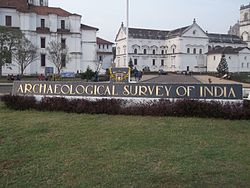
Between 1986 and 1992, the Archaeological Survey of India carried out restoration work on the temple as France did not recognise the Cambodian government at the time.
Image source: Archaeological Survey of India
1992
% complete
In 1992, the Angkor area was designated as a UNESCO World Heritage Site. Simultaneously, Angkor Wat was listed in UNESCO's World Heritage in Danger following appeals by Norodom Sihanouk and UNESCO; the danger listing was later removed in 2004.
Image source: Angkor
1993
% complete
Restoration was coordinated by the International Coordinating Committee for the Safeguarding and Development of the Historic Site of Angkor (ICC-Angkor), established in 1993 under UNESCO, with various international agencies involved.
1994 - 1996
% complete
Zoning of the area was designated to protect the Angkor site in 1994, the Authority for the Protection and Management of Angkor and the Region of Siem Reap (APSARA) was established in 1995, and a law to protect Cambodian heritage was passed in 1996.
Image source: APSARA
2002
% complete
As part of international conservation efforts involving teams from France, India, Japan and China, the west facade of the upper level of Angkor Wat was buttressed by scaffolding in 2002.
2005
% complete
A Japanese team completed the restoration of the north library of the outer enclosure of Angkor Wat in 2005.
Dec 2015
% complete
In December 2015, a research team from the University of Sydney announced the discovery of a previously unseen ensemble of buried towers built and demolished during the construction of Angkor Wat, as well as a massive wooden-fortified structure of unknown purpose on its south side.
1990 - 2016
% complete
The site was managed by SOKIMEX between 1990 and 2016, which rented it from the Cambodian government.
1993 - 2018
% complete
In 1993 there were only 7,650 visitors to the site; by 2004, 561,000 foreign visitors arrived in Siem Reap province, over a million in 2007, over two million by 2012, and 2.6 million by 2018.
2001
% complete
In 2001, tourism revenue incentives resulted in the concept of the 'Angkor Tourist City', developed around traditional Khmer architecture with leisure and tourist facilities and luxurious hotels capable of accommodating large numbers of tourists.
Image source: Siem Reap
2012
% complete
At the ASEAN Tourism Forum 2012, it was agreed that Borobudur and Angkor Wat would become sister sites and sister provinces.
Image source: Borobudur
2020 - 2021
% complete
In 2020, the COVID-19 pandemic led to travel restrictions worldwide that severely impacted Cambodia's tourism sector. Angkor Wat reopened to international visitors in late 2021 but received only 280,000 tourists in 2022 versus 2.6 million in 2018.
Image source: COVID-19 pandemic in Cambodia
2023
% complete
In 2023, the temple saw an increase in visitor numbers over the previous year, having received over 400,000 tourists by late July.
2024
% complete
Tourists reenacting the 2011 game series Temple Run in mid-2024 for social media drew criticism from conservationists who warned that it risks damaging Angkor Wat's structures and carvings and is culturally insensitive.
Image source: Temple Run
Or browse the full history timeline directory, with more than 2,000 topics.
This Angkor Wat timeline was generated with the help of AI, using information found on the internet.
We work hard to keep these timelines accurate, but mistakes do get through. If you spot one, email us at [email protected] and we'll fix it for future visitors.
Generate yours with AI or build it from scratch, for free.
Export your timeline, add your own events, edit or remove AI-generated events, and much more
No credit card required.
Cancel anytime.
Cancel anytime.
You can create an unlimited number of timelines with up to 10 events on each one, customize how they look, export them to PDF, PNG, PowerPoint, CSV, and Excel, and share them with a link. Paid plans raise the event limit and add features like spreadsheet imports and collaborators.
Yes. You can cancel your subscription from your account page at any time, and you will not be charged again. Your subscription stays active for the rest of the period you already paid for.
Yes. We will email you a reminder before the annual renewal, and we will also email you a receipt.
Yes. You can email us within 15 days of any payment, and we will issue you a full refund.
Check out our pricing docs or send us an email anytime: [email protected].