-
Use Cases
-
Resources
-
Pricing
Art Nouveau was an international style of art, architecture, and decorative design that flourished between roughly 1890 and 1910. Characterized by flowing organic lines, floral motifs, and the integration of fine and applied arts, it emerged as a reaction against academic art and historicism. The movement took on distinct names across Europe, including Jugendstil in Germany, Stile Liberty in Italy, and Modernisme in Catalonia, and was championed by figures such as Alphonse Mucha, Antoni Gaudí, Victor Horta, Hector Guimard, and Louis Comfort Tiffany. More Less
1856
% complete
Owen Jones published The Grammar of Ornament, a landmark survey of decorative styles from around the world. Its celebration of organic pattern and color profoundly influenced later designers, including the Art Nouveau generation's fascination with nature-based ornamentation.
Apr 1861
% complete
William Morris co-founded the decorative arts firm Morris, Marshall, Faulkner & Co. in London, championing handcrafted design and medieval-inspired aesthetics. The Arts and Crafts movement he inspired became a direct precursor to Art Nouveau, emphasizing the unity of art, craft, and everyday life.
Image source: Morris & Co.
1870
% complete
The Aesthetic Movement promoted 'art for art's sake' and Japanese-inspired design in Britain during the 1870s. Its emphasis on beauty, exotic motifs, and refined interiors laid important groundwork for the emergence of Art Nouveau across Europe.
Image source: Aestheticism
1876 - 1877
% complete
Whistler created the Peacock Room for shipping magnate Frederick Leyland's London dining room, a sumptuous interior of blue-green peacock motifs inspired by Japanese art. It became an iconic precursor to Art Nouveau's total-design interiors.
Image source: The Peacock Room
May 6, 1889 - Oct 31, 1889
% complete
The 1889 Paris World's Fair, dominated by the newly completed Eiffel Tower, showcased international arts and engineering. Its display of decorative arts and non-Western design helped catalyze the new style that would soon be called Art Nouveau.
Image source: Exposition Universelle (1889)
Dec 26, 1895
% complete
German-born dealer Siegfried Bing opened his Paris gallery Maison de l'Art Nouveau, dedicated to modern decorative arts from Europe, America, and Japan. The gallery gave the entire movement its name and served as its most influential showcase.
Image source: Siegfried Bing
1880
% complete
Victor Horta began practicing architecture in Brussels after studying at the Académie Royale des Beaux-Arts. He would become one of the founding fathers of Art Nouveau architecture, pioneering whiplash ironwork and open-plan interiors.
Image source: Victor Horta
Mar 19, 1882
% complete
Construction began on Antoni Gaudí's basilica La Sagrada Família, which he took over in 1883 and transformed into an extraordinary fusion of Gothic structure and organic Modernista forms. It remains unfinished to this day, embodying Art Nouveau's spiritual ambitions.
Image source: Sagrada Família
1883 - 1885
% complete
Gaudí's Casa Vicens in Barcelona, with its Moorish-inspired tilework and exuberant polychromy, marked the beginning of Catalan Modernisme. It announced the distinctive regional branch of Art Nouveau that flourished in Barcelona.
Image source: Casa Vicens
1885 - 1889
% complete
Hector Guimard trained at the École des Beaux-Arts in Paris during the late 1880s, absorbing rationalist structural ideas that he would later fuse with organic ornament to create his signature Parisian Art Nouveau buildings and Métro entrances.
Image source: Hector Guimard
1893 - 1894
% complete
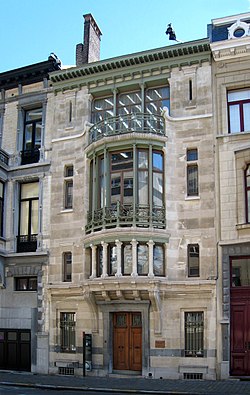
Widely considered the first true Art Nouveau building, Horta's Hôtel Tassel featured exposed iron columns with sinuous plant-like forms, a glazed central stairwell, and flowing open plans — establishing the vocabulary of Art Nouveau architecture.
Image source: Hôtel Tassel
May 1, 1893 - Oct 30, 1893
% complete
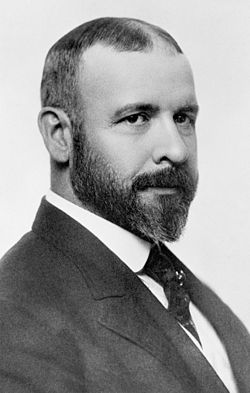
At the Chicago World's Fair, Louis Sullivan's Transportation Building displayed ornamental exuberance that influenced European observers. Sullivan's organic ornamentation and 'form follows function' philosophy bridged American architecture and Art Nouveau ideals.
Image source: Louis Sullivan
1895 - 1898
% complete
Guimard's apartment building in the 16th arrondissement, with its wrought-iron balconies, asymmetrical facade, and organic stone carvings, won the city's best facade competition and established Guimard as France's leading Art Nouveau architect.
Image source: Castel Béranger
1896 - 1899
% complete
Mackintosh won the competition to design the Glasgow School of Art, producing a masterpiece blending Scottish Baronial tradition, Japanese minimalism, and Art Nouveau stylization. He became the leading figure of the Glasgow School alongside the 'Spook School' circle.
Image source: Glasgow School of Art
1898
% complete
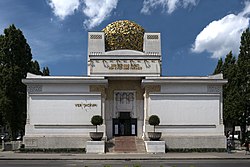
Joseph Maria Olbrich's Secession Building opened as the exhibition hall of the Vienna Secession. Its dome of gilded laurel leaves, nicknamed the 'golden cabbage,' became an emblem of Austrian Art Nouveau and a manifesto in built form.
Image source: Secession Building
1900 - 1913
% complete
Guimard's cast-iron Métro entrances, with their green plant-like canopies and amber lamp globes, became the most recognizable symbols of Art Nouveau in Paris. Dozens were installed between 1900 and 1913, democratizing the style across the city.
Image source: Paris Métro
May 19, 1903 - 1932
% complete
The Wiener Werkstätte, a community of visual artists and craftsmen funded by Fritz Waerndorfer, produced furniture, textiles, metalwork, and fashion of geometric elegance. It evolved Viennese Art Nouveau toward the cleaner lines of early modernism.
Image source: Wiener Werkstätte
1904 - 1906
% complete
Gaudí remodeled Casa Batlló on Barcelona's Passeig de Gràcia into a fantastical dwelling with skeletal balconies, a scaled dragon-back roof, and undulating colored-glass facades. It stands among the most celebrated works of Catalan Modernisme.
Image source: Casa Batlló
1905 - 1911
% complete
Josef Hoffmann's Stoclet Palace, with marble-clad facades and a dining room frescoed by Gustav Klimt (the Stoclet Frieze), is considered a Gesamtkunstwerk — a total work of art. It marks the transition from Art Nouveau toward geometric modernism.
Image source: Stoclet Palace
1906 - 1912
% complete
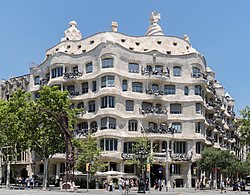
Gaudí's Casa Milà, nicknamed La Pedrera ('the quarry'), featured a rippling limestone facade, wrought-iron balconies, and surreal rooftop chimneys. It represented the mature culmination of Catalan Art Nouveau architecture before the style waned.
Image source: Casa Milà
Oct 28, 1883
% complete
The Brussels-based exhibition society Les XX was founded by Octave Maus, bringing together avant-garde painters and designers. Its annual shows introduced Symbolist and emerging Art Nouveau works to an international audience, including exhibitions by Van Gogh and Gauguin.
Image source: Les XX
1891
% complete
Toulouse-Lautrec's bold lithographic posters for the Moulin Rouge cabaret revolutionized advertising art. Though more Post-Impressionist than strictly Art Nouveau, his flat colors and dynamic compositions shaped the movement's graphic language.
Image source: Moulin Rouge: La Goulue
1893
% complete
Louis Comfort Tiffany patented Favrile glass, known for its iridescent surface and organic forms. His lamps and vases, often featuring dragonflies, wisteria, and other natural motifs, made him America's foremost Art Nouveau designer.
Image source: Tiffany glass
Jan 1, 1894
% complete
Mucha's life-size poster for actress Sarah Bernhardt's production of Gismonda caused a sensation in Paris on New Year's Day 1894. Its elongated figures, floral halos, and decorative lettering launched the 'Mucha style' and popularized Art Nouveau graphic design worldwide.
Image source: Gismonda
1897 - 1905
% complete
Lalique's jewelry featuring dragonflies, orchids, female figures, and enamel-and-glass techniques dazzled collectors at the turn of the century. His work epitomized Art Nouveau's fusion of naturalism, symbolism, and virtuoso craftsmanship.
Image source: René Lalique
Apr 3, 1897
% complete
Klimt, Moser, Josef Hoffmann, and other artists broke away from the conservative Künstlerhaus to form the Vienna Secession, declaring 'To every age its art, to every art its freedom.' The Secession became Austria's hub of Art Nouveau, known locally as the Secession style.
Image source: Vienna Secession
Jan 1898 - 1903
% complete
The Secession's official journal Ver Sacrum ('Sacred Spring') published innovative graphics, typography, and illustrations by Klimt, Moser, and others. Its experimental page design made it one of the most influential art magazines of the era.
Image source: Ver Sacrum (magazine)
1901 - 1904
% complete
Glassmaker Émile Gallé founded the Alliance Provinciale des Industries d'Art, known as the École de Nancy, promoting Art Nouveau in furniture, glass, and ceramics. Nancy became France's second great center of the movement, rooted in botanical naturalism.
Image source: École de Nancy
Apr 14, 1900 - Nov 12, 1900
% complete
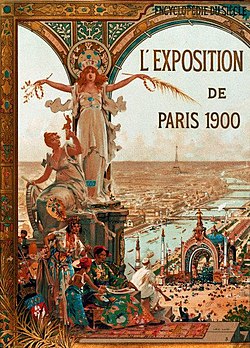
The 1900 Paris World's Fair marked Art Nouveau's triumphant peak, with pavilions, interiors, and objects by Bing, Guimard, Gallé, Tiffany, and others attracting millions of visitors. The fair spread the style internationally and cemented Paris as its capital.
Image source: Exposition Universelle (1900)
1925
% complete
The International Exhibition of Modern Decorative and Industrial Arts in Paris introduced Art Deco, whose streamlined geometry rejected Art Nouveau's curvilinear naturalism. The new style rapidly supplanted Art Nouveau, closing the movement's chapter while preserving its legacy in design history.
Image source: Art Deco
Jun 7, 1926
% complete
Antoni Gaudí died after being struck by a tram in Barcelona, having devoted his final decades to La Sagrada Família. His death symbolized the end of the Art Nouveau era, as modernist functionalism had already displaced the ornate style across Europe.
Image source: Antoni Gaudí
Or browse the full history timeline directory, with more than 2,000 topics.
This Art Nouveau timeline was generated with the help of AI, using information found on the internet.
We work hard to keep these timelines accurate, but mistakes do get through. If you spot one, email us at [email protected] and we'll fix it for future visitors.
Generate yours with AI or build it from scratch, for free.
Export your timeline, add your own events, edit or remove AI-generated events, and much more
No credit card required.
Cancel anytime.
Cancel anytime.
You can create an unlimited number of timelines with up to 10 events on each one, customize how they look, export them to PDF, PNG, PowerPoint, CSV, and Excel, and share them with a link. Paid plans raise the event limit and add features like spreadsheet imports and collaborators.
Yes. You can cancel your subscription from your account page at any time, and you will not be charged again. Your subscription stays active for the rest of the period you already paid for.
Yes. We will email you a reminder before the annual renewal, and we will also email you a receipt.
Yes. You can email us within 15 days of any payment, and we will issue you a full refund.
Check out our pricing docs or send us an email anytime: [email protected].