-
Use Cases
-
Resources
-
Pricing
The Articles of Confederation served as the first governing document of the United States, establishing a loose alliance of sovereign states with a weak central government. Adopted by Congress in 1777 during the Revolutionary War, it was ratified in 1781 but ultimately proved inadequate, leading to the Constitutional Convention of 1787 and the adoption of the current U.S. Constitution in 1789. More Less
1775
% complete
In 1775, with events outpacing communications, the Second Continental Congress began acting as the provisional government for the United Colonies, coordinating the war effort and setting the stage for formal union among the states.
Image source: Second Continental Congress
Jan 1776
% complete
In early 1776, Thomas Paine argued in the closing pages of the first edition of Common Sense that the 'custom of nations' demanded a formal declaration of American independence if any European power were to mediate a peace between the Americans and Great Britain.
Image source: Common Sense
Jun 7, 1776
% complete
On June 7, 1776, Richard Henry Lee introduced a resolution before the Continental Congress declaring the colonies independent. At the same time, he urged Congress to resolve 'to take the most effectual measures for forming foreign Alliances' and to prepare a plan of confederation for the newly independent states.
Image source: Lee Resolution
Jun 12, 1776
% complete
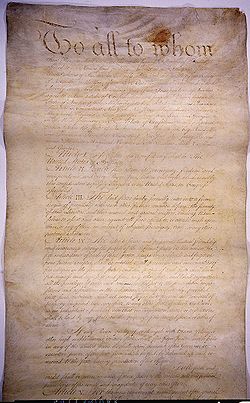
On June 12, 1776, a day after appointing the Committee of Five to prepare a draft of the Declaration of Independence, the Second Continental Congress resolved to appoint a committee of 13 with one representative from each colony to prepare a draft of a constitution for a union of the states.
Image source: Articles of Confederation
Jul 12, 1776
% complete
The drafting committee met frequently, and chairman John Dickinson presented their results to the Congress on July 12, 1776. The Articles were debated by the Second Continental Congress at present-day Independence Hall in Philadelphia between July 1776 and November 1777.
Image source: John Dickinson

Dec 1776
% complete
To further complicate work on the constitution, Congress was forced to leave Philadelphia twice: first for Baltimore, Maryland, in the winter of 1776, and later for Lancaster and then York, Pennsylvania, in the fall of 1777, to evade advancing British troops.
Nov 15, 1777
% complete
The final draft of the Articles of Confederation and Perpetual Union was completed on November 15, 1777, when the Second Continental Congress approved the Articles for distribution to the states at Independence Hall in Philadelphia.
Nov 1777
% complete
In late November 1777, the Articles of Confederation were submitted to the states for ratification, beginning a lengthy process of approval by all 13 colonial states that would take more than three years to complete.
Dec 16, 1777
% complete
Virginia became the first state to ratify the Articles of Confederation on December 16, 1777. Twelve states had ratified the Articles by February 1779, fourteen months into the process.
Jun 27, 1778
% complete
Congress began the signing process by examining their copy of the Articles on June 27, 1778, preparing an official engrossed copy for delegates to sign as state approvals came in.
Jul 9, 1778 - Feb 12, 1779
% complete
On July 9, 1778, the prepared copy was ready for signatures. John Penn was the first of North Carolina's delegates to arrive on July 10, and the delegation signed on July 21, 1778. Georgia signed on July 24, New Jersey on November 26, and Delaware on February 12, 1779.
1780
% complete
In 1780, when Maryland requested that France provide naval forces in the Chesapeake Bay for protection from British raids in the lower part of the bay, French minister La Luzerne indicated Admiral Destouches would do what he could, but also sharply pressed Maryland to ratify the Articles, suggesting the two issues were related.
Image source: Anne-César de La Luzerne
Feb 2, 1781
% complete
On February 2, 1781, the much-awaited decision was taken by the Maryland General Assembly in Annapolis. With Maryland's ratification, all 13 states had approved the Articles of Confederation, clearing the way for the government to come into force.
Mar 1, 1781
% complete
The confirmation signing of the Articles by the two Maryland delegates took place in Philadelphia at noon on March 1, 1781, and was celebrated in the afternoon. The Articles of Confederation thus officially came into force as the first constitution of the United States.
1779
% complete
In 1779, George Washington wrote to John Jay, then serving as president of the Continental Congress, that 'a wagon load of money will scarcely purchase a wagon load of provisions,' illustrating the devastating depreciation of Continental currency under the weak financial system.
1783
% complete
The 1783 Treaty of Paris, which ended hostilities with Great Britain, languished in Congress for several months because too few delegates were present at any one time to constitute a quorum so it could be ratified. By 1783, however, the new nation was regaining prosperity due to the end of armed conflict.
Image source: Treaty of Paris (1783)
1783
% complete
In 1783, George Washington defused the Newburgh conspiracy among restless army officers, but riots by unpaid Pennsylvania veterans forced Congress to leave Philadelphia temporarily. Former generals and lesser officers strongly supported a more muscular union and later fought hard for ratification of the Constitution in 1787.
Image source: Newburgh Conspiracy
1785
% complete
When John Adams went to London in 1785 as the first representative of the United States, he found it impossible to secure a treaty for unrestricted commerce, demonstrating the weakness of the national government in conducting foreign affairs.
Image source: John Adams
1786
% complete
The 1786 Jay–Gardoqui Treaty with Spain showed weakness in American foreign policy. The dispute it created would later be resolved by the implementation of Jay's Treaty in 1795, after the federal Constitution came into force.
1786
% complete
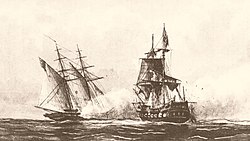
In 1786, Thomas Jefferson, concerned over the failure of Congress to fund an American naval force to confront the Barbary pirates, wrote in diplomatic correspondence to James Monroe that 'It will be said there is no money in the treasury,' highlighting the government's fiscal impotence.
Image source: First Barbary War
Aug 29, 1786 - Feb 1787
% complete
In 1786–87, Shays's Rebellion, an uprising of dissidents in western Massachusetts against the state court system, threatened the stability of state government and underscored the inability of the weak central government to maintain order, energizing calls for constitutional reform.
Image source: Shays's Rebellion
May 20, 1785
% complete
The Land Ordinance of 1785 established both the general practices of land surveying in the west and northwest and the land ownership provisions used throughout the later westward expansion beyond the Mississippi River. It set up protocols for the division of land into useful units and set aside land in each township for public use.
Image source: Land Ordinance of 1785
Jul 13, 1787
% complete
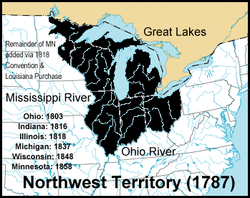
The Northwest Ordinance of 1787 noted the agreement of the original states to give up northwestern land claims, organized the Northwest Territory, and laid the groundwork for the eventual creation of new states. It also made great advances toward the abolition of slavery in the territory.
Image source: Northwest Ordinance
May 1786
% complete
In May 1786, Charles Pinckney of South Carolina proposed that Congress revise the Articles of Confederation, reflecting growing concern over the weaknesses of the national government under the existing framework.
Image source: Charles Pinckney (governor)
Sep 11, 1786 - Sep 14, 1786
% complete
In September 1786, delegates from five states met at what became known as the Annapolis Convention to discuss the need for reversing the protectionist interstate trade barriers each state had erected. At its conclusion, delegates voted to invite all states to a larger convention in Philadelphia in 1787. Hamilton led like-minded nationalists, won Washington's endorsement, and convened the convention to petition Congress to call a constitutional convention.
May 25, 1787 - Sep 17, 1787
% complete
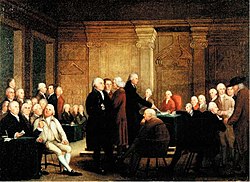
Shortly after the Annapolis Convention, as more states became interested in meeting to revise the Articles, a gathering was set in Philadelphia on May 25, 1787. Rather than merely amending the Articles, the Convention drafted an entirely new Constitution to remedy the long-term crisis facing the nation.
Image source: Constitutional Convention (United States)
Jul 3, 1788
% complete
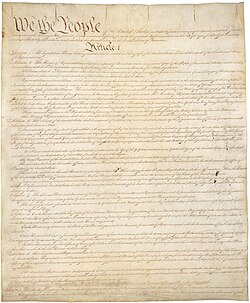
After significant ratification debates in each state and across the nation, on July 3, 1788, Congress received New Hampshire's all-important ninth ratification of the proposed Constitution, establishing it according to its terms as the new framework of governance for the ratifying states. By the end of July 1788, 11 of the 13 states had ratified.
Image source: Constitution of the United States
Sep 13, 1788 - Sep 15, 1788
% complete
On Saturday, September 13, 1788, the Confederation Congress voted to implement the new Constitution, and on September 15 published an announcement that it had been ratified by the necessary nine states. It set dates for appointing electors, for electors to vote for a president, and for commencing proceedings in March 1789.
Image source: Congress of the Confederation
Mar 4, 1789
% complete
On March 4, 1789, after significant ratification debates across the nation, the government under the Articles of Confederation was replaced with the federal government under the Constitution, ending the era of the Confederation and launching the United States government as it exists today.
Or browse the full history timeline directory, with more than 2,000 topics.
This Articles of Confederation timeline was generated with the help of AI, using information found on the internet.
We work hard to keep these timelines accurate, but mistakes do get through. If you spot one, email us at [email protected] and we'll fix it for future visitors.
Generate yours with AI or build it from scratch, for free.
Export your timeline, add your own events, edit or remove AI-generated events, and much more
No credit card required.
Cancel anytime.
Cancel anytime.
You can create an unlimited number of timelines with up to 10 events on each one, customize how they look, export them to PDF, PNG, PowerPoint, CSV, and Excel, and share them with a link. Paid plans raise the event limit and add features like spreadsheet imports and collaborators.
Yes. You can cancel your subscription from your account page at any time, and you will not be charged again. Your subscription stays active for the rest of the period you already paid for.
Yes. We will email you a reminder before the annual renewal, and we will also email you a receipt.
Yes. You can email us within 15 days of any payment, and we will issue you a full refund.
Check out our pricing docs or send us an email anytime: [email protected].