-
Use Cases
-
Resources
-
Pricing
Ayn Rand (1905–1982) was a Russian-born American writer and philosopher best known for novels such as The Fountainhead (1943) and Atlas Shrugged (1957). She developed Objectivism, a philosophy advocating rational self-interest, individualism, and laissez-faire capitalism, which continues to influence political thought, economics, and popular culture today. More Less
Feb 2, 1905
% complete
Ayn Rand was born Alisa Zinovyevna Rosenbaum on February 2, 1905, into a Jewish bourgeois family living in Saint Petersburg, the capital of the Russian Empire. She would grow up to become a Russian-American writer and philosopher known worldwide by her pen name.
Image source: Ayn Rand
Jun 1921
% complete
After graduating from high school in June 1921, Rand returned with her family to Petrograd, as Saint Petersburg was then named, where they faced desperate conditions in the aftermath of the Russian Revolution, occasionally nearly starving.
Oct 1924
% complete
In October 1924, Rand graduated from the renamed Leningrad State University, completing her education in Russia before beginning her new life in America.
Dec 1925
% complete
In late 1925, Rand was granted a visa to visit relatives in Chicago, Illinois, an opportunity that allowed her to leave Soviet Russia for the United States.
Feb 19, 1926
% complete
Rand arrived in New York City on February 19, 1926, marking the start of her life in America. Born and educated in Russia, she had moved to the United States, where she would build her career as a writer and philosopher.
Apr 15, 1929
% complete
Rand married Frank O'Connor on April 15, 1929. The couple would remain together for decades, and O'Connor later accompanied her when she moved to New York City to handle Broadway productions of her work.
Jul 1929
% complete
Rand became a permanent American resident in July 1929, solidifying her status in the country where she would spend the rest of her life.
Mar 3, 1931
% complete
Rand became an American citizen on March 3, 1931, formally embracing her adopted nation, whose values of individualism would become central themes in her novels and philosophy.
1939
% complete
Rand's father died of a heart attack in 1939, while she was living in the United States and building her literary career.
1973
% complete
In 1973, Rand learned that her youngest sister, Nora, was still alive in Leningrad. She arranged for Nora and her husband to visit New York in April 1974, but the sisters clashed repeatedly over their differing beliefs.
Dec 1974 - Jan 1975
% complete
In December 1974, after decades of heavy smoking, Rand was diagnosed with lung cancer. It was successfully treated with surgery in January 1975.
Nov 9, 1979
% complete
Rand's activities in the Objectivist movement declined, especially after her husband, Frank O'Connor, died on November 9, 1979.
Mar 6, 1982
% complete
On March 6, 1982, Rand died of heart failure at her home in New York City, ending a career that spanned fiction, philosophy, and cultural commentary.
1932
% complete
In 1932, Rand's first literary success was the sale of her screenplay Red Pawn to Universal Studios, although it was never produced.
Image source: Red Pawn
1934
% complete
Rand's courtroom drama Night of January 16th was first staged in Hollywood in 1934, and it reopened successfully on Broadway in 1935.
Image source: Night of January 16th
Dec 1934
% complete
In December 1934, Rand and O'Connor moved to New York City so she could handle revisions for the successful Broadway production of Night of January 16th.
Dec 1935 - 1938
% complete
In December 1935, Rand started her next major novel, The Fountainhead, but took a break from it in 1937 to write her novella Anthem, which depicts protagonists Equality 7-2521 and Liberty 5-3000 escaping a collectivistic society and rediscovering the word I. Anthem was published in England in 1938, but Rand could not find an American publisher at that time; a revised edition published in 1946 later sold over 3.5 million copies.
Image source: The Fountainhead
1936
% complete
In 1936, Rand's first novel was published, the semi-autobiographical We the Living. After the success of her later novels, she released a revised version in 1959 that has sold over three million copies.
Image source: We the Living
1943
% complete
In 1943, Rand achieved fame with The Fountainhead, a novel about an uncompromising architect named Howard Roark and his struggle against what Rand described as "second-handers" who attempt to live through others. It was her first major success as a writer.
1943
% complete
In 1943, Rand sold the film rights to The Fountainhead to Warner Bros., leading eventually to a Hollywood adaptation of her famous novel.
Image source: The Fountainhead (film)
1949
% complete
In 1949, after several delays, the film version of The Fountainhead was released by Warner Bros., bringing Rand's story of architect Howard Roark to movie audiences.
1957
% complete
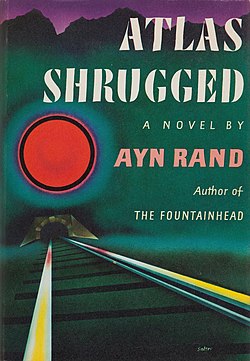
In 1957, Rand published her best-selling work, the novel Atlas Shrugged, which is considered her magnum opus. Afterward, until her death in 1982, she turned to non-fiction to promote her philosophy, publishing her own periodicals and releasing several collections of essays.
Image source: Atlas Shrugged
1940 - Nov 1940
% complete
Rand and her husband were full-time volunteers for Republican Wendell Willkie's 1940 presidential campaign, an early sign of her political engagement in America.
1947
% complete
During the Second Red Scare, Rand testified as a "friendly witness" before the United States House Committee on Un-American Activities that the 1944 film Song of Russia grossly misrepresented conditions in the Soviet Union. She also wanted to criticize the 1946 film The Best Years of Our Lives for its negative presentation of the business world but was not allowed to do so.
Image source: House Un-American Activities Committee
1951
% complete
In 1951, Rand moved from Los Angeles to New York City, where she gathered a group of admirers who met at her apartment on weekends to discuss philosophy, forming the core of what would become the Objectivist movement.
1958
% complete
In 1958, Nathaniel Branden established the Nathaniel Branden Lectures, later incorporated as the Nathaniel Branden Institute (NBI), to promote Rand's philosophy through public lectures.
Image source: Nathaniel Branden
1962
% complete
In 1962, Nathaniel Branden and Rand co-founded The Objectivist Newsletter, later renamed The Objectivist, to circulate articles about her ideas.
1964
% complete
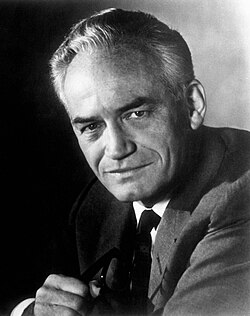
Rand endorsed several Republican candidates for president of the United States over the years, most strongly Barry Goldwater in 1964. Her political views included supporting abortion rights, opposing the Vietnam War and the military draft, supporting Israel in the Yom Kippur War of 1973, claiming European colonists had the right to invade and take land inhabited by American Indians, and calling homosexuality "immoral" and "disgusting" despite advocating the repeal of all laws concerning it.
Image source: Barry Goldwater
1964
% complete
After her close relationship with Nathaniel Branden turned into a romantic affair in 1954, Branden began an affair with the young actress Patrecia Scott in 1964, whom he later married.
1968
% complete
In 1968, Rand learned about Branden's relationship with Patrecia Scott, an event that ruptured her personal and professional partnership with Branden and shook the Objectivist movement.
1976
% complete
In 1976, Rand retired from her newsletter and, despite her objections to government-run social programs, claimed Social Security and Medicare with the aid of a representative from her lawyers.
1979
% complete
In 1979, Peter Schwartz started a newsletter called The Intellectual Activist, which Rand endorsed. She also endorsed The Objectivist Forum, a bimonthly magazine founded by Objectivist philosopher Harry Binswanger, which ran from 1980 to 1987.
Image source: Objectivist periodicals
1984
% complete
The Philosophic Thought of Ayn Rand, a 1984 collection of essays about Objectivism edited by Douglas Den Uyl and Douglas B. Rasmussen, was the first academic book about Rand's ideas published after her death. A few articles about her ideas had appeared in academic journals before her death, many in The Personalist.
Image source: The Philosophic Thought of Ayn Rand
1985
% complete
In 1985, Leonard Peikoff worked with businessman Ed Snider to establish the Ayn Rand Institute, a nonprofit organization dedicated to promoting Rand's ideas and works.
Image source: Ayn Rand Institute
1987
% complete
In 1987, the Ayn Rand Society was founded as an affiliate of the American Philosophical Association. That same year, a New York Times article called Rand the Reagan administration's "novelist laureate".
Image source: Ayn Rand
1990
% complete
In 1990, after an ideological disagreement with Peikoff, David Kelley founded the Institute for Objectivist Studies, now known as The Atlas Society.
1991
% complete
In 1991, a survey conducted for the Library of Congress and the Book of the Month Club asked club members to name the most influential book in their lives, reflecting Rand's enduring popular influence.
1997
% complete
The 1997 documentary film Ayn Rand: A Sense of Life was nominated for the Academy Award for Best Documentary Feature, recognizing her lasting cultural impact.
Image source: Ayn Rand: A Sense of Life
1999
% complete
In 1999, The Journal of Ayn Rand Studies, a peer-reviewed, multidisciplinary academic journal devoted to the study of Rand and her ideas, was established. That same year, The Passion of Ayn Rand, a television adaptation of the book of the same name, won several awards, and Rand's image appeared on a U.S. postage stamp.
2002
% complete
Since 2002, the Ayn Rand Institute has provided free copies of Rand's novels to teachers who promise to include the books in their curriculum. From 2002 to 2012, over 60 colleges and universities also accepted grants from BB&T's charitable foundation that required teaching Rand's ideas or works.
2008
% complete
The 2008 financial crisis renewed interest in Rand's works, especially Atlas Shrugged, which some saw as foreshadowing the crisis.
2012
% complete
In 2012, the Pennsylvania State University Press agreed to take over publication of The Journal of Ayn Rand Studies, and the University of Pittsburgh Press launched an "Ayn Rand Society Philosophical Studies" series. That year, political scientist Alan Wolfe dismissed Rand as a "nonperson" among academics, an attitude described as "the traditional academic view."
2017
% complete
In 2017, Rand was added to the required reading list for the A Level Politics exam in the United Kingdom, extending her influence into British education.
2021
% complete
In 2021, Cass Sunstein said Rand's ideas could be seen in the tax and regulatory policies of the Trump administration, attributing this to the "enduring influence" of Rand's fiction. With over 37 million copies sold as of 2020, her books continue to be read widely.
2023
% complete
In 2023, The Journal of Ayn Rand Studies ceased publication, closing a chapter in academic study devoted to Rand's life and philosophy.
Or browse the full history timeline directory, with more than 2,000 topics.
This Ayn Rand timeline was generated with the help of AI, using information found on the internet.
We work hard to keep these timelines accurate, but mistakes do get through. If you spot one, email us at [email protected] and we'll fix it for future visitors.
Generate yours with AI or build it from scratch, for free.
Export your timeline, add your own events, edit or remove AI-generated events, and much more
No credit card required.
Cancel anytime.
Cancel anytime.
You can create an unlimited number of timelines with up to 10 events on each one, customize how they look, export them to PDF, PNG, PowerPoint, CSV, and Excel, and share them with a link. Paid plans raise the event limit and add features like spreadsheet imports and collaborators.
Yes. You can cancel your subscription from your account page at any time, and you will not be charged again. Your subscription stays active for the rest of the period you already paid for.
Yes. We will email you a reminder before the annual renewal, and we will also email you a receipt.
Yes. You can email us within 15 days of any payment, and we will issue you a full refund.
Check out our pricing docs or send us an email anytime: [email protected].