
-
Use Cases
-
Resources
-
Pricing
Edmund Burke (1729–1797) was an Irish-born British statesman, philosopher, and Member of Parliament widely regarded as the father of modern conservatism. Known for his support of the American colonists, his fierce criticism of the French Revolution in 'Reflections on the Revolution in France,' and his advocacy for gradual, tradition-based political change, Burke shaped political philosophy for generations. More Less
Jan 12, 1729
% complete
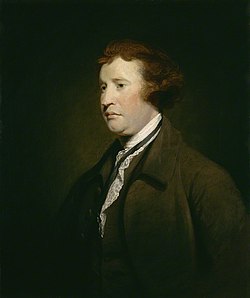
Edmund Burke was born on 12 January 1729 (New Style) into the Anglo-Irish Burke family. He would become an Anglo-Irish writer, philosopher, and politician widely credited as the founder of the philosophy of conservatism.
Image source: Edmund Burke
1744
% complete
In 1744, Burke started at Trinity College Dublin, a Protestant establishment which up until 1793 did not permit Catholics to take degrees.
1747
% complete
In 1747, Burke set up a debating society, Edmund Burke's Club, which in 1770 merged with Trinity's Historical Club to form the College Historical Society, the oldest undergraduate society in the world.
Image source: College Historical Society
1748
% complete
Burke graduated from Trinity College Dublin in 1748, completing his formal education at the Protestant institution.
Image source: Trinity College Dublin
1750
% complete
Burke's father wanted him to read Law and with this in mind, he went to London in 1750, where he entered the Middle Temple, before soon giving up legal study to travel in Continental Europe.
Image source: Middle Temple
Mar 12, 1757
% complete
On 12 March 1757, Burke married Jane Mary Nugent (1734–1812), daughter of Dr. Christopher Nugent. Their son Richard was born on 9 February 1758 while a second son, Christopher, died in infancy.
Image source: Edmund Burke
Feb 9, 1758
% complete
Burke's son Richard was born on 9 February 1758. A second son, Christopher, born that December, died in infancy. Burke also helped raise a ward, Edmund Nagle, later Admiral Sir Edmund Nagle, orphaned in 1763.
Aug 1794
% complete
A blow fell upon Burke with the loss of his son Richard in August 1794, shortly after Richard succeeded him in Parliament. Richard had worked successfully in the early battle for Catholic emancipation.
Image source: Richard Burke Jr.
Jul 9, 1797
% complete
Burke died in Beaconsfield, Buckinghamshire, on 9 July 1797 and was buried there alongside his son and brother. In the 19th century he was praised by both conservatives and liberals, and in the 20th century became widely regarded as the philosophical founder of conservatism.
1752 - 1754
% complete
The late Lord Bolingbroke's Letters on the Study and Use of History was published in 1752 and his collected works appeared in 1754, provoking Burke into writing his first published work.
Image source: Henry St John, 1st Viscount Bolingbroke
1756
% complete
Burke published his first work, A Vindication of Natural Society: A View of the Miseries and Evils Arising to Mankind. Some reviewers failed to notice its ironic nature, leading Burke to state in the preface to the second edition (1757) that it was a satire expressing his political views.
Image source: A Vindication of Natural Society
1757
% complete
In 1757, Burke published a treatise on aesthetics titled A Philosophical Enquiry into the Origin of Our Ideas of the Sublime and Beautiful, which attracted the attention of prominent Continental thinkers such as Denis Diderot and Immanuel Kant. It was his only purely philosophical work, completed in 1753.
Image source: A Philosophical Enquiry into the Origin of Our Ideas of the Sublime and Beautiful
Feb 25, 1757
% complete
On 25 February 1757, Burke signed a contract with Robert Dodsley to write a history of England from Julius Caesar to the end of Queen Anne's reign, nearly 400,000 words. Burke completed it only to 1216; it was not published until an 1812 collection as An Essay Towards an Abridgement of the English History.
Image source: Robert Dodsley
1769
% complete
In reply to the 1769 Grenvillite pamphlet The Present State of the Nation, Burke published his own pamphlet titled Observations on a Late State of the Nation.
Image source: The Birth of a Nation
Apr 23, 1770
% complete
Burke's most important publication of this period was his Thoughts on the Cause of the Present Discontents, published on 23 April 1770, a major statement of party principles and criticism of the influence of the King's Friends.
Nov 1795
% complete
In November 1795, there was a debate in Parliament on the high price of corn and Burke wrote a memorandum to Pitt on the subject. Fragments were inserted after his death and published posthumously in 1800 as Thoughts and Details on Scarcity.
Image source: Thoughts and Details on Scarcity
1796
% complete
When Burke's pension was attacked by the Duke of Bedford and the Earl of Lauderdale, Burke replied in his Letter to a Noble Lord (1796): 'To innovate is not to reform.'
1765
% complete
In 1765, Burke became private secretary to the liberal Whig politician Charles, Marquess of Rockingham, then Prime Minister of Great Britain, who remained Burke's close friend and associate until his death in 1782.
Image source: Charles Watson-Wentworth, 2nd Marquess of Rockingham
Dec 1765
% complete
In December 1765, Burke entered the House of Commons as Member for Wendover in Buckinghamshire, a pocket borough in the gift of Lord Fermanagh, later 2nd Earl Verney and a close political ally of Rockingham. He served as MP until 1794.
Image source: House of Commons of Great Britain
Nov 16, 1770
% complete
Speaking in a Parliamentary debate on the prohibition on the export of grain, Burke argued in favour of a free market in corn: 'There are no such things as a high, & a low price that is encouraging, & discouraging; there is nothing but a natural price.'
1771
% complete
During 1771, Burke wrote a bill that would have given juries the right to determine what was libel, if passed. When introducing his own bill in 1791 in opposition, Fox repeated almost verbatim the text of Burke's bill without acknowledgement.
1772
% complete
In 1772, Burke was instrumental in the passing of the Repeal of Certain Laws Act 1772, which repealed various old laws against dealers and forestallers in corn.
Jul 1773
% complete
In the Annual Register for 1772 (published in July 1773), Burke condemned the partition of Poland, demonstrating his concern with international affairs and justice.
Image source: Partitions of Poland
Nov 3, 1774
% complete
On 3 November 1774, Burke was elected Member of Parliament for Bristol, at the time 'England's second city' with a large constituency in a genuine electoral contest.
Mar 22, 1775 - May 1775
% complete
On 22 March 1775, Burke delivered in the House of Commons a speech on reconciliation with America, published in May 1775. It was greatly admired, including its passage on Lord Bathurst describing an angel prophesying the future greatness of England and America.
1776
% complete
Burke called capital punishment 'the Butchery which we call justice' in 1776, reflecting his reformist instincts on criminal justice during his parliamentary career.
Image source: Capital punishment in the United Kingdom
May 1778
% complete
In May 1778, Burke supported a Parliamentary motion revising restrictions on Irish trade, one of several unpopular causes including free trade with Ireland and Catholic emancipation that eventually cost him his seat.
1780
% complete
Burke failed to win re-election for Bristol in the 1780 general election. His support for unpopular causes, notably free trade with Ireland and Catholic emancipation, led to him losing his seat.
Image source: 1780 British general election
1780
% complete
During the Gordon Riots in 1780, Burke became a target of hostility due to his support for unpopular causes, and his home was placed under armed guard by the military.
Image source: Gordon Riots
1781
% complete
In 1781, Burke was appointed Chairman of the Commons Select Committee on East Indian Affairs. From that point until the end of Hastings' trial, India was Burke's primary concern.
Image source: East India Company
1782
% complete
The Civil List and Secret Service Money Act 1782 was a watered-down version of Burke's original intentions as outlined in his famous Speech on Economical Reform of 11 February 1780, another of the two Acts he introduced before Rockingham's government fell.
1782
% complete
The Paymaster General Act 1782, introduced by Burke, ended the post of Paymaster of the Forces as a lucrative sinecure, part of his broader programme of economical reform.
Mar 1782
% complete
The fall of Lord North led to Rockingham being recalled to power in March 1782. Rockingham's unexpected death in July 1782 ended the administration after only a few months, but Burke managed to introduce two Acts.
Image source: Second Rockingham ministry
Feb 1783
% complete
In February 1783, Burke resumed the post of Paymaster of the Forces when Shelburne's government fell and was replaced by a coalition headed by North that included Charles James Fox. That coalition fell later that year, succeeded by Pitt the Younger's long Tory administration.
Image source: Paymaster of the Forces
Feb 28, 1785
% complete
On 28 February 1785, Burke delivered a now-famous speech, The Nabob of Arcot's Debts, wherein he condemned the damage done to India by the East India Company.
Image source: Carnatic Sultanate
Apr 4, 1786
% complete
On 4 April 1786, Burke presented the House of Commons with the Article of Charge of High Crimes and Misdemeanors against Warren Hastings, formerly Governor-General of Bengal. The impeachment trial began in Westminster Hall on 14 February 1788, bringing the morality of imperialism to public perception.
Image source: Impeachment of Warren Hastings
Feb 14, 1788
% complete
The impeachment in Westminster Hall began on 14 February 1788 after years of Burke's pursuit of impeachment efforts against Warren Hastings. It was described as the 'first major public discursive event of its kind in England'.
Jun 20, 1794
% complete
On 20 June 1794, Burke received a vote of thanks from the House of Commons for his services in the Hastings Trial and immediately resigned his seat, being replaced by his son Richard, ending his MP tenure that ran from 1766 to 1794.
Aug 9, 1789
% complete
In a letter of 9 August 1789, Burke wrote: 'England gazing with astonishment at a French struggle for Liberty and not knowing whether to blame or to applaud! The thing indeed... has still something in it paradoxical and Mysterious.'
Oct 5, 1789 - Oct 6, 1789
% complete
The events of 5–6 October 1789, when a crowd of Parisian women marched on Versailles to compel King Louis XVI to return to Paris, turned Burke against the French Revolution.
Image source: Women's March on Versailles
Jan 1790
% complete
In January 1790, Burke read Richard Price's sermon of 4 November 1789 entitled A Discourse on the Love of Our Country to the Revolution Society, a society founded to commemorate the Glorious Revolution of 1688.
Image source: A Discourse on the Love of Our Country
Nov 1790
% complete
In November 1790, François-Louis-Thibault de Menonville, a member of the National Assembly of France, wrote to Burke praising Reflections and requesting more 'very refreshing mental food' that he could publish.
Nov 1790
% complete
Priced at five shillings, Reflections asserted the revolution was destroying the fabric of good society and traditional institutions, and condemned persecution of the Catholic Church. By the end of 1790 it had gone through ten printings and sold approximately 17,500 copies. Its famous passage described Marie-Antoinette during the October days.
Nov 29, 1790 - 1791
% complete
Burke wrote on 29 November 1790 that he had received 'a most full approbation of the principles of that work' from the Duke of Portland, Lord Fitzwilliam, the Duke of Devonshire and other Whig grandees. In 1791, Portland said he recommended the book to his sons as containing the true Whig creed.
Image source: Reflections on the Revolution in France
1791
% complete
Thomas Paine followed Burke's Reflections with the Rights of Man in 1791, offering a direct reply defending the French Revolution and republicanism against Burke's conservative critique.
Image source: Rights of Man
Apr 1791
% complete
Responding to Menonville's request, Burke published A Letter to a Member of the National Assembly in April 1791, continuing his critique of the French Revolution.
Image source: National Assembly (Kuwait)
May 6, 1791
% complete
On 6 May 1791, Burke used the opportunity to answer Fox during a parliamentary debate on the Quebec Bill and condemn the new French Constitution and 'the horrible consequences flowing from the French idea of the Rights of Man', marking his dramatic separation from Fox.
Image source: Constitutional Act 1791
Jun 5, 1791
% complete
Burke demonstrated his separation from the party on 5 June 1791 by writing to Fitzwilliam, declining money from him, underscoring the rupture caused by his stance on the French Revolution.
Aug 3, 1791
% complete
On 3 August 1791, Burke published his Appeal from the New to the Old Whigs, renewing his criticism of radical revolutionary programmes and attacking Whigs who supported them as holding principles contrary to those traditionally held by the Whig Party.
Image source: An Appeal from the New to the Old Whigs
Dec 1791
% complete
In December 1791, Burke sent government ministers his Thoughts on French Affairs, arguing that no counter-revolution in France would come from domestic causes alone, that the Revolutionary Government grows stronger with time, and that its aim is to disturb all other governments of Europe.
Dec 28, 1792
% complete
Burke delivered a speech on the debate of the Aliens Bill on 28 December 1792, amid fears of French revolutionary agents spreading sedition in Britain.
1793
% complete
Eventually most of the Whigs sided with Burke and gave their support to William Pitt the Younger's Tory government, which in response to France's declaration of war against Britain declared war on France's Revolutionary Government in 1793, vindicating Burke's warnings.
Image source: French Revolutionary Wars
Nov 4, 1793
% complete
Burke supported the royalist uprising in La Vendée, describing it on 4 November 1793 in a letter to William Windham as 'the sole affair I have much heart in'.
Image source: War in the Vendée
Oct 1796
% complete
Burke's last publications were the Letters on a Regicide Peace (October 1796), called forth by negotiations for peace with France by the Pitt government, warning against making peace with the revolutionary regime.
Image source: Letters on a Regicide Peace
Or browse the full history timeline directory, with more than 2,000 topics.
This Edmund Burke timeline was generated with the help of AI, using information found on the internet.
We work hard to keep these timelines accurate, but mistakes do get through. If you spot one, email us at [email protected] and we'll fix it for future visitors.
Generate yours with AI or build it from scratch, for free.
Export your timeline, add your own events, edit or remove AI-generated events, and much more
No credit card required.
Cancel anytime.
Cancel anytime.
You can create an unlimited number of timelines with up to 10 events on each one, customize how they look, export them to PDF, PNG, PowerPoint, CSV, and Excel, and share them with a link. Paid plans raise the event limit and add features like spreadsheet imports and collaborators.
Yes. You can cancel your subscription from your account page at any time, and you will not be charged again. Your subscription stays active for the rest of the period you already paid for.
Yes. We will email you a reminder before the annual renewal, and we will also email you a receipt.
Yes. You can email us within 15 days of any payment, and we will issue you a full refund.
Check out our pricing docs or send us an email anytime: [email protected].