-
Use Cases
-
Resources
-
Pricing
Baruch Spinoza (1632–1677) was a Dutch philosopher of Sephardic Jewish descent, one of the great rationalists of the 17th century. Excommunicated from Amsterdam's Jewish community for his unorthodox views, he developed a pantheistic philosophy identifying God with nature, most famously expressed in his work 'Ethics,' and became a foundational figure in Enlightenment thought. More Less
1597
% complete
In 1597, Spinoza's paternal grandfather's family left Vidigueira for Nantes, living outwardly as New Christians, before eventually transferring to Holland for an unknown reason.
1627
% complete
Rachel's children died in infancy, and she died in 1627.
Nov 24, 1632
% complete
Baruch Espinosa, the third child of Michael Espinosa, was born on 24 November 1632 in Amsterdam in the Dutch Republic, named as per tradition for his maternal grandfather. He would become known under his Latinized pen name Benedictus de Spinoza.
1634
% complete
Spinoza's younger brother, Gabriel, was born in 1634, followed by another sister, Rebecca.
1639
% complete
In 1639, as part of an agreement to be readmitted to the Jewish community, Uriel da Costa had to prostrate himself for worshippers to step over him. He died the following year, reportedly committing suicide.
Image source: Uriel da Costa
1649
% complete
In 1649, Spinoza's father Michael was elected to serve as an administrative officer of the recently united congregation Talmud Torah.
Image source: Talmud Torah
1649
% complete
Isaac, who was expected to take over as head of the family and its commercial enterprise, died in 1649. As a result, young Baruch almost certainly became needed in his father's business.
1654
% complete
The family trading firm was saddled with debt by the war's end in 1654 due to its merchant voyages being intercepted by the English, leading to its decline.
Image source: Baruch Spinoza
1654
% complete
Spinoza's father died in 1654, making Baruch the head of the family, responsible for organizing and leading the Jewish mourning rituals, and a business partner with his brother in their inherited firm.
1655
% complete
By 1655, the family's wealth had evaporated and the merchant business had effectively ended.
Mar 1656
% complete
In March 1656, Spinoza went to the Amsterdam city authorities for protection against debts in the Portuguese Jewish community, violating synagogue regulations that disputes be resolved within the community. This was part of lengthy religious, financial, and legal clashes involving his business and the synagogue.
Jul 27, 1656
% complete
On 27 July 1656, the Talmud Torah community leaders, including Aboab de Fonseca, issued a writ of herem against the 23-year-old Spinoza, permanently expelling him from the Jewish community for challenging rabbinic authority and questioning Jewish doctrines.
1655 - 1657
% complete
Sometime between 1654 and 1657, Spinoza started studying Latin with political radical Franciscus van den Enden, a former Jesuit and atheist, who likely introduced him to scholastic and modern philosophy, including Descartes, whose ideas came to dominate Spinoza's philosophy.
1658
% complete
After learning Latin with Van den Enden, Spinoza studied at Leiden University around 1658, where he audited classes in Cartesian philosophy.
Image source: Leiden University
1663
% complete
Spinoza's first publication was his 1663 geometric exposition of proofs using Euclid's model with definitions and axioms of Descartes's Principles of Philosophy. It was one of only two works published in his lifetime under his own name.
Image source: Principles of Philosophy
1665
% complete
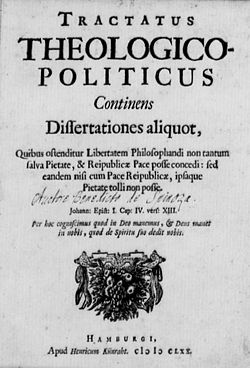
In 1665, Spinoza began writing the Theological-Political Treatise, addressing theological and political issues such as the interpretation of scripture, the origins of the state, and the bounds of political and religious authority, while arguing for a secular, democratic state.
Image source: Tractatus Theologico-Politicus
1670
% complete
Anticipating the reaction to his ideas, Spinoza published his treatise in 1670 under a false publisher and a fictitious place of publication. The work immediately caused an uproar across Europe.
1674
% complete
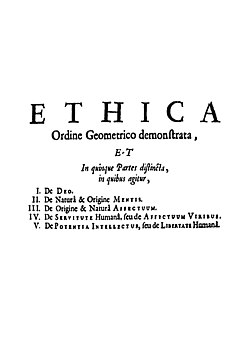
Ethica Ordine Geometrico Demonstrata (The Ethics) was finished in 1674 but published posthumously, its title added posthumously.
Image source: Ethics (Spinoza book)
1676
% complete
Tractatus Politicus was an unfinished work from 1676 concerning how states can function well, intended to show that democratic states are best.
Image source: Tractatus Theologico-Politicus
1677
% complete
Spinoza's works were published posthumously by his friends, published by Jan Rieuwertsz in Amsterdam though both publisher and place were purposely omitted, and influenced philosophers for the next two centuries.
1862
% complete
The Short Treatise on God, Man and His Well-Being, a long-forgotten text that only survived in Dutch translation, was first published by Johannes van Vloten in 1862, remaining unpublished until the 19th century.
Image source: Baruch Spinoza
1656 - 1661
% complete
From 1656 to 1661, Spinoza found lodgings elsewhere in Amsterdam and Leiden, supporting himself with teaching while learning lens grinding and constructing microscopes and telescopes. His circle of discussion partners included Van den Enden, Pieter Balling, Jarig Jelles, Lodewijk Meyer, Johannes Bouwmeester, and Adriaan Koerbagh.
1660 - 1661
% complete
Between 1660 and 1661, Spinoza moved from Amsterdam to Rijnsburg, seeking a quiet retreat in the country with access to the university town of Leiden, where he still had many friends.
Image source: Rijnsburg
1663
% complete
1669
% complete
Serrarius maintained his relationship with Spinoza until his death in 1669.
Image source: Petrus Serrarius
1670
% complete
In 1670, Spinoza moved to The Hague for easier access to intellectual life with his friends and followers.
Image source: The Hague
1675
% complete
In 1675, Albert Burgh, a friend and possibly former pupil of Spinoza, wrote to him repudiating his teachings and announcing his conversion to the Catholic Church.
Image source: Albert Burgh
1676
% complete
In 1676, Leibniz traveled to The Hague to meet Spinoza, remaining with him for three days to converse about current events and philosophy.
Image source: Gottfried Wilhelm Leibniz
Feb 21, 1677
% complete
Spinoza's health began to fail in 1676, and he died in The Hague on 21 February 1677 at age 44, attended by a physician friend, Georg Herman Schuller. Reports circulated that he repented his philosophical stances on his deathbed, but these tales petered out in the 18th century. In the 18th century, his vault was emptied and remnants scattered across the churchyard.
1661
% complete
Few of Spinoza's letters are extant, and none before 1661, making this year significant for scholars reconstructing his intellectual development.
1697
% complete
A few decades after Spinoza's death, Pierre Bayle, in his famous Historical and Critical Dictionary (1697), pointed out a link between Spinoza's alleged atheism and 'the theology of a Chinese sect', supposedly called 'Foe Kiao', which he had learned about through testimonies of Jesuit missions in Eastern Asia.
Image source: Pierre Bayle
1785
% complete
A century after Bayle, Kant also established a parallel between Spinoza's philosophy and the thinking of Laozi, grouping both under pantheists and criticizing what he described as mystical tendencies. In 1785, Friedrich Heinrich Jacobi published a condemnation of Spinoza's pantheism after Lessing was thought to have confessed on his deathbed to being a 'Spinozist', equivalent to being called an atheist. Spinoza's philosophy attracted late 18th-century Europeans as an alternative to materialism, atheism, and deism.
Image source: Immanuel Kant
1834
% complete
The poet Heinrich Heine was lavish in praise for Spinoza in On the History of Religion and Philosophy in Germany (1834).
Image source: Heinrich Heine
1837
% complete
In 1837 the German writer Berthold Auerbach dedicated to Spinoza the first novel in his series on Jewish history, translated into English in 1882 as Spinoza: A Novel. Auerbach later helped shape Spinoza's image among Jewish writers revisiting his expulsion.
Image source: Berthold Auerbach
1863
% complete
In 1863, Elijah Benamozegh purported to establish that the main source of Spinoza's ontology is Kabbalah.
Image source: Elijah Benamozegh
1879
% complete
Theodor Goldstücker was one of the early figures to notice similarities between Spinoza's religious conceptions and the Vedanta tradition of India. By 1879, Spinoza's pantheism was praised by many but considered alarming and dangerously inimical by some.
1886
% complete
In 1886, the young George Santayana published 'The Ethical Doctrine of Spinoza' in The Harvard Monthly. In 1932, he presented 'Ultimate Religion' at The Hague celebrating the tricentennial of Spinoza's birth.
Image source: George Santayana
1916
% complete
Elsewhere, Wittgenstein borrowed the expression sub specie aeternitatis from Spinoza in his Notebooks 1914–16.
Image source: Ludwig Wittgenstein
1929
% complete
In 1929, Einstein was asked in a telegram by Rabbi Herbert S. Goldstein whether he believed in God. Einstein responded: 'I believe in Spinoza's God who reveals himself in the orderly harmony of what exists, not in a God who concerns himself with the fates and actions of human beings.' He later wrote the preface to a biography of Spinoza published in 1946.
Image source: Albert Einstein
1964 - 1976
% complete
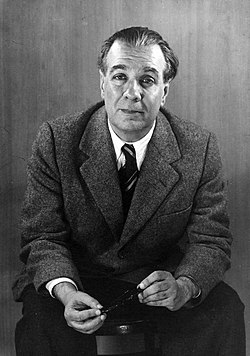
Jorge Luis Borges famously wrote two sonnets in Spinoza's honor: 'Spinoza' in El otro, el mismo (1964) and 'Baruch Spinoza' in La moneda de hierro (1976), with several direct references to his philosophy found throughout Borges's work.
Image source: Jorge Luis Borges
1968
% complete
In his 1968 doctoral thesis, Gilles Deleuze named Spinoza 'the prince of philosophers'. Antonio Negri also wrote books on Spinoza, most notably The Savage Anomaly (1981), reconfiguring Italian Autonomia Operaia.
Image source: Gilles Deleuze
2006
% complete
A conference was organized at the YIVO Institute for Jewish Research in New York entitled 'From Heretic to Hero: A Symposium on the Impact of Baruch Spinoza on the 350th Anniversary of His Excommunication, 1656–2006'.
Image source: YIVO
2008
% complete
The Spinoza Foundation Monument statue of Spinoza was created by Dutch sculptor Nicolas Dings and erected in front of the Amsterdam City Hall (at Zwanenburgwal).
Image source: Amsterdam
2014
% complete
In 2014 a copy of Spinoza's Tractatus Theologico-Politicus was presented to the Chair of the Dutch Parliament, sharing a shelf with the Bible and the Quran.
Dec 2015
% complete
The Amsterdam Jewish community organised a symposium in December 2015 to discuss lifting the cherem, inviting scholars from around the world to form an advisory committee at the meeting.
Or browse the full history timeline directory, with more than 2,000 topics.
This Baruch Spinoza timeline was generated with the help of AI, using information found on the internet.
We work hard to keep these timelines accurate, but mistakes do get through. If you spot one, email us at [email protected] and we'll fix it for future visitors.
Generate yours with AI or build it from scratch, for free.
Export your timeline, add your own events, edit or remove AI-generated events, and much more
No credit card required.
Cancel anytime.
Cancel anytime.
You can create an unlimited number of timelines with up to 10 events on each one, customize how they look, export them to PDF, PNG, PowerPoint, CSV, and Excel, and share them with a link. Paid plans raise the event limit and add features like spreadsheet imports and collaborators.
Yes. You can cancel your subscription from your account page at any time, and you will not be charged again. Your subscription stays active for the rest of the period you already paid for.
Yes. We will email you a reminder before the annual renewal, and we will also email you a receipt.
Yes. You can email us within 15 days of any payment, and we will issue you a full refund.
Check out our pricing docs or send us an email anytime: [email protected].