
-
Use Cases
-
Resources
-
Pricing
Niccolò Machiavelli (1469–1527) was an Italian diplomat, philosopher, and writer of the Renaissance, best known for his treatise 'The Prince,' which laid the foundations of modern political science. Serving Florence as a civil servant and diplomat, he was later exiled after the Medici's return to power, during which he wrote his most influential works analyzing power, statecraft, and human nature. More Less
1469
% complete
The Machiavelli family were a second-rate elite Florentine family that had originated south of Florence near Giogoli and later became substantial landowners around Sant'Andrea in Percussina, possibly descending from minor feudal nobility in the Val di Pesa.
Image source: Niccolò Machiavelli
May 3, 1469
% complete
Niccolò di Bernardo dei Machiavelli was born in Florence, Italy, the third child and first son of attorney Bernardo di Niccolò Machiavelli and his wife Bartolomea di Stefano Nelli. He would grow up to become a Florentine diplomat, author, philosopher, and historian during the Italian Renaissance.
1501
% complete
In 1501 Machiavelli married Marietta Corsini, who would bear him six children and remain a loyal companion throughout his career, exile, and final years.
Image source: Niccolò Machiavelli
1494
% complete
In 1494 Florence restored the republic, expelling the Medici family that had ruled Florence for some sixty years. This political upheaval opened the door for Machiavelli's future career in Florentine government.
Image source: Republic of Florence

1498
% complete
Machiavelli began working as secretary to the second chancery of the Republic of Florence, a post he would hold until 1512 while the Medici remained out of power.
1499
% complete
Machiavelli undertook his first diplomatic missions in 1499, traveling to the respective courts of Iacopo di Appiano in Piombino and Caterina Sforza in Forlì on behalf of Florence.
1500 - 1510
% complete
During the first decade of the 16th century, Machiavelli carried out several diplomatic missions for Florence, most notably to the papacy in Rome, gaining firsthand knowledge of Italian power politics.
1501 - 1502
% complete
Florence sent Machiavelli to Pistoia to pacify the leaders of two opposing factions which had broken into riots. When this failed, the leaders were banished from the city, a recommendation which Machiavelli had disagreed with from the outset and would later advise governments to do the opposite in similar situations.
Image source: Pistoia
Dec 31, 1502
% complete
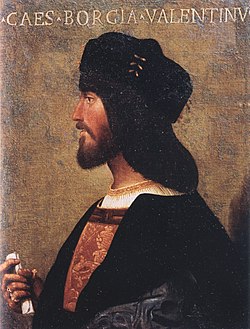
Machiavelli personally witnessed the brutal retribution Cesare Borgia inflicted on his rebellious commanders Oliverotto Euffreducci and Vitellozzo Vitelli in Sinigaglia, an event he famously chronicled in a political work, The Description.
Image source: Cesare Borgia
1503
% complete
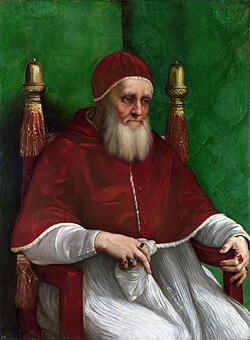
Machiavelli was dispatched to Rome to observe the papal conclave that ultimately selected Julius II as pope, a bitter rival of the Borgia family, despite Cesare Borgia's support for his election.
Image source: Pope Julius II
Aug 29, 1512
% complete
In August 1512 the Medici, backed by Pope Julius II, used Spanish troops to defeat the Florentines at Prato, toppling the republic that Machiavelli had served.
Image source: Prato
Nov 7, 1512
% complete
With the Medici retaking power in Florence in 1512, Machiavelli was expelled from his duties as a diplomat, soon mistakenly suspected of treason, imprisoned, tortured, and sent into exile at his estate at Sant'Andrea in Percussina.
1500 - 1506
% complete
At the start of the 16th century, Machiavelli conceived of a native militia for Florence rather than reliance on mercenaries, and he began recruiting and creating this force of armed citizens.
Feb 1, 1506
% complete
By February 1506 Machiavelli was able to have four hundred farmers marching on parade, equipped including iron breastplates and armed with lances and small firearms, a visible triumph of his militia project.
Image source: Florentine military reforms
1509
% complete
Under Machiavelli's direction, the Florentine citizen-soldiers he had created conquered Pisa in 1509, vindicating his belief in native troops over mercenaries.
Image source: Maritime republics
1502
% complete
Machiavelli wrote the Discorso sopra la provisione del danaro, a discourse about the provision of money for the Florentine state, reflecting his growing engagement with economic policy.
1506
% complete
Machiavelli composed the Decennale primo, a poem in terza rima chronicling the political affairs of Italy during the first decade of the century.
1508 - 1512
% complete
Between 1508 and 1512 Machiavelli wrote the Ritratto delle cose della Magna, a portrait of the affairs of Germany drawing on his diplomatic observations.
1509
% complete
Machiavelli completed the Decennale secondo, a second poem continuing his verse chronicle of contemporary Italian politics.
1510
% complete
In 1510 Machiavelli produced the Ritratti delle cose di Francia, a portrait of the affairs of France based on his diplomatic experience at the French court.
Jul 1, 1513 - 1515
% complete
Following his dismissal, Machiavelli began composing his most famous work, The Prince. Scholar William Connell views its composition and development as a lengthy process, with his ideas being revised from 1513 to 1515. It was originally titled De Principatibus ('Of Principalities'), with the title Il Principe appearing only after publication in 1532.
Image source: The Prince
1514
% complete
Machiavelli wrote Della Lingua ('On the Language'), a dialogue about Italy's language which is normally attributed to him.
Image source: Sardinian language
1515
% complete
Machiavelli composed Belfagor arcidiavolo, a novella about an archdevil who comes to earth to investigate marriage, showcasing his comic literary talents.
1515 - 1517
% complete
Though scholars debate the timing, it is often said Machiavelli composed the Discourses on Livy between 1515 and 1517. The work has been said to have paved the way for modern republicanism, using both Livy's classical history and contemporary political examples.
Image source: Discourses on Livy
1516
% complete
From 1516 Machiavelli frequented the Orti Oricellari gardens, where humanists discussed anti-tyrannical themes. There he gained friendships with Bernardo Rucellai and Zanobi Buondelmonti, men whom he would dedicate his Discorsi to.
1517
% complete
Machiavelli wrote Andria or The Girl from Andros, a semi-autobiographical comedy adapted from Terence.
Image source: Andria (comedy)
1517
% complete
Machiavelli wrote Asino d'oro (The Golden Ass), a terza rima poem offering a new version of the classic work by Apuleius.
1518
% complete
Machiavelli wrote Mandragola (The Mandrake), a five-act prose comedy with a verse prologue that became one of the great comedies of the Italian Renaissance.
Image source: Mandrake
1519 - 1520
% complete
Machiavelli composed Dell'Arte della Guerra (The Art of War), a treatise on high military science reflecting his lifelong interest in military organization and his militia reforms.
Image source: The Art of War (Machiavelli book)
1520
% complete
Machiavelli wrote the Discorso sopra il riformare lo stato di Firenze, a discourse proposing reforms for the government of Florence, likely connected to his renewed ties with the Medici.
1520
% complete
Machiavelli produced the Sommario delle cose della citta di Lucca, a summary of the political affairs of the city of Lucca.
1520
% complete
Machiavelli wrote the Vita di Castruccio Castracani da Lucca, a short, partially fictional biography of Castruccio Castracani, the ruler of Lucca, blending history with moral-political lessons.
1520 - 1525
% complete
Machiavelli wrote the Istorie Fiorentine (Florentine Histories), an eight-volume history of the city-state of Florence commissioned by Giulio de' Medici, later Pope Clement VII.
1525
% complete
Machiavelli wrote Clizia, a prose comedy adapted from Plautus's Casina, further demonstrating his skill as a playwright.
1525
% complete
In 1525 Machiavelli produced the Frammenti storici, fragments of stories representing some of his final historical writings.
1520
% complete
In 1520 Machiavelli won back the favor of the Medici family, and Giulio Cardinal de' Medici commissioned him to write a history of the city of Florence, partially rehabilitating his standing.
Image source: Pope Clement VII
Jun 21, 1527
% complete
After the 1527 Sack of Rome, the Medici were thrown out of Florence once more and citizens set up a republican form of government. Machiavelli died on 21 June 1527 from a stomach disease he had been suffering from since 1525.
Or browse the full history timeline directory, with more than 2,000 topics.
This Niccolo Machiavelli timeline was generated with the help of AI, using information found on the internet.
We work hard to keep these timelines accurate, but mistakes do get through. If you spot one, email us at [email protected] and we'll fix it for future visitors.
Generate yours with AI or build it from scratch, for free.
Export your timeline, add your own events, edit or remove AI-generated events, and much more
No credit card required.
Cancel anytime.
Cancel anytime.
You can create an unlimited number of timelines with up to 10 events on each one, customize how they look, export them to PDF, PNG, PowerPoint, CSV, and Excel, and share them with a link. Paid plans raise the event limit and add features like spreadsheet imports and collaborators.
Yes. You can cancel your subscription from your account page at any time, and you will not be charged again. Your subscription stays active for the rest of the period you already paid for.
Yes. We will email you a reminder before the annual renewal, and we will also email you a receipt.
Yes. You can email us within 15 days of any payment, and we will issue you a full refund.
Check out our pricing docs or send us an email anytime: [email protected].