
-
Resources
-
Pricing
Blackfoot History examines the enduring story of the Siksikaitsitapi, including their societies, homelands, relationships with bison, encounters with colonial powers, treaties, and continuing cultural revitalization. More Less
Build a timeline like this one in minutes, for free. Start Yours →
1700 - 1750
The Blackfoot adopted horses from other Plains peoples, probably by the early eighteenth century. Horses expanded their range and mobility and improved their effectiveness in hunting.
Image source: Blackfoot Confederacy
1700 - 1750
The Sarcee, an offshoot of the Beaver people, migrated south onto the Plains sometime in the early eighteenth century.
1725 - 1750
In the first half of the eighteenth century, the Blackfoot acquired horses and firearms through white traders and Cree and Assiniboine intermediaries.
1730
By about 1730, the Blackfoot and neighboring groups had adapted to using horses, making an adequate supply of animals important to survival and competition on the Plains.
1833
German explorer Prince Maximilian of Wied-Neuwied and Swiss painter Karl Bodmer spent months with the Niitsitapi in 1833 documenting their culture.
1850
By 1850, buffalo herds were found almost exclusively on Blackfoot territory, intensifying competition over access to the animals.
Image source: American bison
1754
Hudson's Bay Company explorer Anthony Henday met a large Blackfoot group in what is now Alberta in 1754.
Image source: Anthony Henday
1787
David Thompson reported that in 1787 Blackfoot territory extended from the North Saskatchewan River south to the Missouri River, and from the Rocky Mountains eastward about 300 miles.
1787
David Thompson reported that the Blackfoot had conquered most of the Shoshone territory by 1787 and had forcibly assimilated some captured Shoshone women and children.
1793 - 1861
The Gros Ventre were allied with the Blackfoot Confederacy from about 1793 to 1861, before disagreements turned the former allies into enemies.
1793
In retaliation for Hudson's Bay Company weapons supplies to their enemies, the Gros Ventre attacked and burned South Branch House near present-day St. Louis, Saskatchewan.
1800 - 1850
After driving the Shoshone and Arapaho from the Northwestern Plains, the Niitsitapi entered a long period of intense competition with their former Cree allies in the fur trade, often involving military conflict.
1800 - 1806
Before encountering the Lewis and Clark Expedition, the Blackfoot had established dealings with traders connected to the Canadian and English fur trade.
1809
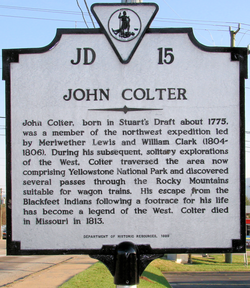
In 1809, John Colter and a companion were trapping by canoe on the Jefferson River when hundreds of Blackfoot warriors on horseback surrounded them on both banks.
Image source: John Colter
1822
The American Fur Company entered the Upper Missouri region from the south in 1822 without permission from the Niitsitapi, creating tensions and conflict.
Image source: American Fur Company
1830
Tensions between the Niitsitapi and the American Fur Company continued until peaceful trade was established in 1830.
1831
Fort Piegan opened in 1831 as the first American trading post in Niitsitapi territory.
1832
The Hudson's Bay Company responded to American trading posts by building Bow Fort, also called Peigan Post, on the Bow River in 1832, though it was unsuccessful.
1833
Fort MacKenzie joined Fort Piegan in 1833 as an American trading post serving the fur trade in Niitsitapi territory.
1837
In 1837, passengers on the American Fur Company steamboat St. Peter's contracted smallpox while traveling toward Fort Union, contributing to a devastating epidemic among the Blackfoot.
1850 - 1870
During the Buffalo Wars, Nehiyaw-Pwat bands increasingly entered Niitsitapi territory in search of bison. The Piegan gave way near the Missouri River, the Kainai withdrew toward the Bow and Belly rivers, and the Siksika retained lands along the Red Deer River.
1867
Events leading to the Marias Massacre were catalyzed in 1867 when Owl Child, a young Piegan warrior, stole a herd of horses from American trader Malcolm Clarke.
1869
In 1869, Owl Child and associates killed Malcolm Clarke at his ranch after dinner and severely wounded his son Horace, escalating conflict between the Blackfoot and American settlers.
1870
In 1870, various Nehiyaw-Pwat bands began a final effort to seize buffalo from the Blackfoot, beginning another war over access to the herds.
1870
Around 1870, the alliance between the Blackfoot and Gros Ventre ended. The Gros Ventre then sought protection from their former enemies, the Southern Assiniboine.
Jan 23, 1870
On January 23, 1870, U.S. Army cavalry attacked a Piegan camp that scouts had mistakenly identified as hostile. The Marias Massacre nearly destroyed a friendly Blackfoot band.
1851
In the United States, the Blackfoot were restricted to land assigned under the Fort Laramie Treaty of 1851.
Image source: Treaty of Fort Laramie (1851)
1855
Blackfoot chief Lame Bull made a peace treaty with the United States government in 1855.
1860
By 1860, very few buffalo remained, leaving the Niitsitapi completely dependent on government supplies.
1877
In 1877, the Canadian Niitsitapi signed Treaty 7 and settled on reserves in southern Alberta.
1881
The near extirpation of the bison by 1881 forced the Niitsitapi to adapt their traditional hunting-based way of life to the encroachment of European settlers and their descendants.
1883 - 1884
The winter of 1883–1884 became known as Starvation Winter because government supplies failed to arrive after the buffalo had disappeared.
1887
Nearly three decades after the Fort Laramie Treaty, the Sweetgrass Hills Treaty of 1887 gave the U.S. Blackfoot a distinct reservation.
Image source: Blackfeet Nation
1890 - 1934
The Sun Dance was illegal from the 1890s through 1934 as part of efforts to assimilate Native Americans into European-American society.
Image source: Sun Dance
1896
In 1896, the Blackfoot sold a large portion of their land to the United States government, which hoped to find gold or copper deposits.
1898
In 1898, the U.S. government dismantled tribal governments and outlawed traditional Indian religions as part of an assimilation policy.
1907
In 1907, the United States adopted allotment of reservation land to individual heads of families, intending to promote family farming and break up communal tribal lands.
Image source: Dawes Act
1910
In 1910, land connected to the former Blackfoot territory was set aside as Glacier National Park.
Image source: Glacier National Park (U.S.)
1919
A drought in 1919 destroyed crops and increased the cost of beef, worsening economic hardship for Blackfoot communities.
1934
The Indian Reorganization Act of 1934 ended allotments and allowed tribes to choose their own governments.
1900 - 1930
In the early twentieth century, white ethnomusicologist Frances Densmore helped the Blackfoot record their language.
1932
Hergé's 1932 work Tintin in America featured Blackfoot people, bringing a fictionalized representation of them into popular culture.
Image source: Tintin in America
1934
After the prohibition ended in 1934, the Blackfoot resumed practicing the Sun Dance every summer, restoring an important traditional religious ceremony.
1935
In 1935, the Blackfeet Nation of Montana began a Tribal Business Council under the new federal policy supporting tribal self-government.
1972 - 1990
The Blackfoot Writing Company, a pen and pencil factory, opened in 1972 and operated until it closed in the late 1990s.
1974
Blackfoot Community College, a tribal college in Browning, Montana, opened in 1974.
1979
Beginning in 1979, Montana required public school teachers on or near the reservation to have a background in American Indian studies.
1986
The Kainai Nation opened Red Crow Community College in Stand Off, Alberta, in 1986.
1989
In 1989, the Siksika tribe in Canada completed construction of a high school alongside its elementary school.
1994
In 1994, the Blackfoot Council accepted Pikuni as the official language.
2013
The 2013 Franco-American film Jimmy P. explores the psychoanalysis of Jimmy Picard, a Blackfoot veteran treated after World War II by ethnologist and psychoanalyst George Devereux.
Build a timeline like this one in minutes, for free. Start Yours →
Or browse the full history timeline directory, with more than 2,500 topics.
This Blackfoot History timeline was generated with the help of AI, using information found on the internet.
We work hard to keep these timelines accurate, but mistakes do get through. If you spot one, email us at [email protected] and we'll fix it for future visitors.
Generate yours with AI or build it from scratch, for free.
Export your timeline, add your own events, edit or remove AI-generated events, and much more
No credit card required.
15-day money-back guarantee.
You can create an unlimited number of timelines with up to 10 events on each one, customize how they look, export them to PDF, PNG, PowerPoint, CSV, and Excel, and share them with a link. Timelines made with Timeline Maker AI keep every event the generator created, and you can add up to 5 events of your own. Paid plans remove the event limit, add spreadsheet imports and hide Preceden's branding, and the higher-priced plan also adds collaborators, a custom logo and a custom domain.
Yes. You can cancel your subscription from your account page at any time, and you will not be charged again. Your subscription stays active for the rest of the period you already paid for.
Yes. We email you a reminder 15 days before your annual renewal, and we email you a receipt after every payment.
Yes. You can email us within 15 days of any payment, and we will issue you a full refund.
Check out our pricing docs or send us an email anytime: [email protected].