-
Use Cases
-
Resources
-
Pricing
1700
Members of the Sahaptin language group, the Nimíipuu were the dominant people of the Columbia Plateau for much of the documented period.
1700 - 1799
After acquiring horses in the 18th century, the Nimíipuu developed breeding practices that led to the Appaloosa horse.
1790 - 1799
French Canadian fur traders who regularly visited the region in the late 18th century used the exonym Nez Percé, meaning “pierced nose.” The designation was inaccurate because nose piercing was not practiced by the tribe.
1800
In 1800, the Nez Perce had more than 70 permanent villages. Villages generally ranged from 30 to 200 people depending on the season and social grouping.
1804 - 1806
At the time of the Lewis and Clark Expedition, Nez Perce territory covered approximately 17 million acres across parts of present-day Washington, Oregon, Montana, and Idaho, surrounding the Snake, Grande Ronde, Salmon, and Clearwater rivers.
1805
By 1805, many Cayuse people west of the Nez Perce had abandoned their mother tongue and adopted Weyíiletpuu, a variety of the Lower Nez Perce or Lower Nimiipuutímt dialect.
1805
In 1805, the Nez Perce were the largest tribe on the Columbia River Plateau, with a population of about 6,000.
1800 - 1900
Reservation life and assimilationist pressure imposed by Americans and the government contributed to the destruction of Nez Perce horse culture during the 19th century.
1881
In A Century of Dishonor, Helen Hunt Jackson described the Nez Perce as among the richest, noblest, gentlest, and most industrious of Indigenous peoples.
Image source: Helen Hunt Jackson
1887
The Dawes Act brought individual land allotments to the Nez Perce and contributed to the loss and fragmentation of reservation lands.
Image source: Dawes Act
1889
Anthropologist Alice Fletcher, whom the U.S. government sent to Idaho to allot the Nez Perce Reservation, explained the mistaken naming of the people and recorded recollections of the Lewis and Clark encounter.
Nov 18, 1895
The U.S. government opened the Nez Perce reservation for general settlement, allowing non-Natives to acquire surplus lands after households received allotments.
1900
By the beginning of the 20th century, the Nez Perce population had declined to about 1,800 because of epidemics, conflicts with non-Indians, and other factors.
1957
Construction of The Dalles Dam flooded Celilo Falls, or Silayloo, a favored Columbia River location for salmon fishing.
1970
Since the late 20th century, the Nez Perce have most often identified themselves as Nimíipuu in the Sahaptin language.
1988 - 2000
The reservation has a total area of about 1,195 square miles. Its population was 17,959 in the 2000 census, while the population on the reservation was reported as nearly 90 percent white in 1988 because of tribal land loss.
1991
The Wallowa Homeland initiative began in 1991 to welcome the Nez Perce back to the Wallowa Valley.
1994
The Nez Perce began a breeding program crossing the Appaloosa with the Central Asian Akhal-Teke to produce the Nez Perce Horse.
1994 - 2021
The 20th-century breeding program was financed by the U.S. Department of Health and Human Services, the Nez Perce Tribe, and the First Nations Development Institute.
2000
The Homeland acquired 320 acres and a visitor center in 2000 to enrich relationships among Indigenous descendants and contemporary inhabitants of the Wallowa Valley and to preserve Indigenous customs and culture.
2004
The Triassic gastropod Cryptaulax nezperceorum, found on Nez Perce tribal land, was named in honor of the Nez Perce.
2021
In 2021, the United Methodist Church returned a small parcel of land and a church building in Wallowa to the Nez Perce Tribe.
2021
The tribe reported more than 3,500 members in 2021.
1805
William Clark was the first known Euro-American to meet members of the Nez Perce, excluding the French Canadian traders who had previously visited the area.
Image source: Lewis and Clark Expedition
1805
Twisted Hair, a Nez Perce leader and father of Chief Lawyer, welcomed and befriended the exhausted Lewis and Clark Expedition in September 1805.
1805
The interpreters Sacagawea and Toussaint Charbonneau mistakenly identified the people encountered by the expedition as the Nez Perce.
Sep 1805
The Nez Perce welcomed and assisted the exhausted Lewis and Clark party. Alice Fletcher later wrote that the people were kind to the tired and hungry explorers, whom many had never seen before.
Sep 20, 1805
Near the western end of the Lolo Trail, William Clark found a small Nez Perce camp at the edge of a camas-digging ground, now called Weippe Prairie.
1855
The Nez Perce participated in the Walla Walla Council alongside the Cayuse, Umatilla, Walla Walla, and Yakama, and signed the Treaty of Walla Walla.
1855 - 1875
Eagle from the Light, chief of the non-treaty Lam'tama band, supported the non-treaty faction, refused to sign the treaties of 1855 and 1866, and moved part of his band away from the Salmon River in 1875.
1863 - 1877
Chief Lawyer, son of Twisted Hair, became a prominent leader of the treaty faction and defended the controversial 1863 treaty, believing resistance to U.S. power was futile.
1863
A treaty in 1863 cut the Nez Perce off from most of their horticultural sites throughout the Camas Prairie and removed nearly 90 percent of their lands. Nimíipuu later called it the “Thief Treaty” or “Steal Treaty.”
1870 - 1877
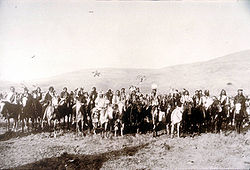
Under pressure from European Americans, the Nez Perce split between those who accepted coerced relocation to a reservation and those who refused to surrender fertile lands in Washington and Oregon.
Image source: Nez Perce War
1877
Nez Perce people willing to move to a reservation made a treaty in 1877, deepening the division with non-treaty bands.
1877
Eelekt, leader of the non-treaty Alpowai band and a war leader whose following did not exceed 40 men, was killed during the tribe’s final battle with the U.S. Army.
1877
Chief Joseph, also known as Young Joseph or Hinmatóoyalahtq'it, led the Wallowa band and became the best-known leader of the non-treaty Nez Perce during their struggle to retain their identity.
Jun 15, 1877
Chief Joseph, Looking Glass, White Bird, Ollokot, Lean Elk, and Toohoolhoolzote led about 750 men, women, and children in an attempt to reach a peaceful sanctuary.
Oct 4, 1877
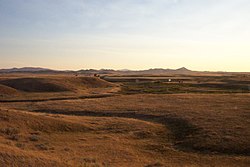
Ollokot, Chief Joseph’s younger brother and war chief of the Wallowa band, was killed while fighting at the final battle on Snake Creek near the Bear Paw Mountains.
Image source: Battle of Bear Paw
Oct 5, 1877
A majority of the surviving non-treaty Nez Perce were forced to surrender after the Battle of the Bear Paw Mountains in Montana, about 40 miles from the Canada–United States border.
Jan 1879
Chief Joseph traveled to Washington, D.C., to meet with the president and Congress. His account of the Nez Perce struggle was subsequently published in the North American Review.
Or browse the full history timeline directory, with more than 2,500 topics.
This Nez Perce History timeline was generated with the help of AI, using information found on the internet.
We work hard to keep these timelines accurate, but mistakes do get through. If you spot one, email us at [email protected] and we'll fix it for future visitors.
Generate yours with AI or build it from scratch, for free.
Export your timeline, add your own events, edit or remove AI-generated events, and much more
No credit card required.
Cancel anytime.
Cancel anytime.
You can create an unlimited number of timelines with up to 10 events on each one, customize how they look, export them to PDF, PNG, PowerPoint, CSV, and Excel, and share them with a link. Paid plans raise the event limit and add features like spreadsheet imports and collaborators.
Yes. You can cancel your subscription from your account page at any time, and you will not be charged again. Your subscription stays active for the rest of the period you already paid for.
Yes. We will email you a reminder before the annual renewal, and we will also email you a receipt.
Yes. You can email us within 15 days of any payment, and we will issue you a full refund.
Check out our pricing docs or send us an email anytime: [email protected].