-
Use Cases
-
Resources
-
Pricing
1000 CE
By about 1000 CE, hunting and gathering groups in the Great Basin spoke languages belonging to the Uto-Aztecan family, providing important cultural and linguistic context for the later Ute people.
1300 CE
By 1300, ancestral Utes lived in southwestern Colorado and southeastern Utah, maintaining a hunter-gatherer lifestyle in the Four Corners region.
1500 CE
The Utes had settled in the Four Corners region by 1500 CE, establishing the broad homeland associated with their later history.
1500 CE
Archaeological evidence indicates that Utes made pottery as early as the 16th century.
1500 CE
Utes produced beadwork over centuries, making it a longstanding element of Ute material culture and artistic practice.
1650 CE
By the mid-17th century, hunting and gathering groups of extended families were led by older members, reflecting the social organization of Ute communities.
1675 CE
By the late 17th century, the Utes had already acquired horses from neighboring tribes, enabling greater mobility and changes in hunting and trade.
1680 CE
The Utes' lifestyle changed substantially with the acquisition of horses on a larger scale by about 1680.
1700 CE
The eastern Utes developed many traits associated with Plains Indians and lived in tepees after the 17th century.
1700 CE
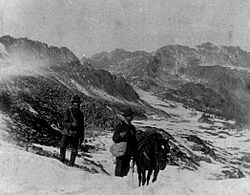
By the 18th century, Ute bands came together for tribal activities, connecting otherwise distinct local communities.
Image source: Ute people
1637 CE
In 1637, the Spanish fought with the Utes, capturing and enslaving 80 Utes.
1700 CE
During the 18th century, Utes traded with other tribes involved in the deerskin and fur trade with Spanish New Mexico.
1700 CE
The Utes' first contact with Europeans occurred with the Spanish in the 18th century.
1750 CE
Although the Spanish seriously guarded trade with the Utes and limited it to annual caravans, by 1750 Spanish authorities relied on the trade, especially because Ute deerskins were highly sought after.
1765 CE
The Utes had direct trade with the Spanish by at least 1765, and possibly earlier.
1776 CE
The Spanish Domínguez–Escalante expedition traveled through the region in 1776 and saw the prehistoric and Ute cultural landscape, including sites such as Cañon Pintado.
Image source: Domínguez–Escalante expedition
1800 CE
By the early 19th century, Utes traded with Europeans at encampments in the San Luis Valley, Wet Mountains, Upper Arkansas Valley, and the annual Rocky Mountain Rendezvous.
1800 CE
In the 19th century, the Arapaho and Cheyenne invaded southward into eastern Colorado, intensifying regional competition and conflict.
1840 CE
By about 1840, the Pawnee, Osage, and Navajo had also become enemies of Plains Indians, contributing to the wider conflicts affecting the Utes.
1847 CE
Sustained contact with Euro-Americans began in 1847 when Mormons arrived in the American West. In Utah, Mormon settlement began to affect Ute communities and their homelands.
Dec 30, 1849
Quixiachigiate and 27 other Capote and Mouache Ute chiefs signed the Peace Treaty of Abiquiú at Abiquiú, New Mexico, with new U.S. Indian Commissioner James S. Calhoun.
1853 CE - 1854 CE
Continued Mormon pressure on Utah Ute homelands escalated into the Walker War of 1853–54.
1858 CE
A gold strike in 1858 began a rush of Euro-American settlers and prospectors into Ute country.
Image source: Pike's Peak gold rush
Oct 3, 1861
President Abraham Lincoln signed an executive order reserving the Uinta River Valley in the Territory of Utah for American Indians.
Oct 7, 1863
Leaders of the Tabeguache Utes signed the Tabeguache Treaty at the Tabaquache Agency at Conejos in the San Luis Valley.
May 5, 1864
President Lincoln signed an act directing the removal of all Indians in Utah Territory to the Uinta Valley Reservation, unilaterally imposing a major relocation on Utah's Native peoples.
1865 CE - 1872 CE
The Black Hawk War occurred in Utah from 1865 to 1872 as Utes and their allies resisted expanding settlement and the loss of their lands. Black Hawk, son of Chief San-Pitch, was a noted war leader.
Feb 23, 1865
President Lincoln signed an act extinguishing Indian title to lands in Utah Territory outside the Uinta Valley Reservation that were considered suitable for agriculture and mineral development.
1868 CE
In 1868, the U.S. federal government established a reservation in Colorado; that year, reports counted 5,000 Utes living on the Colorado reservation.
Mar 2, 1868
Leaders of the seven Ute bands signed the Ute Treaty of 1868 in Washington, D.C. The treaty removed the Utes to the Consolidated Ute Reservation in western Colorado and the Uinta Valley Reservation in Utah Territory.
Sep 13, 1873
Leaders of the seven Ute bands signed the Brunot Treaty in Washington, D.C. The Utes relinquished land in the San Juan Mountains sought by miners.
Nov 9, 1878
Leaders of the Capote, Mouache, and Weeminuche Utes signed an agreement at Pagosa Springs, Colorado, establishing the Southern Ute Indian Reservation and relinquishing all other land in Colorado.
1879 CE
After the 1873 cession of the gold-rich San Juan area, the Utes lost most of their remaining land in 1879 following the Meeker Massacre.
Mar 6, 1880
Leaders of the seven Ute bands signed the Ute Agreement of 1880 in Washington, D.C. It called for the Tabeguache to move to Colorado's Grand Valley and the Parianuche and Yamparica to move to the Uintah Reservation in Utah Territory.
Jan 5, 1882
President Chester A. Arthur signed an executive order removing the Tabeguache Utes to the new Uncompahgre Indian Reservation in Utah Territory.
Jul 28, 1882
President Arthur signed an act expropriating lands in Colorado lately occupied by the Uncompahgre and White River Ute Indians, including lands of the Parianuche, Tabeguache, and Yamparica.
1846 CE - 1868 CE
Estimates placed the Ute population at 6,000 in New Mexico in 1846, 6,000 in 1854, 7,000 in Colorado in 1866, and 13,050 in Utah in 1867, for roughly 26,050 Utes in the mid-19th century.
1890 CE - 1910 CE
The 1890 census counted 2,839 Utes, including 1,854 in Utah and 985 in Colorado. Indian Affairs reported 2,694 in 1900, and about 2,658 in 1910, including Utes in Utah, Colorado, and South Dakota.
1897 CE
The Ute Mountain Utes are descendants of the Weeminuche band, which moved to the western end of the Southern Ute Reservation in 1897.
1920 CE
The Ute population fell sharply after relocation to reservations. From about 8,000 Utes in the early 19th century, only about 1,800 tribal members remained in 1920.
1934 CE
Utes have exercised self-government since the Indian Reorganization Act of 1934.
Image source: Indian Reorganization Act
Jun 6, 1940
The Weeminuche Utes separated from the Southern Ute Indian Reservation and became the Ute Mountain Tribe of the Ute Mountain Reservation.
1950 CE
Although relocation to reservations caused a significant population reduction, the Ute population began to increase in the mid-20th century.
1954 CE
Under the 1954 Ute Partition and Termination Act, members of the Ute Indian Tribe classified as mixed-blood were separated from the federally recognized tribal structure.
1975 CE
Since the Indian Self-Determination and Education Assistance Act of 1975, Utes have controlled police, courts, credit management, and schools.
1990 CE
By 1990, there were about 7,800 Utes, including approximately 2,800 living in cities and towns and 5,000 living on reservations.
2000 CE
The age expectancy in the Ute community was reported as 40 years in 2000.
2016 CE
Public land surrounding the Bears Ears buttes in southeastern Utah became Bears Ears National Monument in 2016, recognizing its ancestral and cultural significance to several Native American tribes, including the Utes.
2020 CE
The Ute population continued to increase in the 20th and 21st centuries. The 2020 census counted 15,119 people who identified as Ute.
Or browse the full history timeline directory, with more than 2,500 topics.
This Ute History timeline was generated with the help of AI, using information found on the internet.
We work hard to keep these timelines accurate, but mistakes do get through. If you spot one, email us at [email protected] and we'll fix it for future visitors.
Generate yours with AI or build it from scratch, for free.
Export your timeline, add your own events, edit or remove AI-generated events, and much more
No credit card required.
Cancel anytime.
Cancel anytime.
You can create an unlimited number of timelines with up to 10 events on each one, customize how they look, export them to PDF, PNG, PowerPoint, CSV, and Excel, and share them with a link. Paid plans raise the event limit and add features like spreadsheet imports and collaborators.
Yes. You can cancel your subscription from your account page at any time, and you will not be charged again. Your subscription stays active for the rest of the period you already paid for.
Yes. We will email you a reminder before the annual renewal, and we will also email you a receipt.
Yes. You can email us within 15 days of any payment, and we will issue you a full refund.
Check out our pricing docs or send us an email anytime: [email protected].