-
Use Cases
-
Resources
-
Pricing
The Boer War, also known as the Second Anglo-Boer War (1899–1902), was fought between the British Empire and the two independent Boer republics—the Orange Free State and the South African Republic (Transvaal). The conflict arose from British imperial ambitions and control over gold-rich territories. It featured guerrilla warfare, concentration camps, and ended with British victory and the annexation of the Boer republics into the Union of South Africa. More Less
1806
% complete
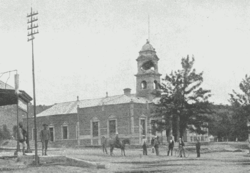
Britain seized the Dutch Cape Colony during the Napoleonic Wars and formally acquired it in 1814. British rule brought English-language administration, Anglicization policies, and eventually the abolition of slavery, all of which alienated the Boer settlers of Dutch descent.
Image source: Cape Colony
1835
% complete
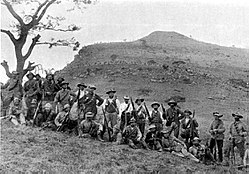
Discontented with British rule, thousands of Boer farmers known as Voortrekkers left the Cape Colony in ox-wagon trains, moving north and east into the interior of southern Africa to establish independent republics beyond British control.
Image source: Great Trek
Dec 16, 1838
% complete
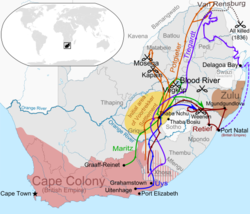
Voortrekker commandos under Andries Pretorius defeated a large Zulu force at the Ncome River, a victory that became central to Afrikaner identity and secured Boer expansion into Natal and the interior.
Image source: Battle of Blood River
1852
% complete
By the Sand River Convention, Britain recognized the independence of the Boers north of the Vaal River, allowing them to found the South African Republic, commonly known as the Transvaal.
Image source: South African Republic
1854
% complete
Under the Bloemfontein Convention, Britain abandoned its sovereignty over the Orange River territory, permitting the Boers to create the independent Orange Free State between the Orange and Vaal rivers.
Image source: Orange Free State
1867
% complete
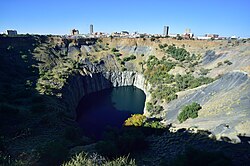
The discovery of rich diamond deposits near the confluence of the Orange and Vaal rivers transformed the region's economy, drew massive British investment and immigration, and heightened imperial interest in the Boer republics.
Image source: Kimberley, Northern Cape
Jan 11, 1879 - Sep 4, 1879
% complete
Britain invaded Zululand, defeating the Zulu kingdom after early setbacks such as Isandlwana. The destruction of Zulu military power removed a major obstacle to colonial expansion but also emboldened Boer resistance to British rule.
Image source: Anglo-Zulu War
1886
% complete
The discovery of the world's largest gold deposits near Johannesburg triggered an enormous influx of foreign miners, mostly British, known as uitlanders, whose political exclusion became a major source of tension with Paul Kruger's government.
Image source: Witwatersrand Gold Rush
Apr 12, 1877
% complete
Citing the Transvaal's financial troubles and fears of Zulu conflict, Britain annexed the South African Republic under Theophilus Shepstone. The move was deeply resented by the Boers, who repeatedly petitioned for restoration of their independence.
Image source: First Boer War
Dec 16, 1880
% complete
Frustrated by years of petitions ignored by London, Transvaal Boers declared the restoration of their republic at Paardekraal and attacked British garrisons, beginning the First Boer War.
Dec 20, 1880
% complete
A Boer commando ambushed and destroyed a British column marching to reinforce Pretoria, killing or wounding most of its officers and men in one of the first engagements of the war.
Image source: Battle of Bronkhorstspruit
Dec 23, 1880 - Mar 1881
% complete
Boer forces surrounded the British garrison in Pretoria, besieging it for months while other garrisons across the Transvaal were similarly isolated, demonstrating the weakness of British control.
Jan 28, 1881
% complete
General George Colley's Natal Field Force assaulted entrenched Boer positions on the Drakensberg pass and was repulsed with heavy casualties, including many of the 58th Regiment.
Image source: Battle of Laing's Nek
Feb 8, 1881
% complete
Colley's force fought an inconclusive engagement with Boer commandos near the Ingogo River while escorting a convoy; British losses were severe and the force narrowly escaped encirclement.
Image source: Battle of Schuinshoogte
Feb 27, 1881
% complete
Boer marksmen stormed Majuba Hill and routed General Colley's troops, killing Colley himself. The humiliating defeat shocked Britain and effectively decided the outcome of the First Boer War.
Image source: Battle of Majuba Hill
Aug 3, 1881
% complete
Britain signed a convention granting the South African Republic self-government under British suzerainty, ending the First Boer War without full recognition of complete independence.
Image source: Pretoria Convention
Feb 27, 1884
% complete
A revised agreement reduced British suzerainty over the Transvaal, though retaining control over its foreign relations. The Boers interpreted it as restoring near-full independence, sowing later disputes.
Image source: London Convention (1884)
Dec 29, 1895 - Jan 2, 1896
% complete
Leander Starr Jameson led a failed raid from Bechuanaland into the Transvaal to spark an uitlander uprising against Kruger. Its collapse embarrassed Cecil Rhodes, deepened Boer distrust of Britain, and pushed both sides toward war.
Image source: Jameson Raid
1898
% complete
Paul Kruger won re-election as president of the South African Republic, continuing his firm resistance to uitlander demands and British pressure, hardening the diplomatic standoff.
Image source: Paul Kruger
May 31, 1899 - Jun 5, 1899
% complete
Alfred Milner and Paul Kruger met to negotiate uitlander franchise rights but talks collapsed due to irreconcilable positions, making war increasingly likely.
Image source: Bloemfontein Conference
Oct 9, 1899
% complete
Facing British troop buildups on its borders, the Transvaal demanded that Britain withdraw its forces within 48 hours or face war. Britain rejected the ultimatum, and the Orange Free State joined the Transvaal in declaring war.
Image source: Second Boer War
Oct 14, 1899
% complete
Boer forces invaded Natal and the Cape frontier, besieging the key towns of Ladysmith, Mafeking, and Kimberley, trapping large British garrisons and dominating the war's opening phase.
Image source: Siege of Ladysmith
Dec 10, 1899 - Dec 17, 1899
% complete
In a disastrous 'Black Week,' British forces suffered three consecutive defeats: at Stormberg, Magersfontein where the Highland Brigade was shattered, and Colenso where General Buller's assault failed, prompting his replacement by Lord Roberts.
1900 - 1902
% complete
To deny guerrillas support, Kitchener burned Boer farms and herded civilians, mostly women and children, into concentration camps where poor conditions caused tens of thousands of deaths, provoking international outrage.
Image source: Second Boer War concentration camps
Jan 23, 1900 - Jan 24, 1900
% complete
British forces seized Spion Kop by night only to be pinned down by Boer artillery and rifle fire from surrounding hills; after horrific casualties they withdrew, another costly setback in the campaign to relieve Ladysmith.
Image source: Battle of Spion Kop
Feb 15, 1900 - Mar 13, 1900
% complete
Lord Roberts launched a major offensive: French's cavalry relieved Kimberley, Piet Cronjé surrendered with 4,000 men at Paardeberg, and Roberts entered Bloemfontein, capital of the Orange Free State, in March.
Image source: Great Trek
Feb 28, 1900
% complete
After months of siege marked by disease and shelling, Buller's forces finally broke through Boer lines and relieved Ladysmith, boosting British morale after earlier defeats.
May 17, 1900
% complete
Colonel Robert Baden-Powell's 217-day defense of Mafeking ended when a flying column broke the siege, sparking wild celebrations in Britain that coined the term 'mafficking.'
Image source: Siege of Mafeking
May 28, 1900 - Oct 25, 1900
% complete
Britain annexed the Orange Free State as the Orange River Colony and later proclaimed the annexation of the Transvaal, though Boer commandos continued guerrilla resistance long after formal conquest.
Image source: Orange River Colony
Aug 26, 1900 - Aug 27, 1900
% complete
Kitchener's forces decisively defeated the last organized Boer army in the field along the Delagoa Bay railway, forcing President Kruger to flee to Portuguese East Africa and ending conventional warfare.
Image source: Battle of Bergendal
Sep 1900
% complete
With their armies broken, Boer leaders such as Christiaan de Wet and Koos de la Rey turned to mobile guerrilla raids, attacking supply lines and isolated garrisons, prolonging the war for nearly two more years.
Apr 1902 - May 31, 1902
% complete
Boer representatives met British negotiators at Vereeniging and, after bitter debate, accepted terms surrendering independence in exchange for £3 million compensation, amnesty, and eventual self-government.
Image source: Treaty of Vereeniging
May 31, 1902
% complete
The signing of the Treaty of Vereeniging formally ended the Second Boer War, bringing the Boer republics under British sovereignty and closing one of the costliest conflicts of the late Victorian era.
May 31, 1910
% complete
Eight years after the war, the former Boer republics and British colonies were united as the self-governing Union of South Africa, fulfilling the imperial vision of federation and granting former Boer generals like Botha and Smuts leading roles.
Image source: Union of South Africa
Or browse the full history timeline directory, with more than 2,000 topics.
This Boer War timeline was generated with the help of AI, using information found on the internet.
We work hard to keep these timelines accurate, but mistakes do get through. If you spot one, email us at [email protected] and we'll fix it for future visitors.
Generate yours with AI or build it from scratch, for free.
Export your timeline, add your own events, edit or remove AI-generated events, and much more
No credit card required.
Cancel anytime.
Cancel anytime.
You can create an unlimited number of timelines with up to 10 events on each one, customize how they look, export them to PDF, PNG, PowerPoint, CSV, and Excel, and share them with a link. Paid plans raise the event limit and add features like spreadsheet imports and collaborators.
Yes. You can cancel your subscription from your account page at any time, and you will not be charged again. Your subscription stays active for the rest of the period you already paid for.
Yes. We will email you a reminder before the annual renewal, and we will also email you a receipt.
Yes. You can email us within 15 days of any payment, and we will issue you a full refund.
Check out our pricing docs or send us an email anytime: [email protected].