-
Use Cases
-
Resources
-
Pricing
The Bosnian War was a brutal armed conflict fought in Bosnia and Herzegovina from 1992 to 1995, following the country's declaration of independence from Yugoslavia. It involved Bosniaks, Serbs, and Croats, and was marked by ethnic cleansing, the Siege of Sarajevo, and the Srebrenica genocide. The war ended with the Dayton Agreement, which established Bosnia and Herzegovina as a federal state. More Less
May 4, 1980
% complete
The death of Yugoslav leader Josip Broz Tito removed the unifying figure who had held Yugoslavia's diverse republics together for decades. His passing exposed deep ethnic, political, and economic tensions within the federation, setting the stage for the nationalist movements that would eventually tear the country apart.
Image source: Death and state funeral of Josip Broz Tito
Sep 24, 1987
% complete
Slobodan Milošević rose to power in Serbia after the Gazimestan speech era began with his 1987 visit to Kosovo Polje, where he declared that Serbs should not be beaten. He embraced Serbian nationalism, curtailed the autonomy of Kosovo and Vojvodina, and dominated Yugoslav federal institutions, alarming other republics and fueling separatist sentiment.
Image source: Slobodan Milošević
Mar 31, 1991
% complete
Tensions between Croatia's newly elected nationalist government and its Serb minority erupted into open conflict in 1991, with Serb forces backed by the JNA seizing roughly a third of Croatian territory. The war displaced hundreds of thousands and demonstrated the JNA's transformation into a de facto Serbian army, foreshadowing the conflict in Bosnia.
Image source: Croatian War of Independence
Jun 27, 1991 - Jul 7, 1991
% complete
Following Slovenia's declaration of independence on June 25, 1991, the Yugoslav People's Army (JNA) moved to seize border crossings. Slovenian territorial defense forces resisted, and after ten days of light fighting, the Brioni Agreement ended hostilities. Slovenia's successful secession emboldened Croatia and Bosnia and Herzegovina to pursue independence.
Image source: Ten-Day War
Jan 9, 1992
% complete
Months before Bosnia's independence referendum, Bosnian Serb leaders proclaimed the 'Serbian Republic of Bosnia and Herzegovina,' later renamed Republika Srpska. Under Radovan Karadžić, the entity sought union with Serbia and laid the political groundwork for the military campaign to seize territory and expel non-Serb populations.
Image source: Republika Srpska
Mar 1, 1992
% complete
Following a referendum held between February 29 and March 1, 1992, in which over 99% of voters—mostly Bosniaks and Croats—supported independence, Bosnia and Herzegovina declared sovereignty from Yugoslavia. Most Bosnian Serbs boycotted the referendum, and the declaration was swiftly followed by violence in Sarajevo and across the country.
Image source: 1992 Bosnian independence referendum
Apr 6, 1992
% complete
The European Community formally recognized Bosnia and Herzegovina as an independent state on April 6, 1992, followed by the United States on April 7. Recognition came as fighting escalated dramatically, and Bosnian Serb forces, supported by Serbia and the rump Yugoslavia, launched operations to carve out their own territory.
Image source: Bosnian War
Mar 1, 1992
% complete
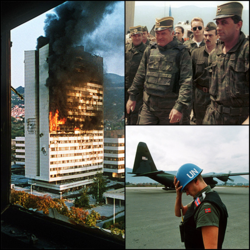
On the day of Bosnia's independence referendum, Serb paramilitaries under Željko Ražnatović (Arkan) seized Bijeljina and killed dozens of Bosniak civilians. The massacre was among the first atrocities of the war and signaled the brutal ethnic cleansing strategy that would define the conflict.
Image source: Bijeljina massacre
Apr 7, 1992 - Jan 1, 1994
% complete
Serb forces captured Foča in southeastern Bosnia in April 1992, systematically murdering Bosniak men and detaining women and girls in rape camps, including at the Partizan sports hall. The systematic sexual violence in Foča later became a landmark case establishing rape as a crime against humanity in international law.
Image source: Foča ethnic cleansing
Apr 8, 1992
% complete
In early April 1992, Serb paramilitary forces including Arkan's Tigers attacked the eastern Bosnian town of Zvornik, killing Muslim civilians and expelling thousands. The assault marked the start of a systematic campaign of ethnic cleansing across eastern Bosnia aimed at creating contiguous Serb-controlled territory.
Image source: Zvornik massacre
Apr 16, 1993
% complete
The Croatian Defence Council (HVO), with support from Croatia, conducted a campaign against Bosniak civilians in the Lašva Valley of central Bosnia, culminating in the Ahmići massacre of April 16, 1993, when over 100 villagers were killed. The International Criminal Tribunal for the former Yugoslavia (ICTY) later judged the campaign a crime against humanity.
Image source: Lašva Valley ethnic cleansing
Jul 11, 1995 - Jul 22, 1995
% complete
Bosnian Serb forces under General Ratko Mladić overran the UN 'safe area' of Srebrenica, executing more than 8,000 Bosniak men and boys in the days that followed while Dutch peacekeepers were overwhelmed. The Srebrenica genocide remains the worst mass murder in Europe since World War II and was recognized as genocide by international courts.
Image source: Srebrenica massacre
Jul 24, 1995
% complete
The International Criminal Tribunal for the former Yugoslavia indicted Bosnian Serb political leader Radovan Karadžić and military commander Ratko Mladić for genocide, crimes against humanity, and war crimes, including the Srebrenica massacre. Both remained fugitives for years before eventual arrest and trial.
Image source: Radovan Karadžić
Jul 21, 2008
% complete
After more than a decade in hiding, Radovan Karadžić was arrested in Belgrade, where he had been living disguised as a practitioner of alternative medicine. He was extradited to The Hague and tried by the ICTY, which convicted him of genocide and other crimes in 2016, sentencing him to life imprisonment.
May 26, 2011
% complete
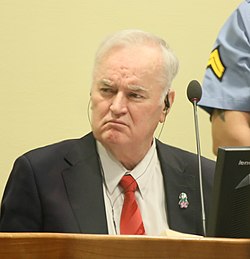
Ratko Mladić, the Bosnian Serb general known as the 'Butcher of Bosnia,' was arrested in a village in northern Serbia after 16 years on the run. His capture removed the last major ICTY fugitive and allowed his long-delayed trial for the Srebrenica genocide and the siege of Sarajevo to proceed.
Image source: Ratko Mladić
Apr 5, 1992
% complete
On April 5, 1992, Suada Dilberović and Olga Sučić were killed by sniper fire while participating in an anti-war demonstration on the Vrbanja Bridge in Sarajevo. They are widely regarded as the first casualties of the Bosnian War, and the bridge was later renamed in their honor.
Image source: Suada and Olga bridge
Apr 5, 1992 - Feb 29, 1996
% complete
Bosnian Serb forces encircled Sarajevo, the capital of Bosnia and Herzegovina, beginning the longest siege of a capital city in modern warfare history. For nearly four years, artillery shelling and sniper fire from surrounding hills terrorized residents, cutting off supplies of food, water, electricity, and medicine to the besieged population.
Image source: Siege of Sarajevo
Jul 30, 1993
% complete
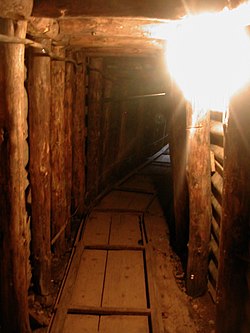
Bosnian government forces completed a hand-dug tunnel beneath the Sarajevo airport runway, linking the besieged city to free territory at Dobrinja. The tunnel became a lifeline for food, fuel, weapons, and people, allowing the city to survive the siege despite the blockade.
Image source: Sarajevo Tunnel
Feb 5, 1994
% complete
A mortar shell struck the crowded Markale marketplace in central Sarajevo, killing 68 civilians and wounding about 200. The massacre provoked international outrage and led directly to NATO issuing an ultimatum to Bosnian Serb forces to withdraw heavy weapons from around Sarajevo.
Image source: Markale massacres
Aug 28, 1995
% complete
A second mortar attack on the Markale marketplace killed 37 civilians and wounded about 90. UN investigators attributed the shell to Bosnian Serb forces, and the massacre triggered Operation Deliberate Force, the sustained NATO air campaign against the VRS.
Sep 14, 1995
% complete
Under intense NATO pressure and facing battlefield losses, Bosnian Serb forces agreed to withdraw heavy weapons from around Sarajevo in mid-September 1995. Utility services were progressively restored, effectively ending the strangulation of the capital after nearly four years of siege.
Feb 29, 1996
% complete
Bosnian Serb forces completed their withdrawal from positions around Sarajevo under the Dayton framework, formally ending the 1,425-day siege. The siege had killed approximately 14,000 people, including over 5,000 civilians, and left much of the city in ruins.
Jun 1, 1992
% complete
The United Nations Protection Force (UNPROFOR), originally created for Croatia, expanded into Bosnia in June 1992 to protect humanitarian aid deliveries. Its mandate gradually grew to include protecting six UN-declared safe areas, though its rules of engagement left peacekeepers largely unable to prevent atrocities.
Image source: United Nations Protection Force
Feb 9, 1994
% complete
Responding to the Markale massacre, NATO demanded that Bosnian Serb forces withdraw heavy weapons from a 20-kilometer exclusion zone around Sarajevo or face airstrikes. The ultimatum, backed by Russian diplomacy, temporarily eased the siege and marked NATO's first major coercive intervention in the war.
Image source: NATO intervention in Bosnia and Herzegovina
Mar 18, 1994
% complete
Brokered by the United States, the Washington Agreement ended the year-long Croat-Bosniak conflict and established the Federation of Bosnia and Herzegovina, uniting Bosniak- and Croat-held territories. It also created a joint federation army and paved the way for the broader peace framework that would follow.
Image source: Washington Agreement
Aug 30, 1995 - Sep 20, 1995
% complete
NATO began a sustained air campaign against Bosnian Serb military targets in response to the second Markale massacre and the siege of Sarajevo. Combined with coordinated ground offensives by Bosnian government and Croatian forces, the campaign forced the VRS onto the defensive and brought Milošević to the negotiating table.
Image source: Operation Deliberate Force
Nov 1, 1995 - Nov 21, 1995
% complete
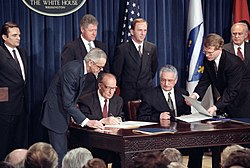
U.S.-brokered proximity talks at Wright-Patterson Air Force Base near Dayton, Ohio brought together Slobodan Milošević, Franjo Tuđman, and Alija Izetbegović. After three weeks of intense negotiation, the parties initialed a comprehensive peace agreement on November 21, 1995, ending the war.
Image source: Dayton Agreement
Dec 14, 1995
% complete
Presidents Milošević, Tuđman, and Izetbegović signed the General Framework Agreement for Peace in Paris, officially ending the Bosnian War. The agreement preserved Bosnia and Herzegovina as a single state divided into two entities—the Federation of Bosnia and Herzegovina and Republika Srpska—and deployed a 60,000-strong NATO force (IFOR) to enforce it.
Dec 20, 1995 - Dec 20, 1996
% complete
NATO's Implementation Force (IFOR), numbering about 60,000 troops, deployed across Bosnia to separate the former warring factions, monitor the ceasefire, and oversee the transfer of territory. Its success stabilized the country and was succeeded by the smaller Stabilisation Force (SFOR) in December 1996.
Jun 14, 1992 - Oct 5, 1992
% complete
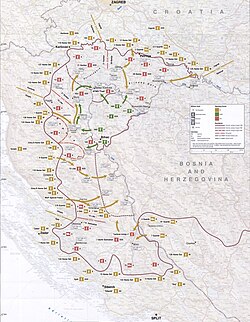
The Army of Republika Srpska (VRS) captured the Posavina corridor connecting Serb-held territories in western and eastern Bosnia. The operation severed the main supply route to Bosniak-held Tuzla and consolidated Serb control over nearly 70% of Bosnian territory by late 1992.
Image source: Operation Corridor 92
Oct 29, 1992
% complete
Serb forces captured the historic town of Jajce in October 1992, triggering one of the largest single refugee flows of the war as tens of thousands of Bosniaks and Croats fled toward Travnik and central Bosnia. The fall underscored the VRS's dominance during the first year of the conflict.
Image source: Jajce
Mar 30, 1994 - Apr 26, 1994
% complete
Bosnian Serb forces launched a major offensive against the eastern enclave of Goražde, one of six UN-designated safe areas. In response, NATO conducted its first-ever combat strikes against ground targets, hitting Serb positions near the enclave and helping halt the offensive.
Image source: Goražde
Aug 4, 1995 - Aug 7, 1995
% complete
Croatian forces launched a massive offensive to recapture the Krajina region from rebel Serbs, routing the self-proclaimed Republic of Serbian Krajina in days. Around 200,000 Serb civilians fled, and the collapse of the Krajina dramatically shifted the strategic balance in Bosnia, where Croatian and Bosnian government forces advanced soon after.
Image source: Operation Storm
Or browse the full history timeline directory, with more than 2,000 topics.
This Bosnian War timeline was generated with the help of AI, using information found on the internet.
We work hard to keep these timelines accurate, but mistakes do get through. If you spot one, email us at [email protected] and we'll fix it for future visitors.
Generate yours with AI or build it from scratch, for free.
Export your timeline, add your own events, edit or remove AI-generated events, and much more
No credit card required.
Cancel anytime.
Cancel anytime.
You can create an unlimited number of timelines with up to 10 events on each one, customize how they look, export them to PDF, PNG, PowerPoint, CSV, and Excel, and share them with a link. Paid plans raise the event limit and add features like spreadsheet imports and collaborators.
Yes. You can cancel your subscription from your account page at any time, and you will not be charged again. Your subscription stays active for the rest of the period you already paid for.
Yes. We will email you a reminder before the annual renewal, and we will also email you a receipt.
Yes. You can email us within 15 days of any payment, and we will issue you a full refund.
Check out our pricing docs or send us an email anytime: [email protected].