
-
Use Cases
-
Resources
-
Pricing
The Boxer Rebellion was an anti-foreign and anti-Christian uprising in northern China between 1899 and 1901, led by a group known as the Boxers (Yihequan, or 'Righteous and Harmonious Fists'). The movement arose from resentment over foreign imperialism, missionary activity, and economic hardship. After initially condemning the movement, Empress Dowager Cixi backed the Boxers in 1900, leading to the siege of foreign legations in Beijing. An Eight-Nation Alliance of Japan, Russia, Britain, France, the United States, Germany, Italy, and Austria-Hungary invaded China to relieve the siege, capturing Beijing in August 1900. The rebellion ended with the signing of the Boxer Protocol in September 1901, which imposed heavy indemnities on China and marked a turning point toward the dynasty's eventual collapse. More Less
Jun 26, 1858
The Treaty of Tianjin ended the first phase of the Second Opium War, opening more Chinese ports to foreign trade, allowing foreign legations in Beijing, and permitting Christian missionary activity, further deepening foreign influence in China.
Image source: Treaty of Tientsin
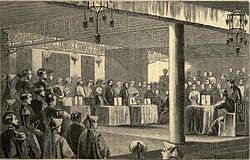
Oct 24, 1860
The Convention of Peking concluded the Second Opium War, forcing China to pay large indemnities, open Tianjin as a treaty port, and cede Kowloon Peninsula to Britain. Foreign troops were even permitted to occupy parts of Beijing, intensifying anti-foreign sentiment.
Image source: Convention of Peking

Apr 17, 1895
The Treaty of Shimonoseki ended the First Sino-Japanese War with China's humiliating defeat by Japan. China ceded Taiwan and the Liaodong Peninsula and recognized Korean independence, shocking the Qing court and exposing its weakness.
Image source: Treaty of Shimonoseki

Nov 23, 1895
Russia, France, and Germany pressured Japan to return the Liaodong Peninsula to China. Russia then secured concessions in Manchuria itself, heightening rivalry among foreign powers for spheres of influence in China.
Image source: Triple Intervention

Nov 14, 1897
Germany used the murder of two missionaries as a pretext to seize Jiaozhou Bay in Shandong Province, establishing the port of Qingdao as a naval base and triggering a scramble among other powers for concessions across China.
Image source: Kiautschou Bay Leased Territory

Jun 11, 1898 - Sep 21, 1898
The Guangxu Emperor launched sweeping modernizing reforms, but Empress Dowager Cixi staged a coup, placing him under house arrest and executing or exiling reformers. Conservative officials regained power, shaping the court's hostile stance toward foreigners.
Image source: Hundred Days' Reform

Sep 6, 1899
U.S. Secretary of State John Hay issued the Open Door notes calling for equal trading rights in China and preservation of Chinese territorial integrity, reflecting international concern over the division of China into exclusive spheres of influence.
Image source: Open Door Policy

Jan 1, 1895 - Dec 31, 1899
In Shandong Province, rural self-defense groups like the Big Sword Society organized against banditry, Christian missionary influence, and foreign encroachment, providing an early model for the militant anti-foreign movement that followed.
Jan 1, 1896 - Dec 31, 1898
The Spirit Boxers, drawing on traditional martial arts and spirit possession rituals, spread through drought-stricken Shandong. Practitioners believed ritual invulnerability would protect them from bullets, and they targeted Christian converts and missionaries as agents of foreign corruption.
Image source: Boxer movement

Nov 1, 1897
Two German Catholic missionaries were murdered in Juye County, Shandong. Germany used the killings to justify seizing Qingdao and extracting concessions, demonstrating to Chinese villagers how missionary presence invited foreign aggression.
Image source: Juye Incident

This Boxer Rebellion timeline was generated with the help of AI, using information found on the internet.
We work hard to keep these timelines accurate, but mistakes do get through. If you spot one, email us at [email protected] and we'll fix it for future visitors.
Generate yours with AI or build it from scratch, for free.


