
-
Use Cases
-
Resources
-
Pricing
The Taiping Rebellion was a massive civil war in southern China fought between the ruling Qing dynasty and the Taiping Heavenly Kingdom, a movement led by Hong Xiuquan, who claimed to be the younger brother of Jesus Christ. It was one of the bloodiest conflicts in human history, resulting in tens of millions of deaths before its suppression in 1864. More Less
Jan 1851
% complete
In early January 1851, following a small-scale battle in late December 1850, a 10,000-strong rebel army organized by Feng Yunshan and Wei Changhui routed Qing forces stationed in Jintian (present-day Guiping, Guangxi), marking the effective outbreak of the Taiping Rebellion.
Image source: Jintian Uprising
Jan 11, 1851
% complete
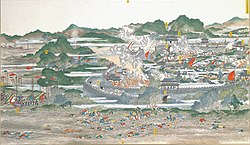
On January 11, 1851, Hong Xiuquan declared himself the Heavenly King of the Heavenly Kingdom of Peace, or Taiping Heavenly Kingdom, from which comes the term 'Taipings' commonly used for the rebels in English-language studies.
Image source: Taiping Rebellion
Sep 1851
% complete
In September 1851, the Taipings began marching north to escape Qing forces closing in on them, beginning their long advance out of Guangxi.
Dec 1852
% complete
The Taiping army pressed north into Hunan following the Xiang River, besieging Changsha, occupying Yuezhou, and capturing Wuchang in December 1852 after reaching the Yangtze River.
1853 - 1855
% complete
The Taiping launched a campaign against Beijing (1853–1855), which ultimately failed and severely weakened the rebellion, contributing to later internal strife.
Feb 1853
% complete
In February 1853, the Taiping forces captured the strategic city of Anqing on the Yangtze River, opening the way for their advance on Nanjing.
Mar 19, 1853
% complete
On March 19, 1853, the Taipings captured the city of Nanjing and Hong Xiuquan renamed it 'Tianjing', or the 'heavenly capital' of his kingdom, which would serve as the Taiping capital until 1864.
Oct 27, 1853
% complete
On October 27, 1853, Taiping forces crossed the Yellow River in Cangzhou and murdered 10,000 Manchus during their Northern Expedition.
Dec 1856
% complete
In December 1856, Qing forces retook Wuchang for the final time, marking a turning point as the Taiping lost their foothold in the middle Yangtze.
May 1858
% complete
In May 1858, Zeng Guofan's Xiang Army captured Jiujiang, and then the rest of Jiangxi by September, steadily eroding Taiping control in the region.
Mar 19, 1860
% complete
On March 19, 1860, the Taiping rebels successfully took Hangzhou, part of their successful invasion of southern Jiangsu and Zhejiang provinces, the wealthiest region of the Qing Empire.
May 1860
% complete
In May 1860, the Taiping defeated the imperial forces that had been besieging Nanjing since 1853, eliminating them from the region and opening the way for the invasion of southern Jiangsu and Zhejiang.
May 26, 1860
% complete
On May 26, 1860, the Taiping rebels captured Changzhou as they swept through the wealthy Jiangsu region east of Nanjing.
Jun 2, 1860
% complete
On June 2, 1860, the Taiping rebels captured Suzhou, one of the richest cities of the Qing Empire, further expanding their control over southern Jiangsu.
1861
% complete
In 1861, around the time of the death of the Xianfeng Emperor and ascension of the Tongzhi Emperor, Zeng Guofan's Xiang Army captured Anqing with help from a naval blockade imposed by the Royal Navy on the city.
Image source: Battle of Anqing
Jan 1862
% complete
Near the end of 1861 the Taipings launched a final Eastern Expedition. In January 1862, Taiping troops surrounded Shanghai, but were unable to capture it.
May 1862 - Jul 1864
% complete
After moving down the Yangtze River and recapturing the strategic city of Anqing, Zeng Guofan's forces besieged Nanjing during May 1862, beginning the final siege of the Taiping capital.
Jun 1862 - Aug 1862
% complete
In the summer of 1862, a Western observer noted that rebel factories in Nanjing were producing superior guns—including heavy cannon—than those of the Qing.
Jul 1864 - Jul 19, 1864
% complete
The younger Hong Tianguifu was inexperienced and powerless; Nanjing fell in July 1864 to the imperial armies after protracted street-by-street fighting in the Third Battle of Nanjing, marking the destruction of the Taiping regime.
Image source: Third Battle of Nanjing
1853
% complete
As early as 1853, foreigners from various countries joined the rebels in combat and administrative roles, and were in a position to observe the Taiping in battle.
1853
% complete
In 1853, Hong Xiuquan invited American missionary Issachar Jacox Roberts to come to Nanjing to aid in the administration of his government.
1861
% complete
After Roberts arrived in Nanjing in 1861 and met with Hong, he was commissioned by him as the director of foreign affairs of the Taiping government.
Feb 1861
% complete
After the conclusion of the Second Opium War, Royal Navy officer Sir James Hope led an expedition to Nanjing in February 1861 to assess the Taiping regime.
Nov 1861
% complete
In late 1861, Sir James Hope made a brief visit to Nanjing to come to an agreement with the Taiping rebels not to attack the city of Shanghai, a proposal which was refused by the Taiping government.
1862
% complete
In 1862, the Ever-Victorious Army, commanded by Frederick Townsend Ward with European officers, repulsed another attack on Shanghai and helped to defend other treaty ports such as Ningbo, reclaimed on May 10.
Image source: Ever Victorious Army
Apr 1862
% complete
In April 1862, a shipment from an American dealer 'well known for their dealings with rebels' included 2,783 percussion cap muskets, 66 carbines, 4 rifles, and 895 field artillery guns; the dealer carried passports signed by the Loyal King.
1863 - 1864
% complete
Many Western officials visited the capital of Taiping between 1863 and 1864, and American commissioner Robert Milligan McLane considered granting official recognition of the Taiping government.
1853
% complete
In 1853, Hong Xiuquan withdrew from active control of policies and administration to rule exclusively by written proclamations, leaving much day-to-day power in the hands of subordinates such as Yang Xiuqing.
Sep 1856 - Oct 1856
% complete
Tension within the Taiping leadership culminated in the 1856 Tianjing Incident, with Yang Xiuqing and his followers slaughtered by Wei Changhui, Qin Rigang, and their troops on Hong Xiuquan's orders, severely weakening the rebellion.
Image source: Tianjing Incident
1859
% complete
In 1859, Hong Rengan, Hong Xiuquan's cousin, joined the Taiping forces in Nanjing and was given considerable power by Hong, becoming the Shield King and a key strategist.
1863
% complete
In 1863, Shi Dakai surrendered to the Qing near the Sichuan capital Chengdu and was executed by slow-slicing, removing one of the Taiping's most capable commanders.
Image source: Shi Dakai
Jan 1864
% complete
By early 1864, Qing control in most areas had been reestablished, leaving Nanjing as the last major Taiping stronghold under siege.
Jun 1, 1864
% complete
On June 1, 1864, Hong Xiuquan died during the siege of Nanjing, his death caused by the consumption of weeds in the palace grounds as well as suspicions of poison, after a 20-day illness.
Image source: Hong Xiuquan
Or browse the full history timeline directory, with more than 2,000 topics.
This Taiping Rebellion timeline was generated with the help of AI, using information found on the internet.
We work hard to keep these timelines accurate, but mistakes do get through. If you spot one, email us at [email protected] and we'll fix it for future visitors.
Generate yours with AI or build it from scratch, for free.
Export your timeline, add your own events, edit or remove AI-generated events, and much more
No credit card required.
Cancel anytime.
Cancel anytime.
You can create an unlimited number of timelines with up to 10 events on each one, customize how they look, export them to PDF, PNG, PowerPoint, CSV, and Excel, and share them with a link. Paid plans raise the event limit and add features like spreadsheet imports and collaborators.
Yes. You can cancel your subscription from your account page at any time, and you will not be charged again. Your subscription stays active for the rest of the period you already paid for.
Yes. We will email you a reminder before the annual renewal, and we will also email you a receipt.
Yes. You can email us within 15 days of any payment, and we will issue you a full refund.
Check out our pricing docs or send us an email anytime: [email protected].