
-
Use Cases
-
Resources
-
Pricing
1783
Hogeland claimed that Hamilton had been working toward the 1794 moment since the Newburgh Crisis in 1783, when he allegedly conceived of using military force against popular resistance to direct taxation.
Image source: Newburgh Conspiracy
Jan 1795
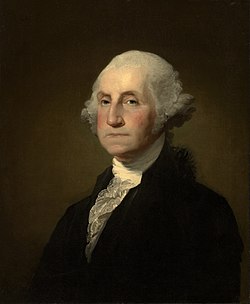
President Washington and Martha Washington attended a performance of a play in Philadelphia in January 1795, shortly after the suppression of the uprising.
Image source: George Washington
1800
Opponents of internal taxes rallied around Thomas Jefferson and helped him defeat President John Adams in the election of 1800.
Image source: 1800 United States presidential election
1801
Thomas Jefferson’s Republican Party came to power in 1801. The party opposed the Federalist Party of Hamilton and Washington, including its approach to internal taxation.
Image source: Thomas Jefferson
1802
By 1802, Congress repealed the distilled spirits excise tax and all other internal federal taxes.
1802 - 1812
Until the War of 1812, the federal government relied solely on import tariffs for revenue, which grew with the nation's expanding foreign trade.
1946
In 1946, W. C. Fields recorded a comedy track entitled “The Temperance Lecture” in Les Paul’s studio shortly before his death, connecting the subject of alcohol prohibition and temperance with later popular culture.
1963
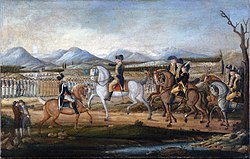
In 1963, historian Jacob Cooke, an editor of Hamilton’s papers, called the charge that Hamilton deliberately engineered the crisis “preposterous” and described it as a conspiracy thesis overstating Hamilton’s control.
Image source: Whiskey Rebellion
1980
L. Neil Smith wrote the alternate-history novel The Probability Broach in 1980. In its fictional history, Albert Gallatin joins the 1794 rebellion, leading to Washington’s overthrow and execution and the abrogation of the Constitution.
Image source: The Probability Broach
1986
In 1986, historian Thomas Slaughter argued that the outbreak resulted from a string of ironic coincidences, while noting that questions about motives remained unresolved.
2003
Historian Mark Spencer wrote in 2003 that historians were not yet agreed on the exact role of the societies in the rebellion, although there was some overlap between society membership and the Whiskey Rebels.
2006
In 2006, William Hogeland argued that Hamilton, David Bradford, and William Rawle intentionally pursued a course likely to provoke violence that could justify federal military suppression.
2008
David Liss’s 2008 novel The Whiskey Rebels covers circumstances during 1788–1792 that led to the 1794 rebellion.
2011
The Whiskey Rebellion Festival began in Washington, Pennsylvania, in 2011, commemorating the region’s association with the rebellion.
1789
A new U.S. federal government began operating in 1789 after ratification of the United States Constitution, creating the institutional framework through which national taxation and enforcement would be organized.
Image source: Federal government of the United States
Jun 1790 - Jul 1790
Congress approved fiscal measures in June and July 1790 as the federal government worked to address the war debt inherited from the American Revolutionary War.
Dec 1790
By December 1790, Alexander Hamilton believed import duties, then the government's primary source of revenue, had been raised as high as feasible. He therefore supported additional internal taxation.
Image source: Alexander Hamilton
1791
The Northwest Indian War was going badly for the United States, with major losses in 1791. The military setbacks formed part of the broader national context surrounding the new tax.
Image source: Northwest Indian War
1791
Although the tax applied to all distilled spirits, rapidly expanding consumption of American whiskey caused the measure to become widely known as the whiskey tax.
Mar 1791
The Whiskey Excise Act, also known as the Whiskey Act, became law in March 1791. It imposed an excise on distilled spirits to generate revenue for paying Revolutionary War debt.
May 1792
Following petitions and continued opposition, the excise law was modified in May 1792, though resistance to the tax did not end.
Jun 5, 1794
At William Findley’s urging, Congress modified the law on June 5, 1794, allowing excise trials to be held in local state courts.
1790
Western Pennsylvania had a population of approximately 75,000 in 1790, forming the substantial frontier population among which resistance to the excise later developed.
1791 - 1792
Because of violent attacks on collectors and officials, the excise went largely uncollected in 1791 and early 1792.
Jul 27, 1791
A preliminary meeting at Redstone Old Fort in Fayette County called for selecting delegates to a more formal assembly concerning resistance to the excise.
Sep 1791
Delegates convened in Pittsburgh in early September 1791 after the Redstone Old Fort meeting, organizing opposition to the whiskey tax.
Sep 6, 1791
Robert Johnson, a recently appointed tax collector, was tarred and feathered by a disguised gang in Washington County. The attack demonstrated the coercive tactics used against tax officials.
Aug 1792
A second convention met in Pittsburgh in August 1792 to discuss resistance to the whiskey tax.
Aug 1792
Tax official John Neville rented a room in Pittsburgh for his tax office in August 1792, but the landlord expelled him after threats from the Mingo Creek Association.
1793
Resistance to the excise continued through 1793 in frontier counties of Appalachia, despite federal efforts to enforce the tax.
Nov 22, 1793
On the night of November 22, 1793, men broke into the home of tax collector Benjamin Wells in Fayette County, continuing the intimidation of revenue officials.
1794
The resistance came to a climax in 1794, when opposition to the excise escalated into an open challenge to federal authority.
Aug 9, 1794
Thirty men surrounded the home of William McCleery, the local tax collector in Morgantown, Virginia, on August 9, 1794, in retaliation for the new whiskey taxes.
Sep 11, 1794
A liberty pole was raised in Carlisle, Pennsylvania, on September 11, 1794, symbolizing opposition to federal authority and the excise.
1792
In 1792, Hamilton advocated military action to suppress violent resistance in western North Carolina. Attorney General Edmund Randolph argued that evidence was insufficient to legally justify such a response.
Sep 1792
In September 1792, Washington sent Pennsylvania tax official George Clymer to western Pennsylvania to investigate resistance to the excise.
Sep 15, 1792
Washington signed a proclamation on September 15, 1792, warning against resistance to federal law. It was published as a broadsheet and printed in many newspapers.
1794
During the 1794 response, Daniel Morgan was promoted to major general and became associated with command of federal forces sent against the resistance.
1794 - 1795
After the uprising was suppressed, Morgan commanded the remnant of the army that remained in Pennsylvania until 1795. The force numbered about 1,200 militiamen, including Meriwether Lewis.
Aug 1794
In early August 1794, Washington dispatched three Pennsylvanians to the west as commissioners: Attorney General William Bradford, Pennsylvania Supreme Court Justice Jasper Yeates, and Senator James Ross.
Aug 4, 1794
On August 4, 1794, Justice James Wilson delivered his opinion that western Pennsylvania was in a state of rebellion, satisfying the legal condition needed for federal militia action.
Aug 7, 1794
Washington issued a proclamation on August 7, 1794, as the federal government moved toward suppressing the insurrection and warned participants against continued resistance.
Sep 24, 1794
On September 24, 1794, Washington received a recommendation from the commissioners concerning the condition of western Pennsylvania and the government's response.
Oct 1794
The insurrection collapsed as the federal army marched west into western Pennsylvania in October 1794.
Or browse the full history timeline directory, with more than 2,500 topics.
This Whiskey Rebellion timeline was generated with the help of AI, using information found on the internet.
We work hard to keep these timelines accurate, but mistakes do get through. If you spot one, email us at [email protected] and we'll fix it for future visitors.
Generate yours with AI or build it from scratch, for free.
Export your timeline, add your own events, edit or remove AI-generated events, and much more
No credit card required.
Cancel anytime.
Cancel anytime.
You can create an unlimited number of timelines with up to 10 events on each one, customize how they look, export them to PDF, PNG, PowerPoint, CSV, and Excel, and share them with a link. Paid plans raise the event limit and add features like spreadsheet imports and collaborators.
Yes. You can cancel your subscription from your account page at any time, and you will not be charged again. Your subscription stays active for the rest of the period you already paid for.
Yes. We will email you a reminder before the annual renewal, and we will also email you a receipt.
Yes. You can email us within 15 days of any payment, and we will issue you a full refund.
Check out our pricing docs or send us an email anytime: [email protected].