
-
Use Cases
-
Resources
-
Pricing
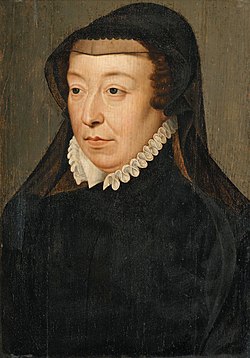
Catherine de Medici (1519–1589) was an Italian noblewoman of the Medici family who became Queen Consort of France as the wife of King Henry II. After his death in 1559, she wielded enormous political influence as regent and advisor to three of her sons—Francis II, Charles IX, and Henry III—during a turbulent era marked by the French Wars of Religion, including her controversial role in the St. Bartholomew's Day Massacre. More Less
Apr 13, 1519
% complete
Catherine de Medici was born in Florence into the powerful Medici family. Orphaned within weeks of her birth, she became a central figure in the family dynasty and would later rise to become one of the most influential women in French history.
Image source: Catherine de' Medici
1529 - Aug 12, 1530
% complete
Republican rebels besieged Florence, where Catherine was living. The city fell to imperial troops, and Catherine was briefly threatened with being held hostage or worse before her Medici relatives secured power again.
Image source: Siege of Florence (1529–1530)
Jan 19, 1544
% complete
After a decade of childless marriage that threatened her position, Catherine gave birth to her first son, who would later reign briefly as King Francis II of France.
Image source: Francis II of France
Oct 28, 1533
% complete
Fourteen-year-old Catherine married the second son of King Francis I of France in Marseille, arranged by her uncle Pope Clement VII. The marriage tied the Medici to the French crown and launched her political career.
Image source: Catherine de' Medici
1536
% complete
The death of Francis I's eldest son made Catherine's husband heir to the French throne, transforming her from a minor princess into the future queen consort of France.
Image source: Henry II of France
Mar 31, 1547 - Jul 25, 1547
% complete
Francis I died and his son ascended the throne as Henry II. Catherine became queen consort, though she remained overshadowed at court by Henry's mistress, Diane de Poitiers.
Image source: Francis I of France
Apr 3, 1559
% complete
France signed peace with Spain and the Holy Roman Empire after decades of war. Celebrations for the treaty included jousts that would prove fatal to King Henry II.
Image source: Treaty of Cateau-Cambrésis (1559)
Jul 10, 1559
% complete
King Henry II was mortally wounded in a tournament when a lance splinter pierced his eye. His death made Catherine queen mother and thrust her into the center of French politics.
Jul 10, 1559
% complete
Fifteen-year-old Francis II became king, but real power lay with the Guise family, relatives of his wife Mary, Queen of Scots. Catherine worked to counter their dominance.
Mar 1560
% complete
Huguenot conspirators attempted to seize the young king from Guise control at Amboise. Its brutal suppression inflamed religious tensions across France.
Image source: Amboise conspiracy
Dec 5, 1560
% complete
Francis II died after barely a year on the throne. Ten-year-old Charles IX succeeded him, and Catherine was appointed regent with substantial authority over the kingdom.
1564 - May 1566
% complete
Catherine took Charles IX and the court on a grand two-year progress around France to display royal majesty and reconcile warring factions, staging lavish festivities along the way.
Image source: Catherine de' Medici's court festivals
1570
% complete
Catherine arranged the marriage of her son to Elisabeth of Austria, daughter of Emperor Maximilian II, strengthening ties with the Habsburgs.
Image source: Charles IX of France
Jun 11, 1573
% complete
Catherine engineered the election of her favorite son, Henry of Anjou, to the elective Polish throne, extending Valois influence abroad.
Image source: Henry III of France
May 30, 1574
% complete
Charles IX died of illness aged twenty-three. Henry abandoned Poland to claim the French throne, and Catherine continued to exercise influence as queen mother.
Sep 1561 - Oct 1561
% complete
Catherine sponsored this conference between Catholic and Protestant theologians in an attempt to find compromise between the faiths, though it ended without agreement.
Image source: Colloquy of Poissy
Jan 17, 1562
% complete
Catherine issued an edict granting Huguenots limited freedom of worship, a landmark policy of moderation that angered hardline Catholics and failed to prevent war.
Mar 1562 - Mar 1563
% complete
Massacre of Huguenot worshippers at Vassy by the Duke of Guise ignited the First War of Religion, beginning decades of civil conflict between Catholics and Protestants.
Sep 28, 1567
% complete
Huguenot forces attempted to seize King Charles IX at Meaux, sparking the Second War of Religion and deepening Catherine's suspicion of Protestant intentions.
Image source: Surprise of Meaux
Mar 23, 1568
% complete
A short-lived truce between crown and Huguenots restored earlier terms of toleration, but hostilities resumed within months as mutual distrust persisted.
Image source: Peace of Longjumeau
Sep 1568 - Aug 1570
% complete
Renewed fighting saw major battles such as Jarnac and Moncontour. It ended with the Peace of Saint-Germain, granting Huguenots significant concessions including fortified towns.
Image source: French Wars of Religion
Aug 8, 1570
% complete
Catherine brokered peace giving Protestants four fortified cities as guarantees, a concession that alarmed Catholics and set the stage for renewed crisis.
Image source: Peace of Saint-Germain-en-Laye
1572 - 1573
% complete
The massacre triggered renewed conflict, including the siege of La Rochelle, which failed to subdue the great Huguenot stronghold and weakened royal authority.
Aug 18, 1572
% complete
Catherine arranged the wedding of her daughter to the Protestant Henry of Navarre, intended to reconcile Catholics and Huguenots. Thousands of Protestant nobles gathered in Paris for the event.
Image source: Margaret of Valois
Aug 24, 1572 - Oct 1572
% complete
Following an assassination attempt on Huguenot leader Admiral Coligny, thousands of Protestants were slaughtered in Paris and throughout France. Catherine's exact role remains debated by historians, but the massacre stained her reputation permanently.
May 12, 1588
% complete
Parisian Catholics led by the Duke of Guise rose against the king, forcing him to flee. Catherine's diplomatic mediation efforts were increasingly ineffective amid rising League power.
Image source: Day of the Barricades
Dec 23, 1588
% complete
Henry III had the powerful Duke of Guise murdered at Blois. Catherine, gravely ill, learned of the killing shortly afterward and reportedly despaired over her son's rash act.
Image source: Henri I, Duke of Guise
1564 - 1600
% complete
Catherine commissioned the Tuileries Palace beside the Louvre and transformed royal architecture and gardens in Paris. Her building projects, including the Hôtel de la Reine with its astronomical column, shaped the face of Renaissance Paris.
Image source: Tuileries Palace
Oct 1572
% complete
The death of her close friend prompted Germain Pilon's celebrated recumbent effigy, exemplifying the Renaissance artistry Catherine patronized throughout her life.
Image source: Catherine de' Medici's building projects
Jan 5, 1589
% complete
Catherine died at the Château de Blois aged sixty-nine, likely of pleurisy. Months later her son Henry III was assassinated, ending the Valois dynasty and vindicating her fears for its survival.
Or browse the full history timeline directory, with more than 2,000 topics.
This Catherine de Medici timeline was generated with the help of AI, using information found on the internet.
We work hard to keep these timelines accurate, but mistakes do get through. If you spot one, email us at [email protected] and we'll fix it for future visitors.
Generate yours with AI or build it from scratch, for free.
Export your timeline, add your own events, edit or remove AI-generated events, and much more
No credit card required.
Cancel anytime.
Cancel anytime.
You can create an unlimited number of timelines with up to 10 events on each one, customize how they look, export them to PDF, PNG, PowerPoint, CSV, and Excel, and share them with a link. Paid plans raise the event limit and add features like spreadsheet imports and collaborators.
Yes. You can cancel your subscription from your account page at any time, and you will not be charged again. Your subscription stays active for the rest of the period you already paid for.
Yes. We will email you a reminder before the annual renewal, and we will also email you a receipt.
Yes. You can email us within 15 days of any payment, and we will issue you a full refund.
Check out our pricing docs or send us an email anytime: [email protected].