-
Use Cases
-
Resources
-
Pricing
The Franco-Prussian War was a conflict fought between France and Prussia, supported by other German states, from July 1870 to May 1871. Triggered by disputes over the Spanish throne succession, the war resulted in a swift Prussian victory, the capture of Emperor Napoleon III at Sedan, the fall of the Second French Empire, the proclamation of the German Empire at Versailles, and the annexation of Alsace-Lorraine—reshaping European politics for decades. More Less
1859
% complete
France gained the status of being the dominant power of continental Europe as a result of the Franco-Austrian War of 1859, a position that would later be challenged by Prussia's rise.
Image source: Second Italian War of Independence
1859 - 1873
% complete
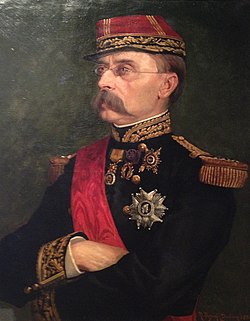
Albrecht von Roon, the Prussian Minister of War from 1859 to 1873, put into effect a series of reforms of the Prussian military system in the 1860s, building the army that would defeat France in 1870–71.
Image source: Albrecht von Roon
1865
% complete
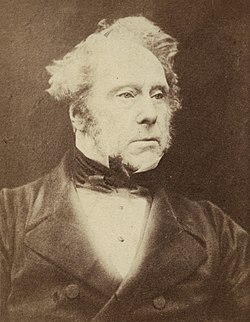
The British statesman Lord Palmerston wrote in 1865: 'The current Prussia is too weak to be honest and independent in its actions,' reflecting British views of Prussia before its dramatic rise.
Image source: Henry John Temple, 3rd Viscount Palmerston
1866
% complete
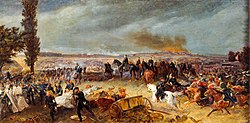
During the Austro-Prussian War of 1866, Empress Eugénie, Foreign Minister Drouyn de Lhuys and War Minister Jacques Louis Randon were concerned that the power of Prussia might overtake that of France following Prussia's decisive victory over Austria.
Image source: Austro-Prussian War
1866
% complete
As a result of Prussia's victory, Napoleon demanded from Prussia a return to the French borders of 1814, with the annexation of Luxembourg, most of Saarland, and the Bavarian Palatinate. Thus, war between the two powers since 1866 was only a matter of time.
Image source: Franco-Prussian War
Jul 26, 1866
% complete
The German army comprised that of the North German Confederation led by the Kingdom of Prussia, and the South German states drawn in under the secret clause of the preliminary peace of Nikolsburg, 26 July 1866.
Aug 23, 1866
% complete
The Treaty of Prague formalised the arrangement drawing the South German states under Prussian influence. After the Peace of Prague in 1866, the nominally independent states of Saxony, Bavaria, Württemberg, Baden and Hesse-Darmstadt remained outside the North German Union.
Image source: Peace of Prague (1866)
1868
% complete
The immediate cause of the war was the candidacy of Leopold of Hohenzollern-Sigmaringen to the throne of Spain after the fall of Isabella II in 1868.
Image source: Glorious Revolution (Spain)
1870
% complete
Prince Leopold of Hohenzollern of the Roman Catholic branch Hohenzollern-Sigmaringen had been offered the vacant Spanish throne in 1870 and had withdrawn his acceptance, but the affair inflamed tensions between France and Prussia.
Image source: Leopold, Prince of Hohenzollern
May 1870
% complete
Within days of the plebiscite, France's pacifist Foreign Minister Napoléon, comte Daru, was replaced by Agenor, duc de Gramont, a fierce opponent of Prussia who had advocated an Austro-French military alliance against Prussia in 1866.
Image source: Agénor de Gramont, 10th Duke of Gramont
May 8, 1870
% complete
A national plebiscite held on 8 May 1870 returned results overwhelmingly in favor of the Emperor's domestic agenda, giving the impression that the regime was politically popular and in a position to confront Prussia.
Jul 13, 1870
% complete
The French ambassador approached Prussian King Wilhelm I at his vacationing site in Ems demanding Prussia renounce any future claims to the Spanish throne, which Wilhelm rejected. The Ems telegram of 13 July 1870 had exactly the effect on French public opinion that Bismarck had intended.
Image source: Ems Dispatch
Jul 15, 1870
% complete
France mobilised its army on 15 July 1870, leading the North German Confederation to respond with its own mobilisation later that day.
Jul 16, 1870
% complete
On 16 July 1870, the French parliament voted to declare war on Prussia, setting the stage for open conflict between the two powers.
1870 - 1871
% complete
German forces fought and defeated new French armies raised in northern France during the latter part of the war, clearing the way for the siege of Paris.
Jul 19, 1870 - Jan 28, 1871
% complete
On 19 July 1870, the French sent a declaration of war to the Prussian government. The conflict between France and the North German Confederation led by Prussia lasted until 28 January 1871 and was caused primarily by France's determination to reassert its dominant position in continental Europe.
Jul 28, 1870
% complete
On 28 July 1870 Napoleon III left Paris for Metz and assumed command of the newly titled Army of the Rhine, some 202,448 strong and expected to grow as the French mobilization progressed.
Image source: Army of the Rhine (1870)
Aug 2, 1870
% complete
France invaded German territory on 2 August 1870, opening hostilities on the ground after the declaration of war.
Aug 4, 1870
% complete
The first action of the Franco-Prussian War took place on 4 August 1870, as German forces crossed into France and engaged French troops.
Image source: Battle of Wissembourg (1870)
Sep 1, 1870
% complete
On 1 September 1870, the battle opened with the Army of Châlons, with 202 infantry battalions, 80 cavalry squadrons and 564 guns, attacking the surrounding Prussian Third and Meuse Armies totaling 222 infantry battalions, 186 cavalry squadrons and 774 guns. The battle ended in disaster for France and the capture of Napoleon III.
Image source: Battle of Sedan
Sep 1870
% complete
As autumn storms of the North Sea forced the return of more of the French ships, the blockade of the north German ports diminished and in September 1870 the French navy abandoned the blockade for the winter.
Image source: Blockade of Germany (1914–1919)
Sep 7, 1870
% complete
Bismarck's demand that France surrender sovereignty over Alsace caused a dramatic shift in sentiment in Italy, exemplified by Garibaldi telling the Movimento of Genoa on 7 September 1870: 'Yesterday I said to you: war to the death to Bonaparte.'
Image source: Giuseppe Garibaldi
Nov 1870
% complete
Outside Europe, the French corvette Dupleix blockaded the German corvette SMS Hertha in Nagasaki, and the Battle of Havana took place between the Prussian gunboat SMS Meteor and the French aviso Bouvet off Havana, Cuba, in November 1870.
Image source: Battle of Havana (1870)
Nov 1870
% complete
This disparity in forces created a crisis for the Germans at the front in November 1870, which only the release of the large forces besieging the fortress of Metz allowed them to overcome.
Image source: Siege of Metz (1870)
Nov 27, 1870
% complete
A second French army which operated north of Paris was turned back at the Battle of Amiens on 27 November 1870, part of a series of failed attempts to relieve the capital.
Image source: Battle of Amiens (1870)
Jan 1871
% complete
In January 1871, Gambetta forced Faidherbe to march his army beyond the fortresses and engage the Prussians in open battle, despite the risks involved.
Image source: Louis Faidherbe
Jan 3, 1871
% complete
A second French army operating north of Paris was also turned back at the Battle of Bapaume on 3 January 1871, further frustrating French efforts to break the German encirclement of Paris.
Image source: Second Battle of Bapaume
Jan 15, 1871
% complete
The French offensive took the Germans by surprise and by mid-January 1871, the French had reached the Lisaine River, just a few kilometers from the besieged fortress of Belfort.
Image source: Battle of the Lisaine
Sep 19, 1870 - Jan 28, 1871
% complete
Prussian forces commenced the siege of Paris on 19 September 1870, surrounding the capital and cutting it off from the rest of France for over four months before it fell.
Oct 31, 1870
% complete
National guard units tried to seize power in Paris on 31 October 1870, one of several internal uprisings during the siege that foreshadowed the later Paris Commune.
Jan 22, 1871
% complete
National guard units made another attempt to seize power in Paris on 22 January 1871, reflecting growing unrest within the besieged city.
Image source: Paris Commune
Jan 26, 1871
% complete
On 26 January 1871, the Government of National Defence based in Paris negotiated an armistice with the Prussians, paving the way for the end of hostilities.
Image source: Armistice of Versailles
Jan 28, 1871
% complete
After being besieged for over four months, Paris fell on 28 January 1871, effectively ending the war between France and the North German Confederation led by Prussia.
Image source: Siege of Paris (1870–1871)
Nov 1870
% complete
Seizing upon the distraction of the Franco-Prussian War, Russia in November 1870 had begun rebuilding its naval bases in the Black Sea, a clear violation of the treaty that had ended the Crimean War fourteen years earlier.
Image source: Black Sea Fleet
1871 - 1914
% complete
The war showed that breech-loading cannons were superior to muzzle-loaded cannons. The Prussian tactics and designs were adopted by European armies by 1914, exemplified in the French 75, optimised for direct fire support to advancing infantry.
1871
% complete
After the peace of Frankfurt in 1871, a rapprochement between France and Russia was born, culminating in the Franco-Russian Alliance of 1894, which explicitly referred to the perceived threat of Germany.
Image source: Franco-Russian Alliance
1871 - 1875
% complete
Twenty-six courts were established to try more than 40,000 people who had been arrested, which took until 1875 and imposed 95 death sentences, of which 23 were inflicted.
1871 - 1872
% complete
About 20,000 Communards were held in prison hulks until released in 1872, and a great many Communards fled abroad to the United Kingdom, Switzerland, Belgium or the United States.
Jan 1871
% complete
Despite opposition to Prussia among their ruling circles, the southern German states of Saxony, Bavaria, Württemberg, Baden and Hesse-Darmstadt became part of the newly proclaimed German Empire in January 1871.
Image source: Unification of Germany
Mar 1871
% complete
The most serious native insurrection since the time of Emir Abdelkader was the 1871 Mokrani Revolt in the Kabylia, which spread through much of Algeria amid France's post-war weakness.
Image source: Mokrani Revolt
Mar 18, 1871
% complete
On 18 March 1871, when the regular army tried to remove cannons from an artillery park on Montmartre, National Guard units resisted and killed two army generals, sparking the Paris Commune uprising.
Apr 1871
% complete
By April 1871, 250 tribes had risen, or nearly a third of Algeria's population, taking advantage of France's preoccupation with the aftermath of defeat in the Franco-Prussian War.
May 10, 1871
% complete
Following an armistice with France, the Treaty of Frankfurt was signed on 10 May 1871, giving Germany billions of francs in war indemnity, as well as most of Alsace and parts of Lorraine, which became the Imperial Territory of Alsace-Lorraine.
Image source: Treaty of Frankfurt (1871)
May 10, 1871
% complete
The indemnity imposed on France was proportioned, according to population, to be the exact equivalent to the indemnity imposed by Napoleon on Prussia in 1807, a deliberate symbolic reversal.
1880
% complete
The surviving Communards were amnestied by a bill introduced by Gambetta in 1880 and allowed to return to France.
Or browse the full history timeline directory, with more than 2,000 topics.
This Franco-Prussian War timeline was generated with the help of AI, using information found on the internet.
We work hard to keep these timelines accurate, but mistakes do get through. If you spot one, email us at [email protected] and we'll fix it for future visitors.
Generate yours with AI or build it from scratch, for free.
Export your timeline, add your own events, edit or remove AI-generated events, and much more
No credit card required.
Cancel anytime.
Cancel anytime.
You can create an unlimited number of timelines with up to 10 events on each one, customize how they look, export them to PDF, PNG, PowerPoint, CSV, and Excel, and share them with a link. Paid plans raise the event limit and add features like spreadsheet imports and collaborators.
Yes. You can cancel your subscription from your account page at any time, and you will not be charged again. Your subscription stays active for the rest of the period you already paid for.
Yes. We will email you a reminder before the annual renewal, and we will also email you a receipt.
Yes. You can email us within 15 days of any payment, and we will issue you a full refund.
Check out our pricing docs or send us an email anytime: [email protected].