-
Use Cases
-
Resources
-
Pricing
The Crimean War was a military conflict fought from October 1853 to February 1856, in which the Russian Empire lost to an alliance of the Ottoman Empire, France, Britain, and Sardinia. The war arose from disputes over the rights of Christian minorities in the Holy Land and Russian expansion into the declining Ottoman Empire. It is remembered for the Siege of Sevastopol, the Battle of Balaclava (including the famous Charge of the Light Brigade), and pioneering nursing reforms by Florence Nightingale. More Less
Jul 2, 1853
% complete
Tsar Nicholas I ordered Russian troops to occupy the Ottoman vassal states of Moldavia and Wallachia, pressuring the Ottomans over disputes regarding the protection of Orthodox Christians in the Holy Land. The occupation alarmed Britain and France and pushed Europe toward war.
Image source: Danubian Principalities
Oct 4, 1853
% complete
After Russia ignored an ultimatum to withdraw from the Danubian Principalities, the Ottoman Empire declared war on Russia, beginning the armed phase of the Eastern Question crisis that would escalate into the Crimean War.
Image source: Crimean War
Oct 23, 1853
% complete
The first engagement of the Crimean War saw Ottoman forces under Omar Pasha cross the Danube and defeat a Russian force at Oltenița in Wallachia. Though tactically minor, the victory boosted Ottoman morale across Europe.
Image source: Battle of Oltenița
Nov 30, 1853
% complete
A Russian squadron under Admiral Nakhimov annihilated an Ottoman fleet anchored at Sinop on the Black Sea coast, killing thousands. The destruction of wooden ships by explosive shells shocked public opinion in Britain and France and spurred their intervention in the war.
Image source: Battle of Sinop
Apr 5, 1854 - Jun 24, 1854
% complete
Russian forces besieged the Ottoman fortress of Silistra on the Danube for nearly three months. Stubborn Ottoman defense, aided by British and French officers, forced the Russians to abandon the siege as diplomatic pressure mounted.
Image source: Siege of Silistra (1828)
Jun 28, 1854
% complete
British and French troops landed at Varna in Bulgaria to support the Ottomans against Russia. Cholera ravaged the Allied army there, and after Austria's ultimatum removed the need for action in the Principalities, the Allies turned toward Crimea.
Image source: Varna, Bulgaria
Sep 14, 1854
% complete
Around 60,000 British, French, and Turkish troops landed at Kalamita Bay north of Sevastopol, beginning the invasion of the Crimean Peninsula aimed at destroying the Russian Black Sea Fleet and its naval base.
Sep 20, 1854
% complete
The first major battle of the war saw Allied forces cross the Alma River and defeat General Menshikov's Russian army defending the heights above it. The victory opened the road to Sevastopol but the Allies failed to pursue decisively.
Image source: Battle of the Alma
Sep 25, 1854
% complete
Rather than assault Sevastopol immediately while its defenses were weak, the Allies executed a slow flank march south of the city, giving Russian engineer Todleben crucial time to fortify the defenses that would resist siege for nearly a year.
Image source: Siege of Sevastopol (1854–1855)
Oct 17, 1854
% complete
Allied artillery opened a massive bombardment of Sevastopol's defenses, damaging forts but failing to silence Russian guns, which were repaired nightly. Repeated bombardments would punctuate the eleven-month siege.
Oct 25, 1854
% complete
Russian forces attacked the Allied supply port at Balaclava. The battle featured the 'Thin Red Line' of Highlanders and the infamous Charge of the Light Brigade, a misdirected cavalry assault against massed Russian artillery that became a symbol of heroic blunder.
Image source: Battle of Balaclava
Oct 25, 1854
% complete
Due to ambiguous orders, Lord Cardigan's light cavalry charged directly into a valley raked by Russian guns. Of roughly 670 riders, over a hundred were killed and many more wounded or captured, immortalized by Tennyson's poem 'The Charge of the Light Brigade.'
Image source: Charge of the Light Brigade
Nov 5, 1854
% complete
Fought in dense fog, this brutal 'soldiers' battle' saw Russian sorties from Sevastopol repulsed by British and French troops in fierce hand-to-hand fighting. The failed Russian offensive ended hopes of quickly lifting the siege.
Image source: Battle of Inkerman
Nov 14, 1854
% complete
A violent hurricane wrecked supply ships carrying winter clothing and food for the Allied armies besieging Sevastopol. Combined with inadequate logistics, the storm plunged the British army into a catastrophic winter of disease, starvation, and exposure.
Image source: Great Storm of 1854
Feb 17, 1855
% complete
Russian field commander Liprandi launched a costly assault on the Ottoman-held town of Eupatoria and was decisively repulsed. The failure undermined Russian morale and led to the dismissal of commander Menshikov.
Image source: Battle of Eupatoria
Jun 18, 1855
% complete
A coordinated Allied assault on the Malakoff and Redan strongpoints on the anniversary of Waterloo ended in bloody repulse, with heavy British casualties at the Redan, deepening tensions between French and British commands.
Aug 16, 1855
% complete
Russian Field Marshal Gorchakov launched a final attempt to break the siege by attacking Allied positions along the Chernaya River. French, Sardinian, and Turkish troops routed the attack, extinguishing Russian hopes of relieving Sevastopol.
Image source: Battle of the Chernaya
Sep 8, 1855
% complete
French troops stormed and captured the key Malakoff redoubt, making the city untenable; the Russians scuttled their remaining fleet and withdrew across a pontoon bridge to the northern side. The fall of Sevastopol effectively decided the war.
Oct 17, 1855
% complete
An Anglo-French naval force bombarded and captured the Russian fortress of Kinburn at the mouth of the Dnieper, using ironclad floating batteries in combat for the first time — a milestone in naval warfare.
Image source: Battle of Kinburn (1855)
Jan 3, 1854
% complete
In response to the massacre at Sinop, Britain and France sent their fleets into the Black Sea to protect Ottoman shipping, effectively placing them on a collision course with Russia despite both nations not yet being formally at war.
Mar 27, 1854
% complete
After Russia rejected an ultimatum to evacuate the Danubian Principalities, Britain and France formally declared war, transforming the Russo-Ottoman conflict into a major European war involving the great powers.
Jun 3, 1854 - Aug 31, 1854
% complete
Austria, mobilizing along its frontier and threatening to join the Allies, demanded Russian withdrawal from Moldavia and Wallachia. Tsar Nicholas I complied, with Austrian troops occupying the principalities, removing one cause of the war but not ending it.
Jan 26, 1855
% complete
The Kingdom of Sardinia-Piedmont under Cavour declared war on Russia and sent about 18,000 troops to Crimea, seeking a seat at the peace conference and great-power backing for Italian unification ambitions.
Image source: Kingdom of Sardinia
Mar 2, 1855
% complete
Tsar Nicholas I died during the war, reportedly of pneumonia, and was succeeded by his son Alexander II. The new tsar eventually accepted the need to seek peace, though he first allowed continued defense of Sevastopol.
Image source: Alexander II of Russia
Dec 16, 1855
% complete
Austria presented Russia with harsh peace terms backed by an ultimatum: accept them or face Austrian entry into the war. Isolated diplomatically and exhausted militarily, Alexander II chose to negotiate.
Feb 25, 1856
% complete
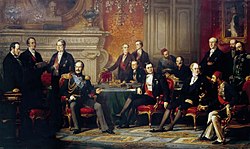
Delegates from Russia, the Ottoman Empire, Britain, France, Sardinia, Austria, and Prussia convened in Paris to negotiate peace, marking a new era of multilateral European diplomacy.
Image source: Congress of Paris (1856)
Mar 30, 1856
% complete
The Treaty of Paris ended the Crimean War. Russia ceded southern Bessarabia, renounced claims to protect Ottoman Christians, and all powers guaranteed Ottoman independence. The Black Sea was neutralized, banning Russian and Ottoman warships and arsenals there.
Nov 21, 1854
% complete
Florence Nightingale arrived with a team of nurses at the British base hospital at Scutari near Constantinople, where she dramatically improved sanitation and care. Her work reduced mortality rates and founded modern professional nursing.
Image source: Florence Nightingale
Jan 29, 1856
% complete
Queen Victoria instituted the Victoria Cross, Britain's highest award for gallantry, largely inspired by acts of valor reported from the Crimean War. It remains the most prestigious decoration in the British honors system.
Image source: Victoria Cross
Feb 18, 1856
% complete
Issued partly under Allied pressure as part of the peace settlement, the Hatt-ı Hümayun promised equality for all Ottoman subjects regardless of religion, launching a new phase of Tanzimat reforms in the empire.
Image source: Ottoman Reform Edict of 1856
Or browse the full history timeline directory, with more than 2,000 topics.
This Crimean War timeline was generated with the help of AI, using information found on the internet.
We work hard to keep these timelines accurate, but mistakes do get through. If you spot one, email us at [email protected] and we'll fix it for future visitors.
Generate yours with AI or build it from scratch, for free.
Export your timeline, add your own events, edit or remove AI-generated events, and much more
No credit card required.
Cancel anytime.
Cancel anytime.
You can create an unlimited number of timelines with up to 10 events on each one, customize how they look, export them to PDF, PNG, PowerPoint, CSV, and Excel, and share them with a link. Paid plans raise the event limit and add features like spreadsheet imports and collaborators.
Yes. You can cancel your subscription from your account page at any time, and you will not be charged again. Your subscription stays active for the rest of the period you already paid for.
Yes. We will email you a reminder before the annual renewal, and we will also email you a receipt.
Yes. You can email us within 15 days of any payment, and we will issue you a full refund.
Check out our pricing docs or send us an email anytime: [email protected].