
-
Use Cases
-
Resources
-
Pricing
Charlemagne (c. 747–814), also known as Charles the Great, was King of the Franks and Lombards and became the first Holy Roman Emperor in 800 CE. His reign marked a turning point in European history, as he united much of Western and Central Europe through military campaigns, promoted the Carolingian Renaissance of learning and culture, and laid foundations for both the Holy Roman Empire and modern concepts of European identity. More Less
Jan 1, 496
% complete
By the 6th century, the western Germanic tribe of the Franks had been Christianised, a process largely instigated by the conversion of King Clovis I to Catholicism. This conversion laid the religious foundation of the Frankish kingdom that Charlemagne would later inherit and rule.
Image source: Clovis I
Jan 1, 675 - Dec 31, 699
% complete
The late 7th century saw a period of war and instability following the murder of King Childeric II, which led to factional struggles among the Frankish aristocrats. This turbulent era set the stage for the rise of the Carolingian family.
Image source: Childeric II
Apr 2, 748
% complete
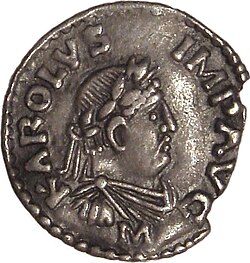
Lorsch Abbey commemorated Charlemagne's date of birth as 2 April from the mid-9th century, and this date is likely to be genuine. He was born into the Carolingian family that was steadily rising to dominance among the Franks.
Image source: Charlemagne
Jan 1, 768 - Dec 31, 814
% complete
Charlemagne united most of Western and Central Europe and was the first recognised emperor to rule from the west after the fall of the Western Roman Empire approximately three centuries earlier. His conquests and diplomacy created an empire of unprecedented scale in the early medieval period.
Jan 1, 769 - Dec 31, 814
% complete
As king and emperor, Charlemagne engaged in numerous reforms in administration, law, education, military organisation, and religion, which shaped Europe for centuries. His reforms standardised governance across his vast empire and fostered a cultural revival known as the Carolingian Renaissance.
Jan 1, 800 - Dec 31, 899
% complete
Scriptoria in monasteries and cathedrals focused on copying new and old works, producing an estimated 90,000 manuscripts during the 9th century. This explosion of textual production was a direct legacy of Charlemagne's educational reforms and preserved much classical learning for posterity.
Image source: Carolingian Renaissance
Dec 25, 800
% complete
Through his assumption of the imperial title, Charlemagne became the forerunner to the line of Holy Roman Emperors, which persisted into the 19th century. His coronation on Christmas Day 800 restored the imperial office in the west.
Image source: The Coronation of Charlemagne
Dec 25, 800 - Dec 31, 812
% complete
Charlemagne's coronation led to a centuries-long ideological conflict between his successors and Constantinople known as the problem of two emperors, which could be seen as a rejection or usurpation of the Byzantine emperors' claim to be the universal, preeminent rulers of Christendom.
Jan 1, 808 - Dec 31, 810
% complete
Charlemagne fought a war against the Danes, who did not pose a threat for the remainder of his reign, but the effects of this war and their earlier expansion in Saxony helped set the stage for the intense Viking raids across Europe later in the 9th century.
Jan 28, 814
% complete
Charlemagne died in 814. The 9th-century biographer Einhard reports him as being 72 years old at the time of his death; the Royal Frankish Annals imprecisely gives his age at death as about 71, and his original epitaph called him a septuagenarian.
Jan 1, 814 - Dec 31, 1900
% complete
According to historian Jennifer Davis, Charlemagne 'invented medieval rulership,' and his influence can be seen at least into the 19th century. Charlemagne grew over the centuries as a figure of myth and emulation; Matthias Becher writes that over 1,000 legends are recorded about him, far outstripping subsequent emperors and kings.
Jan 1, 814 - Dec 31, 1099
% complete
The political structures Charlemagne established remained in place through his Carolingian successors and continued to exert influence into the 11th century, shaping the governance of medieval Europe long after his death.
Jan 1, 865
% complete
The author of the Latin poem Visio Karoli Magni, written c. 865, uses facts (apparently from Einhard) and his own observations on the decline of Charlemagne's family after their civil wars later in the 9th century as the bases of a visionary tale about Charles meeting a prophetic spectre in a dream.
Jan 1, 900
% complete
The epithet 'the Great' is attested in the works of the Poeta Saxo around 900, and it had become commonly applied to Charlemagne by 1000, cementing his reputation as an exceptional ruler.
Jan 1, 962
% complete
Otto founded (or re-established) the Holy Roman Empire, which would last until its dissolution in 1806 during the Napoleonic Wars, continuing the imperial line of which Charlemagne was the forerunner.
Jan 1, 1000
% complete
Emperor Otto III attempted to have Charlemagne canonised in 1000, opening his tomb at Aachen and demonstrating the deep veneration of Charlemagne among medieval emperors.
Image source: Otto III, Holy Roman Emperor
Jan 1, 1100 - Dec 31, 1199
% complete
By the 12th century, Charlemagne is described as bearded rather than moustachioed in literary sources such as the Song of Roland, the Pseudo-Turpin Chronicle, and other works in Latin, French, and German, reflecting the evolution of his legendary image.
Image source: Song of Roland
Jan 1, 1165
% complete
Charlemagne's remains were exhumed by Holy Roman Emperor Frederick Barbarossa in 1165 as part of the emperor's efforts to honour his great predecessor and bolster imperial legitimacy.
Jan 1, 1165
% complete
In 1165 Barbarossa persuaded Antipope Paschal III to elevate Charlemagne to sainthood, a canonisation never recognised by the mainstream Catholic Church but influential in imperial propaganda.
Image source: Antipope Paschal III
Jan 1, 1215
% complete
Charlemagne's remains were reinterred by Frederick II in 1215, completing a ceremonial cycle begun by Barbarossa half a century earlier and reinforcing Charlemagne's cult at Aachen.
Jan 1, 1500 - Dec 31, 1599
% complete
As early as the 16th century, debate between German and French writers began about Charlemagne's 'nationality', with both nations claiming him as a foundational figure of their respective histories.
Jan 1, 1800 - Dec 31, 1899
% complete
Some 19th-century historians tried to use the Oaths of Strasbourg to determine Charlemagne's native language, reflecting scholarly interest in the linguistic world of the Carolingian court.
Image source: Oaths of Strasbourg
Jan 1, 1800 - Dec 31, 1899
% complete
These contrasting portraits—a French Charlemagne versus a German Karl der Große—became especially pronounced during the 19th century with Napoleon's use of Charlemagne's legacy and the rise of German nationalism.
Jan 1, 1800 - Dec 31, 1899
% complete
The view of Charlemagne as 'the father of Europe' was first advanced during the 19th century by Friedrich Schlegel, a German romantic philosopher, though it would only become the dominant interpretation after World War II.
Image source: Friedrich Schlegel
Jan 1, 1806
% complete
The Holy Roman Empire, which Charlemagne's imperial coronation had foreshadowed and Otto I had founded, was dissolved in 1806 during the Napoleonic Wars, ending a millennium of imperial continuity in Central Europe.
Image source: Holy Roman Empire
Jan 1, 1861
% complete
Charlemagne's tomb was opened in 1861 by scientists who reconstructed his skeleton and measured it at 1.92 metres (6 ft 4 in) in length, roughly equivalent to Einhard's measurement of his height.
Oct 1, 1944 - Oct 31, 1944
% complete
As a result of Aachen's association with Charlemagne, Hitler insisted on a staunch defense of the city, which led to a protracted and destructive battle in October 1944 as American forces fought to capture the first German city to fall in the war.
Image source: Battle of Aachen
Jan 1, 1945 - Dec 31, 2026
% complete
Historiography after World War II focused on Charlemagne as 'the father of Europe' rather than a nationalistic figure, a view first advanced during the 19th century by Friedrich Schlegel, a German romantic philosopher.
Jan 1, 1949
% complete
Since 1949, Aachen has awarded an international prize (the Karlspreis der Stadt Aachen) in honour of Charlemagne, recognising contributions to European unity and understanding.
Image source: Charlemagne Prize
Jan 1, 2010
% complete
A 2010 estimate of Charlemagne's height from an X-ray and CT scan of his tibia was 1.84 metres (6 ft 0 in); this puts him in the 99th percentile of height for his period, given that average male height of his time was 1.69 metres (5 ft 7 in).
Or browse the full history timeline directory, with more than 2,000 topics.
This Charlemagne timeline was generated with the help of AI, using information found on the internet.
We work hard to keep these timelines accurate, but mistakes do get through. If you spot one, email us at [email protected] and we'll fix it for future visitors.
Generate yours with AI or build it from scratch, for free.
Export your timeline, add your own events, edit or remove AI-generated events, and much more
No credit card required.
Cancel anytime.
Cancel anytime.
You can create an unlimited number of timelines with up to 10 events on each one, customize how they look, export them to PDF, PNG, PowerPoint, CSV, and Excel, and share them with a link. Paid plans raise the event limit and add features like spreadsheet imports and collaborators.
Yes. You can cancel your subscription from your account page at any time, and you will not be charged again. Your subscription stays active for the rest of the period you already paid for.
Yes. We will email you a reminder before the annual renewal, and we will also email you a receipt.
Yes. You can email us within 15 days of any payment, and we will issue you a full refund.
Check out our pricing docs or send us an email anytime: [email protected].