
-
Use Cases
-
Resources
-
Pricing
The Deepwater Horizon oil spill, also known as the BP oil spill, began on April 20, 2010, when an explosion on the Deepwater Horizon drilling rig in the Gulf of Mexico killed 11 workers and triggered a massive oil leak from the Macondo well. Over 87 days, approximately 4.9 million barrels of crude oil flowed into the Gulf before the well was capped, causing catastrophic damage to marine ecosystems, coastal communities, and industries across the region. More Less
Feb 2010 - Apr 2016
% complete
Federal and state trustees initiated a Natural Resource Damage Assessment (NRDA) under the Oil Pollution Act to quantify harm to Gulf ecosystems and wildlife. Studies documented injuries to dolphins, sea turtles, birds, corals, and marsh habitats, forming the basis for the record restoration settlement reached years later.
Image source: Natural resource valuation
May 1, 2010
% complete
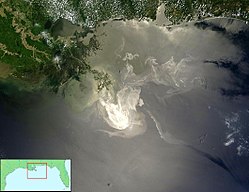
Light bands of weathered oil from the spreading slick began washing ashore along Louisiana's fragile barrier islands and marshes, threatening sensitive wetland ecosystems, wildlife breeding grounds, and the region's vital fishing and tourism industries. Booms were deployed in an effort to protect shorelines.
Image source: Deepwater Horizon oil spill
Apr 4, 2016
% complete
Federal agencies approved a comprehensive restoration plan directing billions of dollars toward rebuilding Gulf ecosystems, restoring wetlands and oyster reefs, protecting endangered species, and revitalizing coastal economies. Restoration projects funded by the settlement are expected to continue for decades.
Image source: RESTORE Act
Feb 15, 2010
% complete
The Deepwater Horizon, a dynamically positioned semi-submersible offshore drilling rig owned by Transocean and leased by BP, began drilling an exploratory well at the Macondo Prospect in Mississippi Canyon Block 252, about 41 miles off the Louisiana coast in the Gulf of Mexico. The well was planned to a depth of approximately 18,000 feet below sea level.
Image source: Deepwater Horizon
Apr 16, 2010
% complete
Just days before the disaster, the Minerals Management Service (MMS) announced that the Deepwater Horizon was among the finalists for its 2010 Safety Award for Excellence, highlighting the industry's perception of the rig's strong safety record despite growing concerns about the pace of deepwater drilling operations.
Apr 19, 2010
% complete
Halliburton completed cementing the final production casing string of the Macondo well using nitrogen foam cement. Later investigations found that the cement job likely failed to isolate the hydrocarbon-bearing formation, allowing gas to migrate up the wellbore — a critical failure that set the stage for the blowout.
Apr 20, 2010
% complete
Crew members performed a negative pressure test to verify well integrity before temporarily abandoning the well. The initial test showed anomalous pressure readings on the drill pipe, but after further manipulation of the test procedure, crew members declared the test successful despite indications that the well may not have been properly sealed.
Image source: Deepwater Horizon explosion
Apr 20, 2010
% complete
At approximately 9:45 p.m., high-pressure methane gas escaped from the Macondo well, shot up the riser onto the platform, and ignited, triggering massive explosions and fires on the Deepwater Horizon. Eleven workers were killed and 17 others injured; most of the 126 crew members evacuated by lifeboat or jumped into the sea.
Apr 21, 2010 - Apr 24, 2010
% complete
The U.S. Coast Guard launched an extensive search-and-rescue operation covering thousands of square miles of the Gulf of Mexico for the eleven missing crew members. Despite three days of searching by air and sea, none of the missing workers were found, and they were presumed dead.
Apr 22, 2010
% complete
After burning for approximately 36 hours, the heavily damaged Deepwater Horizon sank beneath the surface of the Gulf of Mexico about 50 miles southeast of Venice, Louisiana. The sinking ruptured the riser connecting the rig to the wellhead, unleashing an uncontrolled flow of oil from the well nearly a mile below the surface.
Apr 22, 2010
% complete
The Coast Guard discovered oil leaking from the damaged wellhead and broken riser pipe on the seafloor, roughly 5,000 feet below the surface. Initial estimates suggested around 1,000 barrels per day were escaping, an estimate that would later be revised dramatically upward as the spill's severity became clear.
Image source: Timeline of the Deepwater Horizon oil spill
Apr 24, 2010 - May 2010
% complete
Remotely operated vehicles (ROVs) made repeated attempts over several days to activate the well's blowout preventer, a 450-ton stack of valves designed to seal the well in an emergency. The device had failed during the blowout, and all attempts to trigger it remotely proved unsuccessful, leaving the well flowing freely.
Image source: Blowout preventer
Apr 25, 2010
% complete
The Obama administration declared the spill an incident of national significance and mobilized federal resources, deploying the Coast Guard, Navy vessels, and National Guard troops to assist with containment. Homeland Security Secretary Janet Napolitano and Interior Secretary Ken Salazar traveled to the Gulf to oversee the response.
Apr 28, 2010
% complete
NOAA estimated that the leaking well was releasing approximately 5,000 barrels (210,000 gallons) of crude oil per day — five times the earlier estimate. Subsequent scientific assessments would eventually conclude the actual rate was far higher, peaking at an estimated 60,000 barrels per day.
May 2, 2010 - Jun 4, 2010
% complete
President Barack Obama made multiple trips to Louisiana, Mississippi, Alabama, and Florida during the crisis to inspect cleanup efforts and reassure affected communities. His administration faced criticism over the perceived slow federal response, drawing comparisons to the government's handling of Hurricane Katrina.
Image source: Political effects of Hurricane Katrina
May 7, 2010 - May 8, 2010
% complete
BP lowered a 98-ton containment dome over the largest leak point in an attempt to capture escaping oil. The effort failed when methane gas hydrates accumulated inside the dome, clogging the pipe intended to funnel oil to the surface and rendering the structure buoyant and unusable.
May 16, 2010 - May 25, 2010
% complete
BP inserted a narrow tube into the broken riser pipe, siphoning a portion of the escaping oil and gas to a surface vessel for processing. At its peak, the tube captured roughly 2,000 barrels per day — only a fraction of the total flow, but the first partial success in containing the spill.
May 26, 2010 - May 29, 2010
% complete
BP attempted a 'top kill,' pumping heavy drilling mud into the well at high pressure to overcome the upward flow of oil, followed by cement to permanently seal it. After three days, BP announced the procedure had failed, dashing hopes for a quick end to the spill and intensifying public frustration.
Jun 3, 2010 - Jul 15, 2010
% complete
Using robotic saws to cut away the damaged riser, BP installed a lower marine riser package (LMRP) cap over the wellhead. The cap gradually increased its collection rate, eventually capturing the majority of the escaping oil through a drillship on the surface until the well was fully sealed.
Aug 3, 2010 - Aug 5, 2010
% complete
BP pumped heavy drilling mud through the newly installed cap into the well in a 'static kill' operation, forcing the oil back down into the reservoir. The procedure succeeded in stabilizing the well, paving the way for the final permanent sealing via the relief wells.
Sep 16, 2010 - Sep 19, 2010
% complete
After months of drilling, the first relief well intersected the Macondo well at a depth of about 13,000 feet below the seafloor. Crews pumped cement into the annulus, and on September 19, retired Coast Guard Admiral Thad Allen declared the well effectively dead, ending the flow of oil after 87 days.
Sep 19, 2010
% complete
National Incident Commander Thad Allen announced that the Macondo well was 'effectively dead,' confirming that cement injected through the relief well had permanently sealed it. An estimated 4.9 million barrels of oil had been released, making it the largest marine oil spill in history.
Apr 23, 2010
% complete
Under the Oil Pollution Act of 1990, BP was designated the 'responsible party' for the spill, making it legally liable for cleanup costs and damages. BP committed to paying all legitimate response costs, marking the beginning of what would become tens of billions of dollars in financial obligations for the company.
May 30, 2010 - Oct 12, 2010
% complete
Interior Secretary Ken Salazar issued a six-month moratorium on new deepwater drilling permits in the Gulf of Mexico, suspending 33 exploratory wells. The ban, later extended, drew fierce opposition from Gulf Coast officials and industry groups who warned of economic devastation, and it was challenged in federal court.
Jun 16, 2010
% complete
After meeting with President Obama at the White House, BP agreed to establish a $20 billion claims fund administered by attorney Kenneth Feinberg to compensate individuals and businesses harmed by the spill. The company also suspended its dividend to preserve capital for spill-related obligations.
Jun 17, 2010
% complete
BP CEO Tony Hayward testified before the House Energy and Commerce Committee, facing sharp criticism for evasive answers and his earlier remark that he wanted his 'life back.' Lawmakers accused BP of cutting corners to save time and money. Hayward stepped down as CEO months later, replaced by Bob Dudley.
Image source: Tony Hayward
Jun 22, 2010 - Jan 11, 2011
% complete
President Obama created the bipartisan National Commission on the BP Deepwater Horizon Oil Spill and Offshore Drilling, co-chaired by former Senator Bob Graham and former EPA Administrator William Reilly, to investigate the causes of the disaster and recommend reforms to offshore drilling regulation.
Jan 11, 2011
% complete
The presidential commission concluded that the disaster was avoidable and resulted from systemic failures by BP, Halliburton, and Transocean, compounded by weak regulatory oversight. It called for sweeping reforms to offshore drilling safety practices, industry standards, and government regulation.
Image source: Deepwater Horizon oil spill
Mar 2, 2012
% complete
A federal court approved a class-action settlement between BP and private plaintiffs — including fishermen, hotel owners, and other Gulf businesses and residents — valued at approximately $7.8 billion. Payments continued for years, though disputes over claim eligibility led to further litigation.
Nov 15, 2012
% complete
BP pleaded guilty to 14 criminal counts, including 11 felony counts of manslaughter for the deaths of the rig workers, and agreed to pay $4 billion in fines and penalties — the largest criminal resolution in U.S. history at the time. Two Halliburton employees and a Transocean executive also faced charges.
Sep 4, 2014
% complete
U.S. District Judge Carl Barbier ruled that BP bore 67% of the blame and acted with gross negligence and willful misconduct, a finding that exposed the company to Clean Water Act penalties of up to $4,300 per barrel spilled. Halliburton and Transocean were found negligent but not grossly so.
Jul 2, 2015
% complete
BP reached an $18.7 billion settlement with the federal government and five Gulf states, resolving outstanding Clean Water Act penalties and natural resource damage claims. Combined with prior payments, BP's total pre-tax costs for the disaster ultimately exceeded $65 billion.
Or browse the full history timeline directory, with more than 2,000 topics.
This Deepwater Horizon Oil Spill timeline was generated with the help of AI, using information found on the internet.
We work hard to keep these timelines accurate, but mistakes do get through. If you spot one, email us at [email protected] and we'll fix it for future visitors.
Generate yours with AI or build it from scratch, for free.
Export your timeline, add your own events, edit or remove AI-generated events, and much more
No credit card required.
Cancel anytime.
Cancel anytime.
You can create an unlimited number of timelines with up to 10 events on each one, customize how they look, export them to PDF, PNG, PowerPoint, CSV, and Excel, and share them with a link. Paid plans raise the event limit and add features like spreadsheet imports and collaborators.
Yes. You can cancel your subscription from your account page at any time, and you will not be charged again. Your subscription stays active for the rest of the period you already paid for.
Yes. We will email you a reminder before the annual renewal, and we will also email you a receipt.
Yes. You can email us within 15 days of any payment, and we will issue you a full refund.
Check out our pricing docs or send us an email anytime: [email protected].