-
Use Cases
-
Resources
-
Pricing
The history of the oil industry traces the discovery, extraction, refining, and global trade of petroleum from the mid-19th century onward. Beginning with Edwin Drake's first commercial well in Pennsylvania in 1859, the industry grew rapidly with the rise of Standard Oil, the expansion of international exploration, the founding of OPEC, and the oil crises of the 1970s. Today, petroleum remains a cornerstone of the global economy while facing challenges from environmental concerns and the transition to renewable energy. More Less
1800 - 1900
% complete
Petroleum's importance to the world economy evolved slowly, with whale oil being used for lighting in the 19th century, while wood and coal remained dominant fuels for heating and cooking well into the 20th century.
Image source: Whale oil
1850
% complete
When it was discovered that kerosene could be extracted from crude oil and used as a lighting and heating fuel, demand for petroleum increased greatly, and by the early twentieth century it had become the most valuable commodity traded on world markets.
1854 - 1856
% complete
Ignacy Łukasiewicz built one of the first modern oil-refineries near Jasło (then in Austrian Galicia), present-day Poland, between 1854 and 1856.
Image source: Ignacy Łukasiewicz
1825 - 1850
% complete
Imperial Russia produced 3,500 tons of oil in 1825 and doubled its output by mid-century, laying the groundwork for its later dominance of international oil markets.
Image source: Petroleum industry in Russia
1846
% complete
In 1846 Baku's Bibi-Heybat settlement featured the first ever well drilled with percussion tools to a depth of 21 meters for oil exploration.
Image source: Bibi-Heybat Mosque
1846
% complete
After oil drilling began in 1846 in the region of present-day Azerbaijan, in Baku, the Russian Empire later built two major pipelines to transport crude oil across the region.
Image source: History of the petroleum industry
1871 - 1872
% complete
The first drilled oil wells in Baku were built in 1871–1872 by Ivan Mirzoev, an Armenian businessman referred to as one of the 'founding fathers' of Baku's oil industry.
1878
% complete
In 1878 Ludvig Nobel and his Branobel company revolutionized oil transport by commissioning the first oil tanker and launching it on the Caspian Sea.
Image source: Branobel
1878
% complete
The first successful oil tanker, the Zoroaster, was built in 1878 in Sweden and designed by Ludvig Nobel for service on the Caspian Sea.
1884
% complete
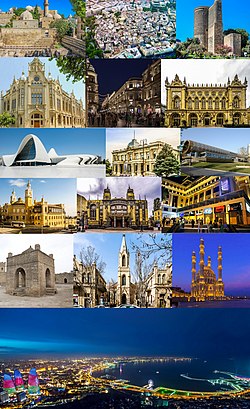
By 1884 nearly 200 small refineries operated in the suburbs of Baku, making it one of the world's great centers of petroleum refining.
Image source: Baku
1900
% complete
At the turn of the 20th century, Imperial Russia's output of oil, almost entirely from the Apsheron Peninsula, accounted for half of the world's production and dominated international markets.
1906
% complete
Completed in 1906, the 833 km Baku-Batum pipeline transported oil from the Caspian Sea to the Black Sea port of Batum, complemented by a 162 km pipeline carrying oil from Chechnya to the Caspian.
Image source: Baku–Tbilisi–Ceyhan pipeline
1853
% complete
Samuel Kier established America's first oil refinery in Pittsburgh on Seventh avenue near Grant Street in 1853, pioneering petroleum refining in the United States.
Image source: Samuel Kier
1855 - 1858
% complete
Businessman James Miller Williams dug several wells between 1855 and 1858 before discovering a rich reserve of oil four metres below ground in Ontario.
Image source: James Miller Williams
1858
% complete
The first commercial oil-well in Canada became operational in 1858 at Oil Springs, Ontario (then Canada West), marking a milestone for North American oil production.
Image source: Oil Springs, Ontario
Aug 28, 1859
% complete
Edwin Drake's 1859 well near Titusville, Pennsylvania, typically considered the first true modern oil well, came into production on August 28, 1859 and touched off a major oil boom.
Image source: Drake Well
1860
% complete
By 1860 Williams had extracted 1.5 million litres of crude oil from his wells at Oil Springs, refining much of it into kerosene-lamp oil.
Jan 16, 1862
% complete
Canada's first gusher (flowing well) erupted on January 16, 1862, when local oil-man John Shaw struck oil at 158 feet (48 m) below ground.
Image source: Martin Shaw
1900 - 1925
% complete
In the first quarter of the 20th century, the United States overtook Russia as the world's largest oil producer, reflecting the booming American petroleum industry.
1937
% complete
In 1937 Pure Oil Company (now part of Chevron) and its partner Superior Oil Company (now part of ExxonMobil) used a fixed platform to develop a field in 14 feet of water, one mile offshore of Calcasieu Parish, Louisiana.
Image source: Pure Oil
1947
% complete
In early 1947 Superior Oil erected a drilling/production oil-platform in 20 ft of water some 18 miles off Vermilion Parish, Louisiana.
Image source: Superior Oil Company
Nov 1947
% complete
Kerr-McGee Oil Industries, as operator for partners Phillips Petroleum (ConocoPhillips) and Stanolind Oil & Gas (BP), completed its historic Ship Shoal Block 32 well in November 1947, months before Superior drilled a discovery farther offshore.
Image source: Kerr-McGee
1949
% complete
Forty-four Gulf of Mexico exploratory wells discovered 11 oil and natural gas fields by the end of 1949, accelerating offshore exploration.
Image source: Gulf of Mexico
1949
% complete
In 1949 the first offshore oil-drilling at Oil Rocks (Neft Dashlari) in the Caspian Sea off Azerbaijan eventually resulted in a city built on pylons.
Image source: Neft Daşları
1939 - 1945
% complete
During World War II (1939–1945) control of oil supply from Romania, Baku, the Middle East and the Dutch East Indies played a huge role in the events of the war and the ultimate victory of the Allies.
Image source: Oil campaign of World War II
1941
% complete
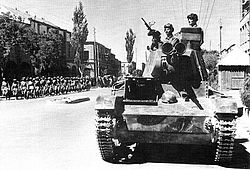
The Anglo-Soviet invasion of Iran in 1941 secured Allied control of oil-production in the Middle East during World War II.
Image source: Anglo-Soviet invasion of Iran
1942
% complete
Germany, cut off from sea-borne oil supplies by the Allied blockade, failed in Operation Edelweiss to secure the Caucasus oil-fields for the Axis military in 1942.
Image source: Battle of the Caucasus
Aug 1944
% complete
From August 1944, Romania deprived the Wehrmacht of access to the Ploesti oilfields – the largest in Europe – dealing a severe blow to Nazi Germany's fuel supplies.
Image source: Ploiești
1945
% complete
After World War II ended in 1945, the countries of the Middle East took the lead in oil production from the United States, reshaping the global energy landscape.
1959
% complete
In 1959, at a symposium organised by the American Petroleum Institute for the centennial of the American oil industry, physicist Edward Teller warned of the danger of global climate change.
Image source: Edward Teller
1988
% complete
The Intergovernmental Panel on Climate Change, founded by the United Nations in 1988, concludes that human-sourced greenhouse gases are responsible for most of the observed temperature increase since the middle of the twentieth century.
Image source: Intergovernmental Panel on Climate Change
1990 - 1997
% complete
Scholars have examined how the petroleum industry opposed climate policy by supporting economic explanations that emphasized the costs of proposed regulations, with industry-funded consultants and linked organizations promoting these cost estimates in public communications and policy debates during the 1990s, including leading up to the 1997 Kyoto climate negotiations.
Image source: Kyoto Protocol
2010 - 2018
% complete
Contributions tied to the petroleum industry to congressional candidates rose from about $35 million in 2010 to over $84 million in 2018, reflecting growing political influence.
Image source: Campaign finance in the United States
2012
% complete
A ranking of the ten largest national oil companies by reserves and by production in 2012 highlighted the continued dominance of state-owned petroleum enterprises in the global industry.
2015
% complete
The United States consumed 18% of the oil produced in 2015, underscoring its continued central role in global petroleum demand.
Image source: List of countries by oil consumption
Or browse the full history timeline directory, with more than 2,000 topics.
This History of Oil Industry timeline was generated with the help of AI, using information found on the internet.
We work hard to keep these timelines accurate, but mistakes do get through. If you spot one, email us at [email protected] and we'll fix it for future visitors.
Generate yours with AI or build it from scratch, for free.
Export your timeline, add your own events, edit or remove AI-generated events, and much more
No credit card required.
Cancel anytime.
Cancel anytime.
You can create an unlimited number of timelines with up to 10 events on each one, customize how they look, export them to PDF, PNG, PowerPoint, CSV, and Excel, and share them with a link. Paid plans raise the event limit and add features like spreadsheet imports and collaborators.
Yes. You can cancel your subscription from your account page at any time, and you will not be charged again. Your subscription stays active for the rest of the period you already paid for.
Yes. We will email you a reminder before the annual renewal, and we will also email you a receipt.
Yes. You can email us within 15 days of any payment, and we will issue you a full refund.
Check out our pricing docs or send us an email anytime: [email protected].