-
Use Cases
-
Resources
-
Pricing
Gabriel García Márquez (1927–2014) was a Colombian novelist, journalist, and one of the most influential writers of the 20th century. A leading figure of magical realism, he is best known for his masterpiece One Hundred Years of Solitude, which transformed Latin American literature and earned him worldwide acclaim, including the 1982 Nobel Prize in Literature. More Less
Mar 6, 1927
% complete
Gabriel José García Márquez was born on 6 March 1927 in the small town of Aracataca, in the Caribbean region of Colombia, to Gabriel Eligio García and Luisa Santiaga Márquez Iguarán.
Image source: Gabriel García Márquez
Dec 1936
% complete
In December 1936, his father took him and his brother to Sincé.
Mar 1937
% complete
When his grandfather died in March 1937, the family moved first back to Barranquilla and then on to Sucre, where his father started a pharmacy.
1947
% complete
After his graduation in 1947, García Márquez stayed in Bogotá to study law at the Universidad Nacional de Colombia, but spent most of his spare time reading fiction.
1947 - 1955
% complete
From 1947 to 1955, he wrote a series of short stories that were later published under the title "Eyes of a Blue Dog".
Image source: Gabriel García Márquez
Sep 13, 1947
% complete
His first published work, "La tercera resignación", appeared in the 13 September 1947 edition of the newspaper El Espectador.
1948 - 1949
% complete
In 1948 and 1949, he wrote for El Universal in Cartagena, beginning his career in journalism while continuing law studies to please his father.
Image source: El Universal (Cartagena)
1950
% complete
In 1950, he ended his legal studies to focus on journalism and moved again to Barranquilla to work as a columnist and reporter in the newspaper El Heraldo.
1950 - 1952
% complete
From 1950 until 1952, he wrote a whimsical column under the name of "Septimus" for the local paper El Heraldo in Barranquilla.
1954 - 1955
% complete
From 1954 to 1955, García Márquez spent time in Bogotá and regularly wrote for Bogotá's El Espectador.
1955
% complete
Leaf Storm is García Márquez's first novella and took seven years to find a publisher before finally being published in 1955. He later called it his favorite work because he felt it was the most sincere and spontaneous.
Image source: Leaf Storm
1961
% complete
In 1961 he published No One Writes to the Colonel, one of the novels he became best known for.
Image source: No One Writes to the Colonel
1962
% complete
1966
% complete
Among his other screenplays was the film Tiempo de morir (1966), one of several cinematic works he contributed to over his career.
Image source: Tiempo de morir
1967
% complete
When One Hundred Years of Solitude was published in 1967, it became his most commercially successful novel, selling over 50 million copies worldwide. The novel was widely popular and led to his Nobel Prize as well as the Rómulo Gallegos Prize in 1972. An English translation by Gregory Rabassa followed in 1970.
Image source: One Hundred Years of Solitude
1968 - 1975
% complete
García Márquez began writing Autumn of the Patriarch in 1968 and said it was finished in 1971; however, he continued to embellish the dictator novel until 1975, when it was published in Spain.
Image source: The Autumn of the Patriarch
1972
% complete
The Incredible and Sad Tale of Innocent Eréndira and Her Heartless Grandmother was published in 1972, and was later adapted into the 1983 art film Eréndira directed by Ruy Guerra.
Image source: Eréndira (film)
1981
% complete
Chronicle of a Death Foretold, a combination of journalism, realism and detective story inspired by a real-life murder that took place in Sucre, Colombia in 1951, was published in 1981, the year before he won the Nobel Prize.
Image source: Chronicle of a Death Foretold
1983
% complete
The novella The Incredible and Sad Tale of Innocent Eréndira and Her Heartless Grandmother was adapted into the 1983 art film Eréndira, directed by Ruy Guerra, with whom García Márquez worked on rewriting the script.
1985
% complete
Love in the Time of Cholera, one of the novels he became best known for, was first published in 1985.
Image source: Love in the Time of Cholera
1987
% complete
In 1987, the Italian director Francesco Rosi directed the movie Cronaca di una morte annunciata based on Chronicle of a Death Foretold.
Image source: Chronicle of a Death Foretold (film)
1991
% complete
In 1991, he published Changing the History of Africa, an admiring study of Cuban activities in the Angolan Civil War and the larger South African Border War.
1992 - 1997
% complete
García Márquez was one of the original founders of QAP, a Colombian newscast that aired between 1992 and 1997.
1996
% complete
2002
% complete
In 2002 García Márquez published the memoir Vivir para contarla, the first of a projected three-volume autobiography, three years after his cancer diagnosis prompted him to begin writing memoirs.
Image source: Living to Tell the Tale
Nov 2003
% complete
Edith Grossman's English translation, Living to Tell the Tale, was published in November 2003.
Oct 2004
% complete
October 2004 brought the publication of a novel, Memories of My Melancholy Whores, a love story that follows the romance of a 90-year-old man and a child forced into prostitution.
Image source: Memories of My Melancholy Whores
May 2008
% complete
In May 2008 it was announced that García Márquez was finishing a new "novel of love" that had yet to be given a title, to be published by the end of the year.
Image source: Until August
1956 - 1958
% complete
From 1956, he spent two years in Europe, returning to marry Mercedes Barcha in Barranquilla in 1958, and to work on magazines in Caracas, Venezuela.
1958
% complete
In 1958, he married Mercedes Barcha Pardo; they had two sons, Rodrigo and Gonzalo.
Image source: Mercedes Barcha
1961
% complete
In 1961, the family traveled by Greyhound bus throughout the southern United States and eventually settled in Mexico City.
1972
% complete
One Hundred Years of Solitude led to García Márquez receiving the Rómulo Gallegos Prize in 1972.
Image source: Rómulo Gallegos Prize
1972
% complete
García Márquez was awarded the 1972 Neustadt International Prize for Literature, further cementing his reputation as one of the most significant authors of the 20th century.
Image source: Neustadt International Prize for Literature
Oct 1982
% complete
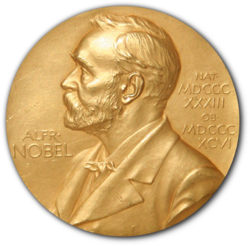
In 1982, García Márquez was awarded the Nobel Prize in Literature, becoming the fourth Latin American to receive the honor, following Gabriela Mistral (1945), Miguel Ángel Asturias (1967), and Pablo Neruda (1971).
Image source: Nobel Prize in Literature
Dec 10, 1982
% complete
García Márquez received the Nobel Prize in Literature on 10 December 1982 "for his novels and short stories, in which the fantastic and the realistic are combined in a richly composed world of imagination, reflecting a continent's life and conflicts".
1999
% complete
In 1999 García Márquez was misdiagnosed with pneumonia instead of lymphatic cancer. This event prompted him to begin writing his memoirs, locking himself away to write every day without interruption.
2000
% complete
In 2000 his impending death was incorrectly reported by Peruvian daily newspaper La República.
Dec 2008
% complete
In December 2008 García Márquez told fans at the Guadalajara book fair that writing had worn him out.
2009
% complete
In 2009, responding to claims by both his literary agent and his biographer that his writing career was over, he told Colombian newspaper El Tiempo: "Not only is it not true, but the only thing I do is write".
Apr 2009
% complete
In April 2009 his agent, Carmen Balcells, told the Chilean newspaper La Tercera that García Márquez was unlikely to write again.
2012
% complete
In 2012 his brother Jaime announced that García Márquez was suffering from dementia.
Apr 2014
% complete
In April 2014, García Márquez was hospitalized in Mexico.
Apr 17, 2014
% complete
García Márquez died of pneumonia at the age of 87 on 17 April 2014, in Mexico City.
Feb 2015
% complete
In February 2015, the heirs of Gabriel García Márquez deposited a legacy of the writer in his Memoriam in the Caja de las Letras of the Instituto Cervantes.
Image source: Instituto Cervantes
2023
% complete
In 2023, García Márquez surpassed Miguel de Cervantes as the most translated Spanish-language writer according to the World Translation Map, and remains the most translated Spanish-language author between 2000–2021.
2023
% complete
In 2023 it was announced that the untitled final "novel of love", whose English title would be Until August, would be released posthumously in 2024.
Mar 6, 2024
% complete
The book Until August was published posthumously on the 97th anniversary of his birth, 6 March 2024, against Márquez's own wishes that the manuscript be destroyed after his death.
Or browse the full history timeline directory, with more than 2,000 topics.
This Gabriel García Márquez timeline was generated with the help of AI, using information found on the internet.
We work hard to keep these timelines accurate, but mistakes do get through. If you spot one, email us at [email protected] and we'll fix it for future visitors.
Generate yours with AI or build it from scratch, for free.
Export your timeline, add your own events, edit or remove AI-generated events, and much more
No credit card required.
Cancel anytime.
Cancel anytime.
You can create an unlimited number of timelines with up to 10 events on each one, customize how they look, export them to PDF, PNG, PowerPoint, CSV, and Excel, and share them with a link. Paid plans raise the event limit and add features like spreadsheet imports and collaborators.
Yes. You can cancel your subscription from your account page at any time, and you will not be charged again. Your subscription stays active for the rest of the period you already paid for.
Yes. We will email you a reminder before the annual renewal, and we will also email you a receipt.
Yes. You can email us within 15 days of any payment, and we will issue you a full refund.
Check out our pricing docs or send us an email anytime: [email protected].