
-
Use Cases
-
Resources
-
Pricing
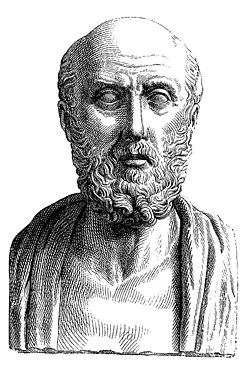
Hippocrates of Kos (c. 460 – c. 370 BCE) was an ancient Greek physician widely regarded as the Father of Medicine. He founded a medical school on the island of Kos and revolutionized healthcare by separating medicine from superstition and religion, promoting observation, diagnosis, and rational treatment. The Hippocratic Corpus, a collection of medical writings attributed to him and his followers, and the Hippocratic Oath, an ethical code for physicians, remain profoundly influential in medicine today. More Less
460 BC
% complete
Hippocrates is traditionally believed to have been born around 460 BC on the Aegean island of Kos. He came from a family that claimed descent from Asclepius, the god of medicine, and his father Heracleides was reportedly a physician who gave him early training in the healing arts.
460 BC
% complete
Hippocrates belonged to the Asclepiads, a hereditary guild or family of physicians tracing their origins to Asclepius. This tradition meant he likely received formal training through apprenticeship within his family, learning remedies, rituals, and practical medical techniques from an early age.
Image source: Asclepieion
450 BC
% complete
As a young man Hippocrates received a broad education encompassing medicine, gymnastics, rhetoric, and philosophy. Sources suggest he studied under his father and later under Democritus of Abdera and Gorgias of Leontini, absorbing both scientific speculation and the art of persuasion.
445 BC
% complete
Hippocrates is said to have trained at the Asclepieion, or healing temple, on his home island of Kos. There patients gathered for treatment and cures were recorded, giving aspiring physicians exposure to many diseases and an empirical foundation for medical practice.
440 BC - 420 BC
% complete
According to ancient biographers, Hippocrates traveled widely across the Greek world, including Thessaly, Thrace, Propontis, and possibly Scythia and Egypt. His journeys exposed him to diverse climates and diseases, material later reflected in the treatise Airs, Waters, Places.
Image source: Hippocrates
430 BC - 426 BC
% complete
Tradition holds that Hippocrates responded to devastating epidemic outbreaks in the Greek world during this period, including plague-like fevers. Later legends credit him with controlling epidemics through measures such as purifying air with bonfires, though the accounts are largely apocryphal.
Image source: Plague of Athens
420 BC
% complete
Hippocratic medicine rejected explanations attributing illness to gods or curses, insisting that every disease had a natural cause. This epistemological shift toward observation, diagnosis, and natural causation is often regarded as the founding moment of Western scientific medicine.
Image source: Ancient Greek medicine
410 BC - 380 BC
% complete
The books of the Epidemics contain day-by-day descriptions of individual patients' symptoms, including famous case studies such as those of Philiscus, Cnidus, and Thasus. They represent some of the oldest surviving clinical records and demonstrate rigorous longitudinal observation of disease.
Image source: Hippocratic Corpus
400 BC
% complete
Hippocratic therapy centered on regimen—diet, exercise, sleep, bathing, and environmental adjustment—with drugs and surgery reserved as needed. Treatises like Regimen in Health and On Regimen detailed how physicians should tailor lifestyle prescriptions to each patient's constitution.
Image source: Dietitian
400 BC
% complete
Corpus treatises such as On Fractures and On Joints describe reduction of dislocations, treatment of fractures including the Hippocratic bench for traction, management of head injuries, and drainage of empyema. These works show a remarkably sophisticated level of surgical practice.
400 BC
% complete
The Prognostic taught physicians to predict the course of illness by observing signs such as facial appearance, fever patterns, and sleep. Emphasis on careful daily observation of patients made prognosis a central skill of the Coan physician and founded clinical medicine as a discipline.
395 BC - 385 BC
% complete
Later traditions place Hippocrates treating patients during military campaigns and pestilences in Thessaly, where several cities honored him. Ancient accounts claim Larisa granted him citizenship and honors for his services during outbreaks of contagious disease.
Image source: Thessaly
430 BC - 370 BC
% complete
Throughout his career Hippocrates taught pupils through lectures, demonstrations, and bedside instruction. Many works of the Hippocratic Corpus appear to be teaching texts written for students, laying out methods of diagnosis, prognosis, and treatment in systematic form.
430 BC
% complete
Hippocrates established a school of medicine on Kos that emphasized systematic observation, clinical training, and rational explanation over superstition. The Coan school became one of the two great centers of Greek medicine alongside its rival at Cnidos.
Image source: Kos
420 BC
% complete
This treatise argued that environment—climate, water quality, winds, and local customs—shapes the health and character of populations. It marks one of the earliest attempts at a systematic medical geography and epidemiological analysis.
420 BC
% complete
Hippocratic medicine articulated the doctrine of four humors—blood, phlegm, yellow bile, and black bile—whose balance determined health and whose imbalance caused disease. This framework dominated European medicine for nearly two thousand years until the rise of modern pathology.
Image source: Humorism
400 BC
% complete
Works such as Physician, Decorum, and Precepts codified physician conduct: professionalism, compassion, discretion, fair fees, and humility before the limits of medicine. These writings created an enduring ideal of the physician as both skilled craftsman and moral agent.
400 BC
% complete
The Hippocratic Oath set ethical obligations for physicians, including duties to teachers, prohibitions on harmful drugs and abortion, and requirements of confidentiality. It became the archetype of medical ethics and continues to influence modern professional oaths.
400 BC - 300 BC
% complete
The roughly sixty treatises of the Hippocratic Corpus were composed and compiled between about 420 and 350 BC, though most are by students and followers rather than Hippocrates himself. The collection spans surgery, gynecology, epidemics, dietetics, ethics, and medical philosophy.
400 BC
% complete
In this influential treatise epilepsy, then called the sacred disease, was declared no more divine than other illnesses but instead a natural disorder of the brain. The work is celebrated as a landmark argument for naturalistic explanations of disease against supernatural interpretations.
Image source: On the Sacred Disease
400 BC
% complete
Already during his lifetime Hippocrates acquired fame throughout Greece; Plato twice refers to him in the Protagoras and Phaedrus, calling him an Asclepiad and comparing him to great sculptors. Contemporaries regarded him as the foremost practitioner and teacher of medicine of the era.
370 BC
% complete
Hippocrates died around 370 BC, traditionally in Larisa, Thessaly, at an advanced age estimated near ninety years. Ancient sources differ on the exact year, with estimates ranging from about 380 to 350 BC, but all agree he lived to old age and died greatly honored.
360 BC
% complete
Ancient writers report that bees made honey on Hippocrates' tomb near Larisa, honey sought after for healing children's sores. The story reflects how quickly his memory passed into legend and how his grave became a symbol of his enduring healing power.
Image source: Larissa
300 BC
% complete
By the Hellenistic period scholars at Alexandria organized the writings of the Coan school into a canonical corpus attributed to Hippocrates, cementing his name as the authority of Greek medicine and preserving the texts that shaped medical education for millennia.
150 AD - 210 AD
% complete
The Roman-era physician Galen revered Hippocrates, writing commentaries on his works and building his own vast medical system upon Hippocratic humoral theory. Galen's endorsement transmitted Hippocratic medicine intact to Byzantine, Islamic, and medieval European physicians.
Image source: Galen
800 AD - 1200 AD
% complete
Physicians such as Al-Razi, Avicenna, and Al-Ruhawi translated and expanded on Hippocratic teachings, with Al-Ruhawi writing the first work on Islamic medical ethics modeled on the Hippocratic tradition. Their scholarship preserved and elaborated the Corpus for centuries.
Image source: Medicine in the medieval Islamic world
1100 AD - 1400 AD
% complete
Through Arabic-Latin translation movements in Salerno and Toledo, Hippocratic treatises including Aphorisms and the Oath entered European universities, forming the backbone of scholastic medical curricula and reviving clinical observation in Western medicine.
Image source: Renaissance of the 12th century
Or browse the full history timeline directory, with more than 2,000 topics.
This Hippocrates timeline was generated with the help of AI, using information found on the internet.
We work hard to keep these timelines accurate, but mistakes do get through. If you spot one, email us at [email protected] and we'll fix it for future visitors.
Generate yours with AI or build it from scratch, for free.

Export your timeline, add your own events, edit or remove AI-generated events, and much more
No credit card required.
Cancel anytime.
Cancel anytime.
You can create an unlimited number of timelines with up to 10 events on each one, customize how they look, export them to PDF, PNG, PowerPoint, CSV, and Excel, and share them with a link. Paid plans raise the event limit and add features like spreadsheet imports and collaborators.
Yes. You can cancel your subscription from your account page at any time, and you will not be charged again. Your subscription stays active for the rest of the period you already paid for.
Yes. We will email you a reminder before the annual renewal, and we will also email you a receipt.
Yes. You can email us within 15 days of any payment, and we will issue you a full refund.
Check out our pricing docs or send us an email anytime: [email protected].