
-
Use Cases
-
Resources
-
Pricing
The history of algebra traces the development of one of mathematics' most fundamental branches, from ancient Babylonian and Egyptian methods for solving equations, through the symbolic innovations of Diophantus and al-Khwarizmi (whose work gave algebra its name), to the Renaissance breakthroughs in solving polynomial equations and the 19th-century emergence of abstract algebra with groups, rings, and fields. More Less
1900 BC - 1600 BC
% complete
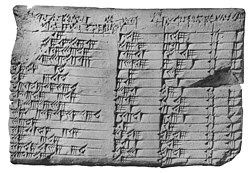
One of the most famous Babylonian mathematical tablets, Plimpton 322 was created around 1900–1600 BC. It gives a table of Pythagorean triples and represents some of the most advanced mathematics prior to Greek mathematics.
Image source: Plimpton 322
1800 BC
% complete
Rhetorical algebra, in which equations are written in full sentences without symbols, was first developed by the ancient Babylonians. It remained dominant up to the 16th century.
1650 BC
% complete
In 1650 BC, the Egyptian scribe Ahmes transcribed a mathematical papyrus from an earlier work that he dated to between 2000 and 1800 BC, preserving some of the earliest known algebraic problem-solving.
Image source: Rhind Mathematical Papyrus
600 BC
% complete
The earliest known Indian mathematical documents are dated to around the middle of the first millennium BC (around the 6th century BC), marking the beginning of a rich tradition of mathematics in India.
Image source: Indian mathematics
250 AD
% complete
Diophantus' Arithmetica, dated to about 250 AD (though the uncertainty of this date is so great it may be off by more than a century), introduced syncopated algebraic expressions, using abbreviations for unknowns and operations.
Image source: Diophantus
628 AD
% complete
Syncopated algebraic expression first appeared in Diophantus' Arithmetica in the 3rd century AD, followed by Brahmagupta's Brahma Sphuta Siddhanta in the 7th century, which advanced algebraic methods in India.
Image source: Brahmagupta
650 AD - 750 AD
% complete
The first century of the Islamic Arab Empire saw almost no scientific or mathematical achievements, since the Arabs, with their newly conquered empire, had not yet gained any intellectual drive, and research elsewhere in the world had faded.
Image source: Islamic Golden Age
750 AD - 800 AD
% complete
In the second half of the 8th century, Islam experienced a cultural awakening, and research in mathematics and the sciences increased dramatically across the Islamic world.
820 AD
% complete
Al-Khwarizmi's Al-Jabr established algebra as an independent discipline devoted to the theory of equations. He most likely did not know of Diophantus's Arithmetica, which became known to the Arabs sometime before the 10th century.
Image source: Al-Khwarizmi
950 AD
% complete
The Baghdadi mathematician Abu'l-Hasan al-Uqlidisi used decimal fractions as early as the 10th century, five centuries before later mathematicians who were once credited with their invention.
Image source: Abu'l-Hasan al-Uqlidisi
1000 AD
% complete
Al-Karaji was praised by Woepcke in his 1853 Extrait du Fakhri for being 'the first who introduced the theory of algebraic calculus', freeing algebra from geometrical operations.
Image source: Al-Karaji
1070 AD
% complete
Omar Khayyam (1050–1123) wrote a book on Algebra that went beyond Al-Jabr to include equations of the third degree, advancing the geometric solution of cubic equations.
Image source: Omar Khayyam
1150 AD
% complete
Al-Hassār, a Moroccan mathematician specializing in Islamic inheritance jurisprudence during the 12th century, developed the modern symbolic notation for fractions, separating numerator and denominator with a horizontal bar.
Image source: History of algebra
1200 AD
% complete
In the 12th century, Sharaf al-Dīn al-Tūsī (1135–1213) wrote the Al-Mu'adalat (Treatise on Equations), dealing with eight types of cubic equations with positive solutions and five types which may not have positive solutions.
Image source: Sharaf al-Din al-Tusi
1300 AD
% complete
The Arabs did not adopt or develop a syncopated or symbolic algebra until the work of Ibn al-Banna, who developed a symbolic algebra in the 13th century — the first such attempt since Diophantus and Brahmagupta.
1450 AD
% complete
Abū al-Hasan ibn Alī al-Qalasādī (1412–1486), the last major medieval Arab algebraist, made the first attempt at creating an algebraic notation since Ibn al-Banna two centuries earlier.
1202 AD
% complete
The same horizontal-bar fractional notation developed by Al-Hassār appeared soon after in the work of Fibonacci in the 13th century, transmitting Islamic mathematics to Europe.
Image source: Fibonacci sequence
1453 AD
% complete
The end of the medieval period is set as the fall of Constantinople to the Turks in 1453. As the Islamic world declined after the 15th century, the European world ascended.
Image source: Fall of Constantinople
1489 AD - 1525 AD
% complete
Modern notation for arithmetic operations was introduced between the end of the 15th century and the beginning of the 16th century by Johannes Widmann and Michael Stifel, including the plus and minus signs.
Image source: Johannes Widmann
1540 AD - 1560 AD
% complete
Another key event in the development of algebra was the general algebraic solution of the cubic and quartic equations, developed in the mid-16th century by Italian mathematicians.
Image source: Cubic equation
1545 AD
% complete
In 1545, Gerolamo Cardano published Ars Magna, covering many topics in algebra, discussing imaginary numbers, and presenting general methods for solving cubic and quartic equations.
Image source: Ars Magna (Cardano book)
1591 AD
% complete
At the end of the 16th century, François Viète introduced symbols, now called variables, for representing indeterminate or unknown numbers, developing fully symbolic algebra.
Image source: François Viète
1600 AD - 1799 AD
% complete
In the 17th and 18th centuries, numerous attempts were made to find general solutions to polynomials of degree five and higher, but all proved unsuccessful.
Image source: Quintic function
1637 AD
% complete
René Descartes introduced modern algebraic notation, first published in La Géométrie (1637), including the use of x, and showed that problems in geometry can be expressed and solved in terms of algebra (Cartesian geometry).
Image source: La Géométrie
1683 AD
% complete
The idea of a determinant was developed by Japanese mathematician Kowa Seki in the 17th century, followed by Gottfried Leibniz ten years later, for solving systems of simultaneous linear equations using matrices.
Image source: Seki Takakazu
1692 AD - 1694 AD
% complete
Gottfried Leibniz was the first, in 1692 and 1694, to employ the notion of function explicitly, denoting geometric concepts derived from a curve such as abscissa, ordinate, tangent, chord, and perpendicular.
Image source: Function (mathematics)
1750 AD
% complete
Gabriel Cramer did important work on matrices and determinants in the 18th century, culminating in Cramer's rule for solving linear systems.
Image source: Gabriel Cramer
1248 AD
% complete
Ts'e-yuan hai-ching, or Sea-Mirror of the Circle Measurements, is a collection of some 170 problems written by Li Zhi (or Li Ye) (1192–1279 AD), showcasing advanced Chinese algebraic techniques.
Image source: Li Ye (mathematician)
1261 AD - 1275 AD
% complete
Yang Hui (c. 1238–1298), working between 1261 and 1275, studied magic squares of order as high as ten, contributing to combinatorial and algebraic mathematics in China.
Image source: Yang Hui
1303 AD
% complete
Ssy-yüan yü-chien, or Precious Mirror of the Four Elements, was written by Chu Shih-chieh in 1303 and marks the peak in the development of Chinese algebra, dealing with systems of polynomial equations in four unknowns.
Image source: Zhu Shijie
1799 AD
% complete
At the end of the 18th century, Carl Friedrich Gauss proved the fundamental theorem of algebra, describing the existence of zeros of polynomials of any degree without providing a general solution.
Image source: Fundamental theorem of algebra
1799 AD - 1824 AD
% complete
At the beginning of the 19th century, Paolo Ruffini and Niels Henrik Abel showed that no general algebraic solution exists for polynomials of degree five and higher.
Image source: Abel–Ruffini theorem
1850 AD
% complete
Starting in the mid-19th century, interest shifted from the study of polynomials toward a more general inquiry into algebraic structures, marking the emergence of abstract algebra, largely a product of the 19th and 20th centuries.
Image source: Abstract algebra
1884 AD
% complete
The theory on the etymology of the word 'algebra' originated in 1884 with German orientalist Paul de Lagarde, shortly after he published a 1505 Spanish/Arabic bilingual glossary pairing Spanish 'cosa' with Arabic 'shayʔ'.
Image source: Paul de Lagarde
1898 AD
% complete
The idea of the even more general approach associated with universal algebra was conceived by English mathematician Alfred North Whitehead in his 1898 book A Treatise on Universal Algebra.
1900 AD - 1950 AD
% complete
Topological algebra arose in the early 20th century, studying algebraic structures such as topological groups and Lie groups, blending algebra with topology.
Image source: Topological group
Or browse the full history timeline directory, with more than 2,000 topics.
This History of Algebra timeline was generated with the help of AI, using information found on the internet.
We work hard to keep these timelines accurate, but mistakes do get through. If you spot one, email us at [email protected] and we'll fix it for future visitors.
Generate yours with AI or build it from scratch, for free.
Export your timeline, add your own events, edit or remove AI-generated events, and much more
No credit card required.
Cancel anytime.
Cancel anytime.
You can create an unlimited number of timelines with up to 10 events on each one, customize how they look, export them to PDF, PNG, PowerPoint, CSV, and Excel, and share them with a link. Paid plans raise the event limit and add features like spreadsheet imports and collaborators.
Yes. You can cancel your subscription from your account page at any time, and you will not be charged again. Your subscription stays active for the rest of the period you already paid for.
Yes. We will email you a reminder before the annual renewal, and we will also email you a receipt.
Yes. You can email us within 15 days of any payment, and we will issue you a full refund.
Check out our pricing docs or send us an email anytime: [email protected].