-
Use Cases
-
Resources
-
Pricing
The history of zero traces the evolution of one of mathematics' most revolutionary concepts, from its early use as a placeholder in ancient Babylonian and Mayan number systems to its formal development as a number in India, its transmission through Arab mathematicians to Europe, and its foundational role in modern algebra, calculus, and computer science. More Less
1770 BC
In a papyrus written around 1770 BC, an Egyptian scribe recorded daily incomes and expenditures for the pharaoh's court, using the nfr hieroglyph to indicate cases where the amount of a foodstuff received was exactly equal to the amount disbursed — one of the earliest known symbolic representations of a zero-like concept.
1400 BC - 400 BC
The Olmec civilization, which ended by the 4th century BC, occupied the heartland where many of the earliest Long Count calendar dates were later found, suggesting the region played a foundational role in the development of Mesoamerican positional notation involving zero.
Image source: Olmecs

400 BC
Many of the earliest Long Count dates were found within the Olmec heartland. Although the Olmec civilization ended by the 4th century BC, several centuries before the earliest known Long Count dates, its cultural legacy is tied to the emergence of this zero-based calendar system.
Image source: Mesoamerican Long Count calendar

300 BC - 200 BC
Pingala (c. 3rd or 2nd century BC), a Sanskrit prosody scholar, used binary sequences in the form of short and long syllables (the latter equal in length to two short syllables) to identify possible valid Sanskrit meters, a notation similar to Morse code and an early example of positional thinking.
Image source: Pingala

36 BC
The earliest known Long Count dates, found within the former Olmec heartland, demonstrate the Maya use of zero as a positional placeholder in their vigesimal calendar system, one of the earliest independent inventions of zero in the world.
Image source: Maya civilization

400 BC
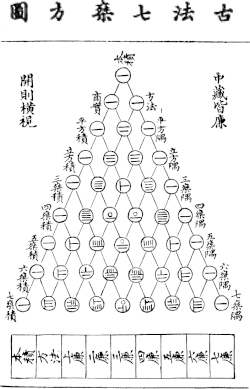
The 4th century BC Chinese counting rods system enabled one to perform positional decimal calculations, as described in the Sūnzĭ Suànjīng, a text of unknown date estimated to be from the 1st to 5th centuries AD.
Image source: Counting rods
100 AD - 200 AD
By the Han dynasty (2nd century AD), Chinese authors had been familiar with the idea of negative numbers and decimal fractions, as seen in The Nine Chapters on the Mathematical Art, demonstrating sophisticated numerical concepts that complemented positional calculation with counting rods.
Image source: The Nine Chapters on the Mathematical Art

100 AD - 200 AD
By the Han dynasty (2nd century AD), Chinese authors had been familiar with negative numbers alongside decimal fractions, as seen in The Nine Chapters on the Mathematical Art, situating zero within a broader framework of signed quantities.
Image source: Negative number

300 AD - 500 AD
The Sūnzĭ Suànjīng, of unknown date but estimated to be from the 1st to 5th centuries AD, describes how the 4th century BC Chinese counting rods system enabled one to perform positional decimal calculations, preserving knowledge of early positional arithmetic.
Image source: Sunzi Suanjing

425 AD - 468 AD
As noted in the Xiahou Yang Suanjing (425–468 AD), to multiply or divide a number by 10, 100, 1000, or 10000, all one needs to do, with rods on the counting board, is to move them forwards or back by 1, 2, 3, or 4 places — reflecting an implicit use of place value and empty positions.
Image source: Xiahou Yang Suanjing

This History of Zero timeline was generated with the help of AI, using information found on the internet.
We work hard to keep these timelines accurate, but mistakes do get through. If you spot one, email us at [email protected] and we'll fix it for future visitors.
Generate yours with AI or build it from scratch, for free.