-
Use Cases
-
Resources
-
Pricing
This timeline traces the history of Auckland, New Zealand's largest city, covering early Māori settlement, the signing of the Treaty of Waitangi, European colonization, its period as New Zealand's capital, industrial growth, immigration waves, and its development into a modern multicultural metropolis. More Less
1600 - 1750
% complete
From 1600 to 1750 the Tāmaki tribes terraced the volcanic cones, building pā (fortified villages) across the isthmus. At the peak of prosperity in 1750, the population numbered tens of thousands.
Image source: History of Auckland
1700
% complete
From the early 18th century the Ngāti Pāoa people edged their way into the Hauraki Gulf and as far north as Mahurangi, extending their influence over the region.
1740 - 1750
% complete
Between 1740 and 1750 Ngāti Whātua-o-Kaipara moved south, invading the isthmus and killing Kiwi Tāmaki, paramount chief of Waiohua, shifting dominance over the area to Ngāti Whātua.
Image source: Kiwi Tāmaki
1807
% complete
Despite lacking muskets, Ngāti Whātua defeated a Ngāpuhi force, who had a few muskets, in the battle of Moremonui north of the Kaipara Harbour in 1807 or 1808, killing at least 150.
Image source: Battle of Moremonui
1821 - 1822
% complete
Over a ten-month period in 1821–1822, Hongi Hika played a principal part in the 1,000-mile (1,600 km) Amiowhenua expedition during the Musket Wars that devastated much of New Zealand.
Image source: Musket Wars
1840
% complete
After the signing of the Treaty of Waitangi in February 1840, the new Governor of New Zealand, William Hobson, had the task of choosing a capital for the colony, selecting the Auckland isthmus.
Sep 15, 1840
% complete
Hobson's barque, the Anna Watson, arrived in Auckland Harbour on 15 September 1840, bringing officials to establish the new capital.
Sep 18, 1840
% complete
A foundation ceremony took place on 18 September 1840 at Point Britomart (Rerenga Ora Iti), marking the official founding of Auckland as the colonial capital.
1841
% complete
Auckland was officially declared New Zealand's capital in 1841, cementing its status as the centre of the new colony.
Nov 26, 1842
% complete
The New Zealand Government Gazette announced royal approval of the name Auckland on 26 November 1842.
1846 - 1853
% complete
Auckland was the seat of the New Ulster province from 1846 until its replacement following the passing of the New Zealand Constitution Act 1852.
Image source: New Ulster Province
1853 - 1876
% complete
The new province, known as Auckland Province, was elected by settlers from 1853 following Robert Wynyard becoming the first superintendent after the provincial elections, and continued until the abolition of provinces in 1876.
Image source: Auckland Province
1856
% complete
Aucklander reaction to the loss of the status of capital included a campaign of redevelopment and rebuilding, including the replacement third Government House, built in 1856 in an attempt to retain status.
Image source: Government House, Auckland
1862
% complete
Parliament met for the first time in Wellington in 1862, marking the shift of national governance away from Auckland.
1865
% complete
In 1865 Wellington became the capital of New Zealand, ending Auckland's period as the colony's seat of government.
Image source: Wellington
1840
% complete
As the Musket Wars drew to a close, pressure for British intervention to quell lawlessness, in large part driven by missionary pressure to protect Māori, led to the annexation of New Zealand and the despatch of Lt Governor Hobson to create the Treaty of Waitangi in 1840.
Image source: Treaty of Waitangi
Mar 20, 1840
% complete
On 20 March 1840 in the Manukau Harbour area where Ngāti Whātua farmed, paramount chief Apihai Te Kawau signed Te Tiriti o Waitangi, the te reo Māori translation of the Treaty of Waitangi.
Image source: Apihai Te Kawau
1842
% complete
The first immigrant ships sailing directly from Britain started to arrive as early as 1842, bringing waves of settlers to the young capital.
1847 - 1852
% complete
Between 1847 and 1852 large numbers of retired British soldiers, called fencibles, and their families came to Auckland to create a ring of outlying villages to protect the capital.
1849
% complete
In 1849 Governor Grey sold land in Māngere to the leading Māori chief Te Wherowhero and 149 members of the Ngāti Mahuta tribe from Tamahere in the Waikato.
Image source: Pōtatau Te Wherowhero
Apr 1851
% complete
In April 1851 a large group of 350–450 Ngāti Pāoa from Thames arrived to attack Auckland in some 20 waka (canoes).
1841
% complete
Amongst the first settlers were some Catholics, and in 1841 they established a school for boys, which was Auckland's first school of any sort.
1841
% complete
The city's first church, St Paul's, and the Fort Britomart army barracks were built on Point Britomart in 1841.
Jul 28, 1841
% complete
When St Paul's was founded by Governor Hobson on 28 July 1841, hundreds attended the ceremony including Ngāti Whātua chiefs Āpihai Te Kawau, Te Keene and a young Pāora Tūhaere, accompanied by over one hundred Māori warriors.
1843
% complete
Auckland's first Catholic church opened in 1843, later to become St Patrick's Cathedral.
1843
% complete
The Bishop of New Zealand, George Selwyn, opened St Paul's in 1843, serving both Māori and European congregations, with two services conducted in te reo Māori and two in English every Sunday.
1843
% complete
From the late 1840s, settlers attending Anglican chapels in the rural communities of Tāmaki, Epsom and Remuera were ministered to by staff and students of St John's Theological College, which was established in 1843.
1847
% complete
St Stephen's Anglican School, initially educating Māori girls and later boys, opened in Kohimarama in 1847 and then moved to Parnell in 1850.
1849
% complete
St Barnabas' chapel was built for Anglican Māori traders, sited in Augustus Terrace, Parnell in 1849.
1885
% complete
The original Emily Place St Paul's was demolished in 1885 when Point Britomart was quarried away for waterfront reclamations; the third and current St Paul's building on Symonds Street replaced it.
1900
% complete
By 1900, Auckland had become the largest New Zealand city, having grown rapidly around the port since its population of just 1,500 in 1841.
1890 - 1900
% complete
A Russian scare at the end of the 19th century caused coastal guns to be bought and fortifications built, notably at North Head and on Waiheke Island, where they can still be seen.
1908
% complete
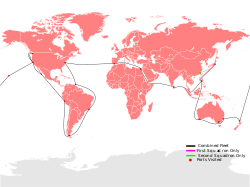
The 1908 visit by the American Fleet underscored Auckland's continuing importance as a major port and the location of the Devonport Naval Base in the country's cultural landscape.
Image source: Great White Fleet
1914
% complete
The opening of the canal in 1914 altered shipping patterns and Auckland's port became one of the most important features of the New Zealand economy.
Image source: Port of Auckland
1959
% complete
In 1959 the new Auckland Harbour Bridge linked North Shore with the city, further extending Auckland's reach and spurring growth across the Waitematā Harbour.
Image source: Auckland Harbour Bridge
1962
% complete
The third Government House remained in use until 1962, when the fourth Government House was established in Mount Eden.
Jul 10, 1985
% complete
Just before midnight NZST on 10 July 1985, two explosive devices attached to the hull of the Greenpeace flagship Rainbow Warrior, docked in Auckland awaiting departure to protest French nuclear testing, were detonated by French intelligence operatives, sinking the vessel.
Image source: Sinking of the Rainbow Warrior
1993
% complete
In 1993, the Police Eagle helicopter and a traffic-spotting plane collided in mid-air, falling to the packed motorway below during Friday night rush hour.
Feb 20, 1998
% complete
All four electrical power cables supplying the Central Business District failed on 20 February 1998, causing the 1998 Auckland power crisis that disrupted the city for weeks.
Image source: 1998 Auckland power crisis
Jun 2006
% complete
The 2006 Auckland Blackout showcased the fact that Auckland's power-supply infrastructure is still very vulnerable to disruption.
Or browse the full history timeline directory, with more than 2,000 topics.
This History of Auckland timeline was generated with the help of AI, using information found on the internet.
We work hard to keep these timelines accurate, but mistakes do get through. If you spot one, email us at [email protected] and we'll fix it for future visitors.
Generate yours with AI or build it from scratch, for free.
Export your timeline, add your own events, edit or remove AI-generated events, and much more
No credit card required.
Cancel anytime.
Cancel anytime.
You can create an unlimited number of timelines with up to 10 events on each one, customize how they look, export them to PDF, PNG, PowerPoint, CSV, and Excel, and share them with a link. Paid plans raise the event limit and add features like spreadsheet imports and collaborators.
Yes. You can cancel your subscription from your account page at any time, and you will not be charged again. Your subscription stays active for the rest of the period you already paid for.
Yes. We will email you a reminder before the annual renewal, and we will also email you a receipt.
Yes. You can email us within 15 days of any payment, and we will issue you a full refund.
Check out our pricing docs or send us an email anytime: [email protected].