-
Use Cases
-
Resources
-
Pricing
The history of biotechnology traces humanity's use of living organisms to produce useful products, from ancient brewing, baking, and selective breeding thousands of years ago to modern breakthroughs such as recombinant DNA technology, genetic engineering, the Human Genome Project, CRISPR-Cas9 gene editing, and mRNA vaccines. This field has evolved through distinct eras—ancient biotechnology, classical biotechnology, and modern molecular biotechnology—transforming medicine, agriculture, and industry. More Less
1875 - 1899
% complete
In late 19th-century Germany, brewing contributed as much to the gross national product as steel, and taxes on alcohol proved to be significant sources of revenue to the government, making industrial microbiology economically vital.
Image source: History of biotechnology
1875
% complete
The most famous private research institute was the Carlsberg Institute, founded in 1875, which employed Emil Christian Hansen, who pioneered the pure yeast process for the reliable production of consistent beer.
Image source: Carlsberg Laboratory
1919
% complete
The Hungarian Károly Ereky coined the word 'biotechnology' in Hungary during 1919 to describe a technology based on converting raw materials into a more useful product, giving the field its modern name.
1919
% complete
In a book entitled Biotechnologie, Ereky further developed a theme that would be reiterated through the 20th century: that biotechnology could provide solutions to societal crises, such as food and energy shortages.
1979
% complete
In 1979, when the Soviet Union sent troops to Afghanistan, the Carter administration cut off its supplies of agricultural produce in retaliation, creating a surplus of agriculture in the U.S.
Jan 1981
% complete
Before a new direction could be taken, the political wind changed again: the Reagan administration came to power in January 1981 and, with declining oil prices of the 1980s, ended support for the gasohol industry before it was born.
1953
% complete
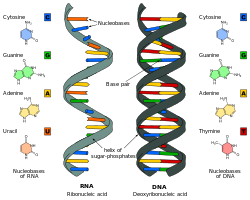
The 1953 discovery of the structure of DNA by Watson and Crick was one of two key breakthroughs that enabled the rise of modern genetic engineering and the new biotechnology industry.
Image source: Nucleic acid
1962
% complete
Building on the MOSFET invented at Bell Labs between 1955 and 1960, L.C. Lyons invented the biosensor in 1962, opening the way for devices combining biology and electronics.
Image source: Biosensor
1963
% complete
Joshua Lederberg's 1963 paper, 'Biological Future of Man,' suggested that while molecular biology might one day make it possible to change the human genotype, what had been overlooked was euphenics — the engineering of human development after conception rather than changes affecting future generations.
Image source: Joshua Lederberg
1970
% complete
The first BioFET was the ion-sensitive field-effect transistor (ISFET), invented by Piet Bergveld in 1970 for electrochemical and biological applications, extending the fusion of semiconductor technology with biology.
Image source: Chemical field-effect transistor
1973
% complete
The second key breakthrough was Cohen and Boyer's 1973 discovery of a recombinant DNA technique, by which a section of DNA was cut from the plasmid of an E. coli bacterium and inserted into another organism, enabling genetic engineering.
Image source: Recombinant DNA
1962
% complete
BP built a pilot plant at Cap de Lavera in Southern France to publicize its product, Toprina, a microbial protein grown on hydrocarbons. Initial research work at Lavera was done by Alfred Champagnat.
1963
% complete
Construction started in 1963 on BP's second single-cell protein pilot plant at the Grangemouth Refinery in Scotland, expanding its efforts to produce protein from petroleum feedstocks.
Image source: Grangemouth Refinery
1966
% complete
As there was no well-accepted term to describe the new foods, in 1966 the term 'single-cell protein' (SCP) was coined at MIT to provide an acceptable and exciting title, avoiding the unpleasant connotations of microbial or bacterial foods.
1973
% complete
The Soviets were particularly enthusiastic about single-cell protein, opening large 'BVK' (belkovo-vitaminny kontsentrat, or protein-vitamin concentrate) plants next to their oil refineries at Kstovo in 1973.
1974
% complete
The escalation in the price of oil in 1974 increased the cost of the Western world's energy tenfold, reshaping investment decisions across industries including biotechnology ventures tied to petrochemicals.
Image source: 1970s energy crisis
1974
% complete
First, the price of oil rose catastrophically in 1974, so that its cost per barrel was five times greater than it had been two years earlier, undermining the economics of oil-based single-cell protein production.
1974
% complete
Continuing their enthusiasm for microbial protein production, the Soviets opened another large BVK plant next to an oil refinery at Kirishi in 1974.
Image source: Kirishi
1989
% complete
Also, in 1989 in the USSR, public environmental concerns made the government decide to close down (or convert to different technologies) all 8 paraffin-fed-yeast plants that the Soviet Ministry of Microbiological Industry had by that time, effectively ending the Soviet SCP program.
Dec 1967
% complete
In December 1967, the first heart transplant performed by Christiaan Barnard reminded the public that the physical identity of a person was becoming increasingly problematic, fueling debate about biological manipulation.
Image source: Christiaan Barnard
1968
% complete
In 1968, an immensely popular work, The Biological Time Bomb, was written by British journalist Gordon Rattray Taylor, bringing public attention to the promises and perils of biological science.
Image source: Gordon Rattray Taylor
1973
% complete
Woody Allen satirized the cloning of a person from a nose in his 1973 movie Sleeper, reflecting popular culture's fascination and anxiety about biotechnology.
Image source: Sleeper (1973 film)
Jul 1974
% complete
In July 1974, a group of eminent molecular biologists headed by Paul Berg wrote to Science suggesting that the consequences of recombinant DNA work were so potentially destructive that there should be a pause until its implications had been thought through.
Image source: Asilomar Conference on Recombinant DNA
Feb 1975
% complete
The suggestion of a pause was explored at a meeting in February 1975 at California's Monterey Peninsula, forever immortalized by the location, Asilomar, where Joshua Lederberg was the most outspoken supporter of this emerging field in biotechnology.
1976
% complete
Cloning Adolf Hitler from surviving cells was the theme of Ira Levin's 1976 novel The Boys from Brazil, showing how deeply fears about genetic engineering had penetrated popular imagination.
Image source: The Boys from Brazil (novel)
Jun 1976
% complete
In June 1976, the 16-month moratorium on recombinant DNA research expired with the Director's Advisory Committee publication of NIH guidelines of good practice, noting analogous applications in fermentation for cheaply manufacturing essential nutrients and improving microbes for antibiotics and special industrial chemicals.
1975 - 1977
% complete
In the period 1975 to 1977, synthetic 'human' insulin represented the aspirations for new products that could be made with the new biotechnology. Insulin, one of the smaller, best characterized and understood proteins, had already been used in treating type 1 diabetes for half a century.
Image source: Insulin
1978
% complete
1978 also saw the first application for a patent on a gene — the gene which produces human growth hormone — by the University of California, introducing the legal principle that genes could be patented.
Image source: Growth hormone
Sep 1978
% complete
By as early as 1978, with the development of synthetic human insulin, Joshua Lederberg's claims proved valid, and the biotechnology industry grew rapidly. Microbial production of synthetic human insulin was announced in September 1978 and produced by the startup company Genentech.
1980
% complete
By 1980, a new company, Biogen, had produced interferon through recombinant DNA, further demonstrating the commercial potential of the emerging biotechnology industry.
Image source: Biogen
1988
% complete
By 1988, only five proteins from genetically engineered cells had been approved as drugs by the United States Food and Drug Administration: synthetic insulin, human growth hormone, hepatitis B vaccine, alpha-interferon, and tissue plasminogen activator (TPa), for lysis of blood clots.
1994
% complete
There was tremendous progress since the market introduction of the genetically engineered Flavr Savr tomato in 1994, the first commercially grown genetically modified food approved for sale.
1998
% complete
Ernst and Young reported that in 1998, 30% of the U.S. cotton and corn crops were also expected to be products of genetic engineering, demonstrating rapid adoption of GM agriculture.
Image source: Genetically modified crops
1999
% complete
Whereas only five proteins from genetically engineered cells had been approved as drugs by the FDA in 1988, this number skyrocketed to over 125 by the end of the 1990s, marking explosive growth in biopharmaceuticals.
2005
% complete
According to Burrill and Company, over $350 billion has been invested in biotech since the emergence of the industry, and global revenues rose from $23 billion in 2000 to more than $50 billion in 2005.
2007 - 2008
% complete
By 2007 and into 2008, though, a downturn in the fortunes of biotech emerged, at least in the United Kingdom, as the result of declining investment in the face of failure of biotech pipelines to deliver and a consequent downturn in return on investment.
2014
% complete
By 2011, financial investment in the biotechnology industry started to improve again and by 2014 the global market capitalization reached $1 trillion, cementing biotechnology as a major global industry.
Or browse the full history timeline directory, with more than 2,000 topics.
This History of Biotechnology timeline was generated with the help of AI, using information found on the internet.
We work hard to keep these timelines accurate, but mistakes do get through. If you spot one, email us at [email protected] and we'll fix it for future visitors.
Generate yours with AI or build it from scratch, for free.
Export your timeline, add your own events, edit or remove AI-generated events, and much more
No credit card required.
Cancel anytime.
Cancel anytime.
You can create an unlimited number of timelines with up to 10 events on each one, customize how they look, export them to PDF, PNG, PowerPoint, CSV, and Excel, and share them with a link. Paid plans raise the event limit and add features like spreadsheet imports and collaborators.
Yes. You can cancel your subscription from your account page at any time, and you will not be charged again. Your subscription stays active for the rest of the period you already paid for.
Yes. We will email you a reminder before the annual renewal, and we will also email you a receipt.
Yes. You can email us within 15 days of any payment, and we will issue you a full refund.
Check out our pricing docs or send us an email anytime: [email protected].