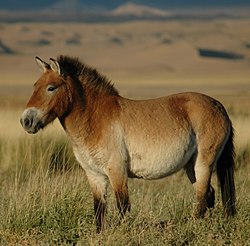
-
Use Cases
-
Resources
-
Pricing
The history of cloning spans more than a century of scientific discovery, beginning with Hans Driesch's experiments on sea urchin embryos in 1885 and advancing through nuclear transfer breakthroughs, most famously Dolly the sheep in 1996. Cloning technology has since evolved to include therapeutic cloning for stem cell research and continues to raise ethical questions about animal welfare and potential human applications. More Less
1903
% complete
In 1903, Webber coined the term clone, deriving it from the Ancient Greek word κλών (klōn), meaning twig — the process whereby a new plant is created from a twig. In horticulture, the spelling clon was used until the early twentieth century; the final e came into use to indicate a 'long o' instead of a 'short o'.
Image source: Clone (cell biology)
1924
% complete
In 1924, Hans Spemann and his student Hilde Mangold were the first to perform somatic-cell nuclear transfer using amphibian embryos — one of the first steps towards cloning.
Image source: Hans Spemann
1935
% complete
Hans Spemann, a German embryologist, was awarded the Nobel Prize in Physiology or Medicine in 1935 for his discovery of embryonic induction — the effect exercised by various parts of the embryo that directs the development of groups of cells into particular tissues and organs.
1931
% complete
An early fictional depiction of cloning is Bokanovsky's Process, which features in Aldous Huxley's 1931 dystopian novel Brave New World.
Image source: Brave New World
1953
% complete
Following renewed interest in cloning in the 1950s, the subject was explored further in works such as Poul Anderson's 1953 story UN-Man, which describes a technology called 'exogenesis', and Gordon Rattray Taylor's book The Biological Time Bomb, which popularised the term 'cloning' in 1963.
Image source: Cloning
1973
% complete
In Doctor Who, an alien race of armour-clad, warlike beings called Sontarans was introduced in the 1973 serial 'The Time Warrior'. The concept of cloned soldiers being bred for combat was revisited in 'The Doctor's Daughter' (2008), when the Doctor's DNA is used to create a female warrior called Jenny.
Image source: Sontaran
1977
% complete
The 1977 film Star Wars was set against the backdrop of a historical conflict called the Clone Wars. The events of this war were not fully explored until the prequel films Attack of the Clones (2002) and Revenge of the Sith (2005), which depict a space war waged by a massive army of heavily armoured clone troopers that leads to the foundation of the Galactic Empire.
Image source: Clone Wars
1990
% complete
In Michael Crichton's 1990 novel Jurassic Park, which spawned a series of feature films, the bioengineering company InGen develops a technique to resurrect extinct species of dinosaurs by creating cloned creatures using DNA extracted from fossils. Possible implications had earlier been dramatized in the 1984 novel Carnosaur.
Image source: Jurassic Park (novel)
Mar 10, 1997
% complete
Newsweek's 10 March 1997 issue critiqued the ethics of human cloning and included a graphic depicting identical babies in beakers. Earlier, Time's 8 November 1993 issue had portrayed cloning negatively, modifying Michelangelo's Creation of Adam to depict Adam with five identical hands.
Image source: Human cloning
2017
% complete
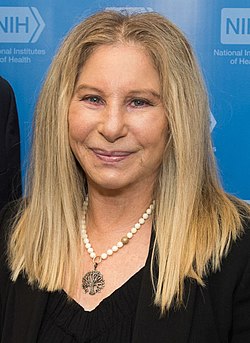
After the death of her beloved 14-year-old Coton de Tulear named Samantha in late 2017, Barbra Streisand announced that she had cloned the dog, and was now 'waiting for [the two cloned pups] to get older so [she] can see if they have [Samantha's] brown eyes and her seriousness'.
Image source: Barbra Streisand
Nov 2025
% complete
In November 2025, former American football quarterback Tom Brady received criticism when he announced that his dog Junie is a clone of his late dog Lua.
Image source: Tom Brady
1952
% complete
In 1952, Robert Briggs and Thomas J. King cloned a tadpole, an early landmark in nuclear transfer research with amphibians.
Image source: Somatic cell nuclear transfer
1963
% complete
In 1963, Chinese embryologist Tong Dizhou produced the world's first cloned fish by inserting the DNA from a cell of a male carp into an egg from a female carp.
Image source: Tong Dizhou
1981
% complete
In 1981, George Streisinger produced the next in line of the vertebrates to be cloned: the zebrafish.
Image source: George Streisinger
1984
% complete
In 1984, Steen Willadsen produced the first cloned mammal from early embryonic cells: a sheep.
1986
% complete
1987
% complete
In 1987, Soviet scientists Levon Chaylakhyan, Veprencev, Sviridova, and Nikitin cloned Masha, a mouse.
Jun 1995
% complete
In June 1995, the Roslin Institute cloned Megan and Morag from differentiated embryonic cells.
Image source: Roslin Institute
Jul 5, 1996
% complete
Dolly was cloned by PPL Therapeutics and the Roslin Institute in July 1996 from a somatic cell. She achieved notoriety as the first mammal cloned from an adult somatic cell. She lived at the Roslin Institute in Scotland from her birth until her death in 2003 when she was six.
Image source: Dolly (sheep)
Feb 22, 1997
% complete
Although Dolly was born on 5 July 1996, her existence was not announced to the world until 22 February 1997, sparking global fascination and debate about cloning.
Oct 1999
% complete
In October 1999, the Oregon National Primate Research Center cloned Tetra from embryo splitting rather than nuclear transfer: a process more akin to artificial formation of twins.
Mar 2000
% complete
In March 2000, PPL Therapeutics cloned five piglets, marking the successful cloning of pigs.
Image source: Dolly (sheep)
2001
% complete
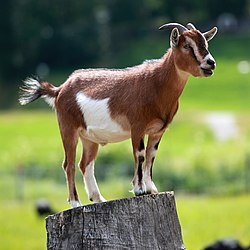
In 2001, scientists of Northwest A&F University successfully cloned the first goat using an adult female cell.
Image source: Goat
2003
% complete
Dolly died in 2003 at age six. Scientists speculated that her death was related to the shortening of telomeres, DNA-protein complexes that protect the end of linear chromosomes. This idea that nuclei have not irreversibly aged was shown in 2013 to be true for mice.
May 4, 2003
% complete
Idaho Gem, a john mule born 4 May 2003, was the first member of the horse family to be cloned.
Image source: Gem County, Idaho
May 28, 2003
% complete
Prometea, a Haflinger female born 28 May 2003, was the first cloned horse.
Image source: Horse cloning
2005
% complete
In 2005, Snuppy, a male Afghan Hound, became the first cloned dog, and Snuwolf and Snuwolffy became the first two cloned female wolves.
Image source: Snuppy
2009
% complete
Cloning of a successful rescue dog was reported in 2009 and of a similar police dog in 2019. Cloning of super sniffer dogs was reported in 2011, four years afterwards when the dogs started working.
Apr 8, 2009
% complete
Injaz, born on 6 February 2009 at India's Karnal National Dairy Research Institute context aside, was the first cloned camel. A cloned water buffalo born at India's Karnal National Dairy Research Institute on 6 February 2009 died five days later due to lung infection.
Image source: Injaz (camel)
2012
% complete
In 2012, Noori became the first cloned pashmina goat.
2017
% complete
In 2017, the world's first gene-editing clone dog, Apple, was created by Sinogene Biotechnology.
Nov 2017
% complete
In 2017, conducted in China and reported in January 2018, the first successful cloning of a primate species using nuclear transfer occurred, with the birth of two live macaque clones named Zhong Zhong and Hua Hua.
Jan 2019
% complete
In January 2019, scientists in China reported the creation of five identical cloned gene-edited monkeys, using the same cloning technique used with Zhong Zhong and Hua Hua and Dolly the sheep, and the gene-editing Crispr-Cas9 technique allegedly used by He Jiankui in creating the first gene-modified human babies Lulu and Nana. In 2018, those scientists declared they had no intention of trying to clone people.
2022
% complete
In 2022, viable mice offspring were born from unfertilized eggs via targeted DNA methylation editing of seven imprinting control regions — the first artificial parthenogenesis in mammals.
Image source: Parthenogenesis
2023
% complete
In 2023, Chinese scientists reported the cloning of three supercows with milk productivity nearly 1.7 times that of an average cow in the United States in 2021, along with a plan for 1,000 such super cows in the near-term.
2000
% complete
Anticipating the possibility of de-extinction, tissue samples from the last bucardo (Pyrenean ibex) were frozen in liquid nitrogen immediately after it died in 2000.
Image source: Pyrenean ibex
Jan 2001
% complete
In 2001, a cow named Bessie gave birth to Noah, a cloned Asian gaur, the first endangered species to be cloned, but the calf died after two days.
Image source: Gaur
2003
% complete
In 2003, for the first time, an extinct animal, the Pyrenean ibex, was cloned at the Centre of Food Technology and Research of Aragon, using preserved frozen cell nuclei of skin samples from 2001 and domestic goat egg-cells.
2003
% complete
In 2003, a banteng was successfully cloned, followed by three African wildcats from a thawed frozen embryo.
Image source: Banteng
Feb 15, 2005
% complete
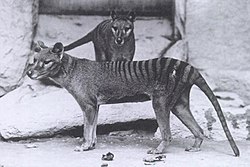
In 2002, geneticists at the Australian Museum announced they had replicated DNA of the thylacine (Tasmanian tiger), extinct for about 65 years, using polymerase chain reaction. However, on 15 February 2005 the museum announced it was stopping the project after tests showed the specimens' DNA had been too badly degraded by the ethanol preservative. On 15 May 2005 the project was announced to be revived.
Image source: Thylacine
2009
% complete
In 2009, the Pyrenean ibex became the first extinct animal to be cloned back to life; the clone lived for only seven minutes before dying of lung defects.
Mar 2013
% complete
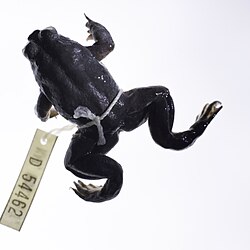
Scientists at the University of Newcastle and University of New South Wales announced in March 2013 that the recently extinct gastric-brooding frog would be the subject of a cloning attempt to resurrect the species. The frog, thought extinct since 1983, was cloned in Australia, although the embryos died after a few days.
Image source: Gastric-brooding frog
2020
% complete
Also in 2020, a clone named Elizabeth Ann was produced of a female black-footed ferret that had no living descendants. A team of scientists cloned Willa, who died in the mid-1980s and left no living descendants. The San Diego Zoo also began projects in partnership with Revive & Restore and ViaGen Pets and Equine to clone individuals of genetically-impoverished endangered species.
Image source: Black-footed ferret
Aug 2020
% complete
Kurt, the first cloned Przewalski's horse, was born in 2020. He was cloned from skin tissue of a stallion preserved in 1980. In 2023, a second clone of the original stallion, named Ollie, was born; this marked the first instance of multiple living clones of a single individual of an endangered species being alive at the same time. Trey was also born in 2023.
Image source: Przewalski's horse
2021
% complete
Engineers proposed a 'lunar ark' in 2021 – storing millions of seed, spore, sperm and egg samples from Earth's contemporary species in a network of lava tubes on the Moon as a genetic backup. Similar proposals have been made since at least 2008. That same year, Russia's defense minister Sergei Shoigu mentioned using DNA of 3,000-year-old Scythian warriors to potentially bring them back to life.
Image source: Moonbase
2022
% complete
In 2022, Colossal Biosciences and University of Melbourne announced further efforts to de-extinct the Thylacine, creating the Thylacine Integrated Genetic Restoration Research (TIGRR) Lab, which claims significant advancements including a thylacine genome more than 99.9-per-cent accurate. Also in 2022, scientists showed major limitations of genetic-editing-based de-extinction, suggesting resources spent on projects such as the woolly mammoth may not be well allocated.
2024
% complete
In 2024, Colossal Biosciences announced they had brought the dire wolf back from extinction via cloning and genetic engineering.
Or browse the full history timeline directory, with more than 2,000 topics.
This History of Cloning timeline was generated with the help of AI, using information found on the internet.
We work hard to keep these timelines accurate, but mistakes do get through. If you spot one, email us at [email protected] and we'll fix it for future visitors.
Generate yours with AI or build it from scratch, for free.
Export your timeline, add your own events, edit or remove AI-generated events, and much more
No credit card required.
Cancel anytime.
Cancel anytime.
You can create an unlimited number of timelines with up to 10 events on each one, customize how they look, export them to PDF, PNG, PowerPoint, CSV, and Excel, and share them with a link. Paid plans raise the event limit and add features like spreadsheet imports and collaborators.
Yes. You can cancel your subscription from your account page at any time, and you will not be charged again. Your subscription stays active for the rest of the period you already paid for.
Yes. We will email you a reminder before the annual renewal, and we will also email you a receipt.
Yes. You can email us within 15 days of any payment, and we will issue you a full refund.
Check out our pricing docs or send us an email anytime: [email protected].