-
Use Cases
-
Resources
-
Pricing
Budapest, the capital of Hungary, was formed in 1873 by the unification of the Danube-side cities of Buda, Pest, and Óbuda. Its history spans Roman settlements (Aquincum), medieval royal rule under Hungarian kings, Ottoman occupation, Habsburg empire, two world wars including the 1956 uprising against Soviet rule, and its modern rebirth as a vibrant European cultural and political center. More Less
400 BC - 399 BC
% complete
The origins of Budapest can be traced to the Celts, who occupied the plains of Hungary in the 4th century BC, establishing the earliest settlements in the region that would later become Budapest.
Image source: History of Budapest
100 BC - 099 BC
% complete
The first town, built by Celts in the first century BC, occupied about 30 hectares along the slopes of Gellért Hill, marking an early urban center on the future site of Budapest.
1 AD - 99 AD
% complete
The inhabitants moved to the Danube plains to a city retaining the Celtic name Aquincum in the first century AD, which developed into an important Roman settlement.
Image source: Aquincum
400 - 499
% complete
The Romans pulled out of the Hungarian plains in the 5th century AD after fierce warfare, succeeded by the Huns, who were then challenged by various tribes over the next several centuries.
Image source: Huns
500 - 899
% complete
The Avar Khaganate dominated Pannonia between the 6th and 9th centuries, controlling the region around present-day Budapest before the arrival of the Magyars.
Image source: Pannonian Avars
800 - 899
% complete
The Hungarian conquest of the Carpathian Basin started at the end of the 9th century, bringing the Magyar tribes into the region and laying the foundations for the Hungarian state.
Image source: Hungarian conquest of the Carpathian Basin
1000 - 1099
% complete
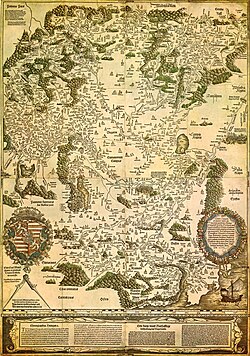
The Kingdom of Hungary was established at the end of the 11th century, consolidating royal power over the lands that included Buda and Pest.
Image source: Kingdom of Hungary
1100 - 1199
% complete
After the Bulgarian–Hungarian Wars, Buda and Pest started to develop economically in the 12th century, largely due to French, Walloon and German settlers who migrated there and traded under royal protection along the banks of the Danube.
1241 - 1242
% complete
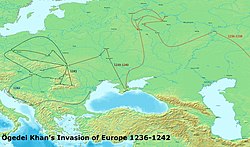
Both towns were devastated during the Mongol invasion of Europe in 1241–42. They were subsequently rebuilt by colonists from Germany, who renamed Buda 'Ofen' ('furnace'), after its numerous lime kilns.
Image source: Mongol invasion of Europe
1300 - 1399
% complete
During the 14th century, the Angevin kings of Hungary, of French origin, established Buda as the royal seat of centralized power and built a succession of palaces on Várhegy (Castle Hill).
Image source: Buda Castle
1300 - 1873
% complete
From around 1300 to the incorporation of 1873, Buda was the capital of the Kingdom of Hungary for five periods of less than a century each, reflecting the city's shifting political fortunes.
1458 - 1490
% complete
The Angevin successors reached their zenith of power and prestige during the Renaissance under 'Good King' Matthias Corvinus (Hunyadi Mátyás), who reigned from 1458 to 1490 and made Buda a flourishing cultural capital.
Image source: Matthias Corvinus
1526
% complete
Hungary's catastrophic defeat in the Battle of Mohács in 1526 against the Turks led by Suleiman the Magnificent paved the way for the Ottoman occupation of Hungary.
Image source: Battle of Mohács
1541
% complete
Suleiman's Siege of Buda in 1541 was part of the Little War in Hungary between the Habsburgs and the Ottoman Empire, resulting in Ottoman control of the city.
Image source: Siege of Buda (1541)
1686
% complete
Three years after the Battle of Vienna in 1683, a pan-European multinational army besieged Buda Castle in the Battle of Buda (1686) for six weeks, finally recapturing it on the 12th attempt with heavy losses on both sides.
Image source: Siege of Buda (1686)
1700 - 1799
% complete
During the 18th century, under the rule of Charles VI, Maria Theresia and her son Joseph II, Budapest was an insignificant provincial town within the Habsburg Empire.
1800 - 1899
% complete
In the first decades of the 19th century, Pest became the center of the Reform movement led by Count Széchenyi, whose vision of progress was embodied in the construction of the Lánchíd (Chain Bridge).
Image source: István Széchenyi
1800 - 1899
% complete
By the end of the 19th century, Budapest had become one of the cultural centers of Europe, and one of the most important centres of the Aromanian diaspora along with Vienna, whose Aromanian population was among the first to develop a strictly Aromanian identity.
1848 - 1849
% complete
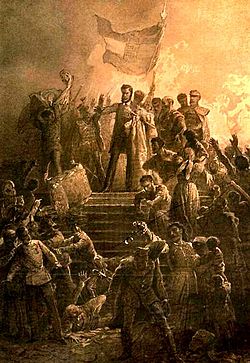
The Hungarian Revolution of 1848 was part of the Revolutions of 1848 in the Habsburg areas, with revolutionaries in Budapest plotting the downfall of the Habsburgs.
Image source: Hungarian Revolution of 1848
1848
% complete
Under the leadership of Lajos Kossuth and the 'people's rights-liberals' dominated parliament, Sándor Petőfi, also a renowned poet, and his fellow revolutionaries began to plot the downfall of the Habsburgs in Budapest at the Café Pilvax, which exists to this day in central Pest.
Image source: Inner City (Budapest)
1867
% complete
The Austro-Hungarian Compromise of 1867 made allowance for the dual monarchy of Austria-Hungary, known in German as k.u.k., ushering in a new era for Budapest.
Image source: Austro-Hungarian Compromise of 1867
1870
% complete
In 1870, under Prime Minister Gyula Andrássy, the Metropolitan Board of Public Works, modeled on the London Metropolitan Board of Works, was created to develop more stringent standards for construction and a long-term plan for the city.
Nov 17, 1873
% complete
The city of Budapest was officially created on 17 November 1873 from a merger of the three neighboring cities of Pest, Buda and Óbuda, forming the modern Hungarian capital.
1896
% complete
Budapest's millennial anniversary celebrations of the settlement of the Magyars in the region in 1896 brought a fresh rush of construction and development, including the opening of the first line of the Budapest Metro under Andrássy Avenue.
Image source: Budapest Metro
1900 - 1914
% complete
At the beginning of the 20th century, the cultural efflorescence and sparkling energy of abundance and well-being of Budapest rivaled that of Vienna and its café society that of Paris—a belle époque extinguished by World War I.
1918 - 1919
% complete
In 1918–19, Budapest was shaken by two revolutions: the Aster Revolution brought about the Hungarian Democratic Republic, followed by the Hungarian Soviet Republic, a short-lived Communist regime led by Béla Kun, and then two years of White Terror.
Image source: Aster Revolution
Aug 1919
% complete
The Hungarian–Romanian War of 1919 ended with the Romanian occupation of parts of Hungary proper, including Budapest in August 1919, and the establishment of the Kingdom of Hungary led by Miklós Horthy, the self-appointed regent for the exiled King Karl IV.
Image source: Hungarian–Romanian War
Mar 1944
% complete
Despite discriminatory legislation against the Jews and widespread antisemitism, the Jewish community of Budapest was relatively secure until the German occupation of Hungary in March 1944, known as Operation Margarethe.
Image source: German invasion of Hungary (1944)
Apr 1944 - Jul 1944
% complete
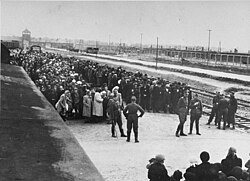
Between April and July 1944, the Germans and Hungarians deported Jews from the Hungarian provinces. With deportations from Slovakia beginning in March 1942, as many as 8,000 Slovak Jewish refugees had settled in Budapest. In June 1944, Hungarian authorities ordered the city's Jews into over 2,000 designated buildings scattered throughout the city, and suspended deportations in July 1944, sparing the remaining Jews of Budapest, at least temporarily.
Image source: The Holocaust in Hungary
Oct 1944
% complete
Anticipating Horthy's possible defection from the Axis alliance in 1944, the Nazis staged Operation Panzerfaust, a coup against Horthy, installing an Arrow Cross government under Ferenc Szálasi to allow the unobstructed massacre of the Jews of Budapest.
Image source: Operation Panzerfaust
Nov 1944 - Jan 1945
% complete
In November 1944, the Arrow Cross ordered the remaining Jews in Budapest into a closed ghetto. Between December 1944 and the end of January 1945, Arrow Cross militias shot Jews from the ghetto, deserters and political enemies along the banks of the Danube and threw their bodies into the river.
Image source: Budapest Ghetto
Nov 8, 1944 - Dec 1944
% complete
On November 8, 1944, Arrow Cross militia concentrated more than 70,000 Jews—men, women and children—in the Ujlaki brickyards in Obuda and forced them to march on foot to camps in Austria; survivors reached Austria in late December 1944.
Image source: Death marches during the Holocaust
Feb 13, 1945
% complete
Soviet forces captured Budapest on February 13, 1945, ending the siege of the city and the German and Arrow Cross control of the Hungarian capital during World War II.
Image source: Siege of Budapest
1945
% complete
After 1945 free elections were held, in which many parties, among them the Smallholders, the Social Democrats and the Communists, were voted into Parliament.
1949
% complete
In the election of 1949, the party, with Soviet backup resources, used the flaw in the so-called 'blue-ticket' election system—voters transported by trucks to vote away from their home districts with reproduced tickets—to cement Communist rule.
1950
% complete
Smaller towns on the outskirts of the original city were amalgamated into Greater Budapest in 1950, significantly expanding the capital's territory and population.
1956
% complete
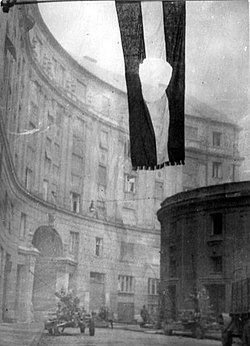
The Hungarian Revolution of 1956 was suppressed; rather than appointing a Hungarian hardliner or a Soviet general, the Soviets gave a chance to János Kádár, a former kidnapped minister of the revolution, who then led the country for decades.
Image source: Hungarian Revolution of 1956
1989
% complete
The revolutions of 1989 brought with them the end of Soviet occupation of Hungary, which meant the end of Communism in Hungary and the start of democratic governance in Budapest.
Image source: End of communism in Hungary
Oct 23, 1989
% complete
The majority of the multi-sided regime decided to step over Gorbachev's line and open the borders—the first official break of the Iron Curtain—declared Hungary a Republic on October 23, 1989 and issued free elections.
Image source: Revolutions of 1989
2019
% complete
Opposition candidate Gergely Karácsony won the 2019 Budapest mayoral election, delivering the first electoral blow for Hungary's nationalist prime minister Viktor Orbán since coming to power in 2010.
Image source: 2019 Budapest mayoral election
Or browse the full history timeline directory, with more than 2,000 topics.
This History of Budapest timeline was generated with the help of AI, using information found on the internet.
We work hard to keep these timelines accurate, but mistakes do get through. If you spot one, email us at [email protected] and we'll fix it for future visitors.
Generate yours with AI or build it from scratch, for free.
Export your timeline, add your own events, edit or remove AI-generated events, and much more
No credit card required.
Cancel anytime.
Cancel anytime.
You can create an unlimited number of timelines with up to 10 events on each one, customize how they look, export them to PDF, PNG, PowerPoint, CSV, and Excel, and share them with a link. Paid plans raise the event limit and add features like spreadsheet imports and collaborators.
Yes. You can cancel your subscription from your account page at any time, and you will not be charged again. Your subscription stays active for the rest of the period you already paid for.
Yes. We will email you a reminder before the annual renewal, and we will also email you a receipt.
Yes. You can email us within 15 days of any payment, and we will issue you a full refund.
Check out our pricing docs or send us an email anytime: [email protected].