-
Use Cases
-
Resources
-
Pricing
Burundi's history spans from its origins as an independent kingdom ruled by mwamis (kings), through German and Belgian colonial rule, to its independence in 1962. The country endured decades of ethnic tension between Hutu and Tutsi populations, marked by assassinations, massacres, and a devastating civil war from 1993 to 2005. Since then, Burundi has worked toward peace and political stability under a presidential republic. More Less
1750
% complete
In the mid-18th century, Tutsi royalty consolidated authority over land, production, and distribution with the development of the ubugabire—a patron-client relationship in which the populace received royal protection in exchange for tribute and land tenure.
Image source: Burundi
1796 - 1850
% complete
The kingdom's greatest growth occurred under Ntare IV Rutaganzwa Rugamba, who ruled from about 1796 to 1850 and saw the kingdom double in size.
Image source: Ntare V of Burundi
1856
% complete
European explorers and missionaries made brief visits to the area as early as 1856, and they compared the organization of the kingdom of Burundi with that of the old Greek empire.
Image source: History of Burundi
1899
% complete
It was not until 1899 that Burundi became a part of German East Africa, bringing it under German colonial rule.
Image source: German East Africa
1905
% complete
A great famine hit in 1905, and further famines struck the entire Great Lakes region in 1914, 1923 and 1944. Between 1905 and 1914 half the population of the western plains region died.
1916
% complete
In 1916 Belgian troops conquered the area during the First World War, ending German control over Burundi.
Image source: Belgian Congo in World War II
1923
% complete
In 1923, the League of Nations mandated to Belgium the territory of Ruanda-Urundi, encompassing modern-day Rwanda and Burundi, with the western kingdoms assigned to Tanganyika.
Image source: Ruanda-Urundi
Jan 20, 1959
% complete
On 20 January 1959, Burundi's ruler Mwami Mwambutsa IV requested Burundi's independence from Belgium and dissolution of the Ruanda-Urundi union.
Image source: Mwambutsa IV of Burundi
Nov 10, 1959
% complete
The trust territory guidelines required preparation for independence and majority rule, but it wasn't until 10 November 1959 that Belgium committed itself to political reform and legalised the emergence of competing political parties.
1960
% complete
UPRONA was a multi-ethnic party led by Tutsi Prince Louis Rwagasore while the Christian Democratic Party (PDC) was supported by Belgium, then ruled by the Christian Social Party under August de Schryver, Minister of the Belgian Congo and Ruanda-Urundi from 1959 until 1960.
Image source: Union for National Progress
Sep 8, 1961
% complete
Burundi's first elections took place on 8 September 1961 and UPRONA won just over 80% of the electorate's votes.
Jul 1, 1962
% complete
The colony gained full independence on July 1, 1962, splitting once again into Rwanda and Burundi.
Jan 15, 1965
% complete
The assassination of the Hutu prime minister Pierre Ngendandumwe on 15 January 1965 set in motion a series of destabilizing Hutu revolts and subsequent governmental repression.
Image source: Pierre Ngendandumwe
May 10, 1965
% complete
The monarchy refused to recognize gains by Hutu candidates in the first legislative elections held by Burundi as an independent country on 10 May 1965. These tensions were partly reactions to Rwanda's 'Social Revolution' of 1959–1961, where Rwandan Tutsi were subject to mass murder.
Oct 18, 1965
% complete
In response to the election outcome, a group of Hutu carried out a failed coup attempt against the monarchy on 18 October 1965, which in turn prompted the killing of scores of Hutu politicians and intellectuals.
Jul 9, 1966
% complete
On 9 July 1966, King Mwambutsa IV was deposed by his son, Prince Ntare V, who himself was deposed by his prime minister Capt. Michel Micombero on 28 November 1966.
Nov 28, 1966
% complete
On 28 November 1966, Prince Ntare V was deposed by his prime minister, Captain Michel Micombero, ending the monarchy and establishing a republic.
Image source: Michel Micombero
1969
% complete
Similar to 1965, rumors of an impending Hutu coup in 1969 prompted the arrest and execution of scores of prominent political and military figures.
Image source: Ikiza
Jun 1971
% complete
In June 1971, a group of Banyaruguru, the socially 'higher up' subgroup of Tutsi located in the north of the country, were accused of conspiracy by the ruling Hima clique.
Jan 14, 1972
% complete
On 14 January 1972, a military tribunal sentenced four Banyaruguru officers and five civilians to death, and seven to life imprisonment.
Apr 1972 - Sep 1972
% complete
Hutu rebels attempted to kill every Tutsi they could, as well as some Hutu who refused to participate in the rebellion, before retreating to Vyanda, near Bururi, and proclaiming a 'Republic of Martyazo.' Somewhere from 800 to 1200 people were killed.
Apr 1972 - Sep 1972
% complete
From late April to September 1972, an estimated 200,000 to 300,000 Hutu were killed in state-sponsored violence following the rebellion.
1976
% complete
In 1976, Colonel Jean-Baptiste Bagaza took power in a bloodless coup, replacing Michel Micombero as head of state.
Image source: Jean-Baptiste Bagaza
1981
% complete
In 1981, a new constitution was promulgated under Bagaza's government, formalizing single-party rule.
1984
% complete
In 1984, Bagaza was elected head of state as the sole candidate.
1987
% complete
In 1987, Major Pierre Buyoya overthrew Colonel Bagaza. He dissolved opposition parties, suspended the 1981 constitution, and instituted his ruling Military Committee for National Salvation (CSMN).
Image source: Pierre Buyoya
1988
% complete
Buyoya formed a commission to investigate the causes of the 1988 unrest and to develop a charter for democratic reform.
1988
% complete
During 1988, increasing tensions between the ruling Tutsis and the majority Hutus resulted in violent confrontations between the army, the Hutu opposition, and Tutsi hardliners.
1991
% complete
In 1991, Buyoya approved a constitution that provided for a president, non-ethnic government, and a parliament.
1993
% complete
Burundi's first Hutu president, Melchior Ndadaye, of the Hutu-dominated Front for Democracy in Burundi (FRODEBU) Party, was elected in 1993.
Image source: Melchior Ndadaye
Oct 1993
% complete
Ndadaye was assassinated three months after taking office, in October 1993, by Tutsi army extremists, plunging the country into renewed ethnic violence.
1994
% complete
The Rwandan genocide in 1994, sparked by the killing of Ndadaye's successor Cyprien Ntaryamira, further aggravated the conflict in Burundi by sparking additional massacres of Tutsis.
Image source: Rwandan genocide
Jul 1996
% complete
After the assassination of Ntaryamira, the Hutu presidency and Tutsi military operated under a power-sharing political system until July 1996, when Tutsi Pierre Buyoya seized power in a military coup.
2000
% complete
Under international pressure, the warring factions negotiated a peace agreement in Arusha in 2000, which called for ethnically balanced military and government and democratic elections.
2001
% complete
The death toll due to the syndrome has been devastating: the UN estimated 12,000 deaths in 2001 and Oxfam estimated 40,000 deaths in 2001.
Nov 2003
% complete
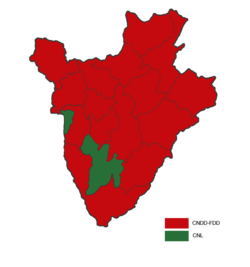
Finally, the CNDD-FDD agreed to sign a peace deal in November 2003 and joined the transitional government.
Image source: National Council for the Defense of Democracy – Forces for the Defense of Democracy
2006
% complete
The last remaining rebel group, the FNL, continued to reject the peace process and committed sporadic acts of violence in 2003 and 2004, finally signing a ceasefire agreement in 2006.
Image source: National Forces of Liberation
2005
% complete
In 2005, Burundi began the transition towards peace with its first elections since 1993.
Aug 2005
% complete
An indirect presidential election took place in August 2005, and the members of the legislature and senate elected Pierre Nkurunziza, a former teacher and CNDD rebel, who had been president of the CNDD-FDD party since August 2000. He became the first post-transitional president.
Image source: Pierre Nkurunziza
2006
% complete
Former President Domitien Ndayizeye and his political supporters were arrested in 2006 and accused of plotting a coup, but later he was acquitted by the Supreme Court.
Image source: Domitien Ndayizeye
Dec 2006
% complete
In December 2006 the International Crisis Group labeled Burundi's human rights status as 'deteriorating'.
Image source: Human rights in Burundi
Feb 2007
% complete
In February 2007, the United Nations officially shut down its peacekeeping operations in Burundi and turned its attention to rebuilding the nation's economy, which relies heavily on tea and coffee but had suffered severely during 12 years of civil war. The UN had deployed 5,600 peacekeepers since 2004, and several hundred troops remained to work with the African Union in monitoring the ceasefire.
Image source: United Nations Operation in Burundi
Aug 26, 2010
% complete
Nkurunziza was re-elected in 2010 with more than 91% of the votes amidst an opposition boycott and sworn in for his second term on 26 August 2010.
Apr 2015
% complete
In April 2015, Nkurunziza announced that he would seek a third term in office, triggering widespread unrest.
Image source: Burundian unrest (2015–2018)
May 13, 2015
% complete
On May 13, 2015, Burundi army General Godefroid Niyombareh, former head of Burundian intelligence, declared a coup via radio while Nkurunziza was abroad attending a summit in Tanzania with other African leaders.
Image source: 2015 Burundian coup attempt
Jul 24, 2015
% complete
The presidential election results were announced on 24 July 2015.
Sep 30, 2016
% complete
On 30 September 2016, the United Nations Human Rights Council established the Commission of Inquiry on Burundi through resolution 33/24, mandating it to investigate human rights violations committed in Burundi since April 2015, identify alleged perpetrators, and formulate recommendations.
Sep 29, 2017
% complete
On 29 September 2017 the Commission of Inquiry on Burundi called on the Burundian government to put an end to serious human rights violations. The government had refused to cooperate despite repeated requests. The Commission interviewed more than 500 Burundian refugees abroad and concluded that serious human rights violations and abuses had been committed in Burundi since April 2015.
May 2018
% complete
In a constitutional referendum in May 2018, Burundians voted by 79.08% to approve an amended constitution that ensured that Nkurunziza could remain in power until 2034.
Dec 24, 2018
% complete
On 24 December 2018, the government moved Burundi's political capital from Bujumbura back to Gitega, where it had been until 1966.
Image source: Gitega
May 20, 2020
% complete
On 20 May 2020, Évariste Ndayishimiye, a candidate hand-picked as Nkurunziza's successor by the CNDD-FDD, won the election with 71.45% of the vote.
Image source: 2020 Burundian general election
Jun 9, 2020
% complete
Shortly after the election, on 9 June 2020, Nkurunziza died of a cardiac arrest at the age of 55. As per the constitution, Pascal Nyabenda, the president of the national assembly, led the government until Ndayishimiye's inauguration on 18 June 2020.
Jan 2021
% complete
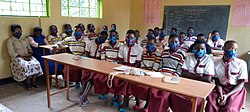
In January 2021, President Ndayishimiye closed national borders, having previously stated that anyone bringing Covid into Burundi would be treated as 'people bringing weapons to kill Burundians'.
Image source: COVID-19 pandemic in Burundi
Feb 2021
% complete
In February 2021, Burundi joined Tanzania in being among the only African nations to reject vaccines from the COVAX scheme. Health minister Thaddee Ndikumana stated that since more than 95% of patients were recovering, vaccines were not yet necessary. As of June 2021, Burundi still had not procured vaccines.
Image source: COVID-19 vaccination in Africa
Jun 2025
% complete
In June 2025, Burundi urged the United Nations to officially recognize the 1972–1973 massacres of Hutus as genocide.
Or browse the full history timeline directory, with more than 2,000 topics.
This History of Burundi timeline was generated with the help of AI, using information found on the internet.
We work hard to keep these timelines accurate, but mistakes do get through. If you spot one, email us at [email protected] and we'll fix it for future visitors.
Generate yours with AI or build it from scratch, for free.
Export your timeline, add your own events, edit or remove AI-generated events, and much more
No credit card required.
Cancel anytime.
Cancel anytime.
You can create an unlimited number of timelines with up to 10 events on each one, customize how they look, export them to PDF, PNG, PowerPoint, CSV, and Excel, and share them with a link. Paid plans raise the event limit and add features like spreadsheet imports and collaborators.
Yes. You can cancel your subscription from your account page at any time, and you will not be charged again. Your subscription stays active for the rest of the period you already paid for.
Yes. We will email you a reminder before the annual renewal, and we will also email you a receipt.
Yes. You can email us within 15 days of any payment, and we will issue you a full refund.
Check out our pricing docs or send us an email anytime: [email protected].