-
Use Cases
-
Resources
-
Pricing
The history of Belize spans thousands of years, beginning with the flourishing Maya civilization, followed by British settlement in the 17th century when it was known as British Honduras, and culminating in its independence from the United Kingdom on September 21, 1981. Today, Belize is the only Central American country with English as its official language. More Less
1200 BC
% complete
Cuello in northern Belize is one of the oldest known Maya settlements, with evidence of continuous occupation dating back to around 1200 BC. Archaeological excavations revealed early pottery, platforms, and burials, providing crucial insight into the origins of Maya society.
Image source: Cuello
250 AD
% complete
Caracol, located in Belize's Cayo District, grew into one of the most powerful Maya city-states during the Classic period. At its height it may have housed over 100,000 people and defeated Tikal in warfare in 562 AD, dominating the region politically and economically before its decline around 900 AD.
Image source: Caracol
900
% complete
During the 9th and 10th centuries, many southern lowland Maya centers, including those in Belize, experienced dramatic decline. Drought, warfare, political instability, and population decline led to the abandonment of major cities like Caracol and Lamanai's monumental building programs slowed dramatically.
1000
% complete
Unlike most Maya sites, Lamanai on the New River Lagoon remained continuously occupied through the Postclassic period and into colonial times. Its name means 'submerged crocodile,' and it became one of the longest continually inhabited Maya sites, enduring into the 20th century.
Image source: Lamanai
Aug 14, 1502
% complete
On his fourth voyage, Christopher Columbus sailed along the coast of Central America near present-day Honduras and Belize, marking European contact with the region. This opened the era of Spanish exploration and eventual colonization attempts along the Caribbean coast.
Image source: Gulf of Honduras
1511
% complete
A handful of survivors from a Spanish shipwreck, including Gonzalo Guerrero, reached the coasts of Yucatán and Belize. Guerrero famously integrated into Maya society, married a Maya noblewoman, and later resisted Spanish efforts to reconquer his adopted people.
Image source: Spanish conquest of Yucatán
1524
% complete
During his expedition to Honduras, Hernán Cortés crossed through what is now southern Belize, encountering Maya communities. His passage was documented by Bernal Díaz del Castillo and marked one of the first detailed European accounts of the interior of the territory.
Image source: Hernán Cortés
Nov 19, 1802
% complete
Garifuna people, descendants of shipwrecked Africans and Indigenous Caribs exiled from St. Vincent, began arriving on Belize's southern shores in the early 1800s. Their arrival at Dangriga is celebrated annually as Garifuna Settlement Day, honoring their rich cultural heritage.
Image source: Garifuna
1638
% complete
English shipwrecked sailors and pirates, known as buccaneers, established settlements along the Belizean coast around 1638. They cut logwood and later mahogany, trading with England while evading Spanish authorities who claimed sovereignty over the region but struggled to expel the settlers.
Image source: History of Belize
1770
% complete
As European demand for dyewood waned, mahogany became the dominant export of the Belize settlement. The labor-intensive logging industry relied heavily on enslaved African workers whose descendants form a core part of Belize's Creole population.
Sep 10, 1798
% complete
The last major Spanish attempt to expel British settlers ended when a small force of Baymen and their enslaved African allies repelled a Spanish fleet off St. George's Caye. The victory cemented British control of the settlement and is commemorated annually as a national holiday in Belize.
Aug 1, 1838
% complete
Following the Slavery Abolition Act of 1833, slavery officially ended throughout the British Empire, including British Honduras. Emancipated Africans and their descendants transitioned to wage labor in forestry, though conditions remained harsh and unequal for decades.
Image source: Slavery Abolition Act 1833
1848
% complete
The Caste War of Yucatán drove thousands of Maya refugees south into British Honduras, where they settled in the north and revitalized sugar cultivation. Their arrival significantly shaped the demographics and agriculture of northern Belize.
Image source: Caste War of Yucatán
1862
% complete
In 1862 the Settlement of Belize in the Bay of Honduras was formally declared a British Crown Colony named British Honduras. A lieutenant governor was appointed under the Governor of Jamaica, formalizing British administration after decades of informal settlement.
Image source: British Honduras
1940
% complete
Guatemala revived and formally maintained its claim to Belizean territory based on its view that the 1859 treaty with Britain was unfulfilled. The long-running territorial dispute threatened Belizean independence plans and remains a sensitive bilateral issue despite international mediation.
Image source: Belize–Guatemala relations
1950
% complete
George Cadle Price, known as the 'Father of the Nation,' co-founded the People's United Party in 1950 and championed decolonization. He served as first minister and premier, guiding Belize through constitutional reforms toward universal adult suffrage and full internal self-government achieved in 1964.
Image source: George Cadle Price
1954
% complete
Belize held its first elections under universal adult suffrage in 1954, a landmark step toward democracy and self-rule. The People's United Party won decisively, launching an era of elected representative government within the colonial framework.
Image source: Elections in Belize
Oct 31, 1961
% complete
Hurricane Hattie struck British Honduras with catastrophic force, destroying much of Belize City and killing hundreds. The disaster prompted the decision to build a new capital inland, ultimately leading to the creation of Belmopan.
Image source: Hurricane Hattie
Aug 1, 1970
% complete
After Hurricane Hattie devastated Belize City, the government constructed a new planned capital at Belmopan in the interior. Government offices relocated there in 1970, making Belmopan the seat of government, though Belize City remains the largest city and commercial hub.
Image source: Belmopan
Jun 1, 1973
% complete
The colony officially changed its name from British Honduras to Belize, reflecting the growing national identity and movement toward self-government and independence from Britain.
Sep 21, 1981
% complete
Belize became an independent nation on September 21, 1981, with George Price as its first prime minister. Independence was delayed by Guatemalan objections until Britain agreed to maintain a military presence to defend the new state, and Belize joined the Commonwealth of Nations.
Sep 25, 1981
% complete
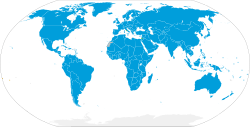
Just days after independence, Belize was admitted as the 156th member of the United Nations, gaining international recognition and support for its sovereignty amid Guatemala's continued territorial claims.
Image source: Member states of the United Nations
Dec 17, 1984
% complete
The United Democratic Party won the first post-independence general election, and Manuel Esquivel became Belize's second prime minister. His government pursued economic liberalization and closer ties with the United States, alternating power with George Price's PUP through the decade.
Image source: Manuel Esquivel
Aug 28, 1998
% complete
Said Musa of the People's United Party became prime minister in 1998 and served two terms. His administration focused on social programs, education, and infrastructure, though it also faced criticism over rising debt from development financing.
Image source: Said Musa
2006
% complete
Facing unsustainable public debt, Belize undertook major bond restructurings in 2006–2007 and again in 2012–2013, negotiating with creditors to reduce its debt burden. These restructuring efforts helped stabilize the economy but highlighted persistent fiscal vulnerabilities.
Image source: Economy of Belize
Feb 8, 2008
% complete
Dean Barrow of the United Democratic Party became Belize's first prime minister of Garifuna descent, winning historic landslide victories. He served three consecutive terms, overseeing economic reforms and navigating the global financial crisis and the Belize Bank debt dispute.
Image source: Dean Barrow
Sep 14, 2016
% complete
Belize's Supreme Court ruled that the country's colonial-era law criminalizing homosexuality was unconstitutional, striking down section 53 of the Criminal Code. The landmark ruling made Belize the first English-speaking Caribbean country to repeal such a law through the courts.
Image source: LGBTQ rights in Belize
May 8, 2019
% complete
In a national referendum, a majority of Belizeans voted to refer the long-standing territorial dispute with Guatemala to the International Court of Justice. Guatemala had voted similarly in 2018, setting both countries on a legal path toward a definitive resolution of the 150-year-old claim.
Nov 12, 2020
% complete
Johnny Briceño led the People's United Party to a decisive victory in the November 2020 general election, becoming prime minister. He took office amid the COVID-19 pandemic and pledged to address corruption, economic recovery, and the resolution of the Guatemala dispute via referendum.
Image source: Johnny Briceño
Or browse the full history timeline directory, with more than 2,000 topics.
This History of Belize timeline was generated with the help of AI, using information found on the internet.
We work hard to keep these timelines accurate, but mistakes do get through. If you spot one, email us at [email protected] and we'll fix it for future visitors.
Generate yours with AI or build it from scratch, for free.
Export your timeline, add your own events, edit or remove AI-generated events, and much more
No credit card required.
Cancel anytime.
Cancel anytime.
You can create an unlimited number of timelines with up to 10 events on each one, customize how they look, export them to PDF, PNG, PowerPoint, CSV, and Excel, and share them with a link. Paid plans raise the event limit and add features like spreadsheet imports and collaborators.
Yes. You can cancel your subscription from your account page at any time, and you will not be charged again. Your subscription stays active for the rest of the period you already paid for.
Yes. We will email you a reminder before the annual renewal, and we will also email you a receipt.
Yes. You can email us within 15 days of any payment, and we will issue you a full refund.
Check out our pricing docs or send us an email anytime: [email protected].