-
Use Cases
-
Resources
-
Pricing
Casablanca is Morocco's largest city and economic capital. Its history spans from Berber settlements and Phoenician and Roman trading posts to its growth under Portuguese rule as Anfa, destruction and rebuilding by Sultan Moulay Ismail, French colonial development in the 20th century, and its pivotal role in Morocco's independence movement, culminating in its status today as a major commercial and cultural hub. More Less
100 - 299
% complete
A Roman wreck of the 2nd century, from which 169 silver coins were salvaged, shows that the Romans appreciated this useful port for commerce. There is even evidence of oil commerce with Roman Volubilis and Tingis in the 3rd century.
Image source: Casablanca
285 AD - 499
% complete
Roman Anfa, connected mainly by commerce and socio-cultural ties to Volubilis (autonomous from Rome since 285 AD), lasted until the 5th century, when Vandals conquered Roman northwestern Africa. A small community of Christians linked to Roman merchants may have persisted until the fifth or sixth century.
1068 AD
% complete
The city of Anfa remained under local rule until it was conquered by the Almoravids in 1068 AD.
Image source: Almoravid dynasty
1149 AD
% complete
The Almohad Sultan Abd al-Mu'min drove the Barghawata out of Tamasna in 1149 and replaced them with Bedouin Arab tribes, notably Banu Hilal and Banu Sulaym.
Image source: Abd al-Mu'min
1500 - 1599
% complete
In his famous Descrittione dell'Africa (Description of Africa), written in the 16th century, Leo Africanus defined Anfa as a city built by the Romans.
Image source: Leo Africanus
1468 AD
% complete
In 1468, the city was captured and destroyed by the Kingdom of Portugal and the Algarves under Rei Afonso V the African.
Image source: Afonso V of Portugal
1515 AD
% complete
The Portuguese used the ruins of the destroyed city to build a military fortress in 1515.
1580 AD - 1640 AD
% complete
After the death of Rei Sebastian at the Battle of Alcácer Quibir against the Saadi Empire and the ensuing crisis of succession, Portugal and with it Casablanca became part of the Iberian Union from 1580 to 1640.
Image source: Iberian Union
1755 AD
% complete
With the secession of Portugal in 1640, Casablanca again became a Portuguese outpost until 1755 AD, when it was destroyed by an earthquake and the Portuguese abandoned it.
Image source: 1755 Lisbon earthquake
1770 AD
% complete
The Medina of Casablanca was founded in 1770 AD by Sultan Muhammad III ben Abdallah (1756–1790), the grandson of Ismail Ibn Sharif.
Image source: Mohammed ben Abdallah
1800 - 1899
% complete
In the 19th century Casablanca became a major supplier of wool to the booming textile industry in Britain and shipping traffic increased; the British began importing Morocco's now famous national drink, gunpowder tea.
1864 AD
% complete
Casablanca was one of the main Atlantic ports to receive Jewish migrants from the Moroccan hinterlands following the mission of Moses Montefiore to Morocco in 1864.
Image source: Moses Montefiore
1906 AD
% complete
Following the Treaty of Algeciras in 1906, which granted the French holding company La Compagnie Marocaine rights to build modern ports in Casablanca and Asfi, Casablanca remained a modestly sized port with around 12,000 inhabitants as French colonial administrators arrived within a sovereign sultanate in 1906.
Image source: Algeciras Conference
May 2, 1907
% complete
Construction at the port of Casablanca began on May 2, 1907, effectively beginning the process of colonization, although French control was not formalized until the Treaty of Fez on March 30, 1912.
Image source: Port of Casablanca
1908 AD
% complete
Dominated by the clock tower built in 1908, the space demarked a contact point between the Moroccan medina and the European nouvelle ville. A contemporary observer noted that apart from the mosques, a few residential doors, and the German consulate, no monument attracted the visitor's gaze.
Mar 30, 1912
% complete
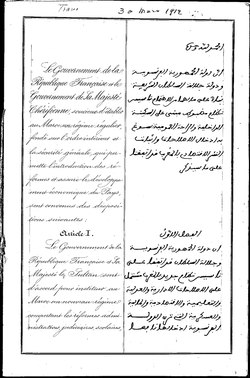
French control of Casablanca, begun de facto with the port construction of 1907, was not formalized until the signature of the Treaty of Fez on March 30, 1912.
Image source: Treaty of Fes
1913 AD
% complete
In 1913, Lyautey invited Henri Prost to handle the urban planning of Moroccan cities, and his work in Casablanca was lauded for applying principles of urbanization.
Image source: Henri Prost
1914 AD
% complete
The city experienced a population increase since 1907, partly due to European immigration and French colonial policies. In 1914, Europeans formed 40% of the total Casablanca population, with their own schools, churches, hospitals and places of recreation.
1915 AD
% complete
In 1915, the French authorities held the Exposition Franco-Marocaine, a display of French soft power after the bombardment of the city in 1907 and during the ongoing wars of occupation, notably the Zaian War—an opportunity to inventory Morocco's resources and crafts.
1921 AD
% complete
By 1921, Casablanca's population had risen to 110,000, largely through the development of bidonvilles—informal shanty settlements surrounding the growing colonial city.
Image source: Shanty town
1930 AD
% complete
In 1930, Casablanca hosted a round of the Formula One world championship. The race would later be held at the Ain-Diab circuit in 1958.
Image source: Moroccan Grand Prix
1937 AD - 1938 AD
% complete
A 1937–1938 typhoid fever outbreak was exploited by colonial authorities to justify the appropriation of urban spaces in Casablanca.
Nov 8, 1942
% complete
In November 1942, the British and Americans organised a three-pronged attack on North Africa (Operation Torch), of which the westernmost prong was at Casablanca. The Task Force landed before daybreak on November 8, 1942, at three points in Morocco: Asfi, Fedala (the largest landing with 19,000 men), and Mehdiya-Port Lyautey.
Image source: Operation Torch
Jan 14, 1943 - Jan 24, 1943
% complete
Casablanca hosted the Casablanca Conference, also called the Anfa Conference, in January 1943, in which Winston Churchill and Franklin Roosevelt discussed the progress of World War II.
Image source: Casablanca Conference
Apr 7, 1947 - Apr 8, 1947
% complete
When the Sultan went to Tangier to deliver a speech requesting independence, French colonial forces instigated a conflict between Senegalese Tirailleurs and Moroccan locals in a failed attempt to sabotage his journey. The massacre, remembered as Darbat Salighan, lasted about 24 hours as tirailleurs fired randomly into working-class neighborhoods, killing between 180 and 1,000 civilians.
Dec 7, 1952 - Dec 8, 1952
% complete
The assassination of Tunisian labor unionist Farhat Hached by La Main Rouge—the clandestine militant wing of French intelligence—sparked protests in cities around the world and riots in Casablanca from December 7–8, 1952.
Image source: Farhat Hached
Apr 1953
% complete
In April 1953, Salut Casa!—a 'pseudo-documentary' propaganda piece intended for French audiences—played at the Cannes Film Festival.
Image source: Cannes Film Festival
Aug 20, 1953 - Apr 6, 1956
% complete
The urban resistance launched 4,520 violent attacks targeting infrastructure in Moroccan cities, mostly Casablanca. Between December 1953 and March 1955 there were 1,222 attacks which claimed 259 deaths and 732 wounded, earning Casablanca the nickname 'Morocco's Chicago.' By 1950, the city had 158,000 Europeans, 414,500 Muslims, and 72,000 Jews.
Mar 2, 1956
% complete
Morocco regained independence from France on March 2, 1956. That year, Elie Azagury, the first Moroccan modernist architect, led the GAMMA group of architects in independent Morocco.
Image source: History of Morocco
Jan 4, 1961 - Jan 7, 1961
% complete
From January 4–7, 1961, the city hosted an ensemble of progressive African leaders during the Casablanca Conference of 1961. Notably absent was Patrice Lumumba of the Republic of the Congo, who had been in prison since September 1960.
Image source: Casablanca Group
Nov 1961 - 1964
% complete
Casablanca was a major departure point for Jews leaving Morocco through Operation Yachin, an operation conducted by Mossad to secretly migrate Moroccan Jews to Israel between November 1961 and spring 1964.
Image source: Operation Yachin
Mar 22, 1965
% complete
The 1965 student protests started on March 22, 1965, in front of Lycée Mohammed V in Casablanca, with almost 15,000 students. The next day students returned along with workers and the poor, vandalizing stores and burning buses while chanting slogans against King Hassan II, who blamed teachers and parents and declared there is no greater danger to the State than a so-called intellectual.
Sep 1965
% complete
Dec 11, 1977
% complete
The poet and activist Saida Menebhi died in Casablanca on December 11, 1977, after a 34-day hunger strike.
May 29, 1981
% complete
On May 29, 1981, riots broke out in Casablanca. This intifada was the first of two IMF riots in Morocco—dubbed the 'Hunger Revolts' by the international press—the second taking place in 1984 primarily in northern cities such as Nador and Tetuan.
1983 AD
% complete
1992 AD
% complete
The first McDonald's franchise on the African continent and in the Arab world opened on Ain Diab in Casablanca in 1992.
Image source: McDonald's
Mar 2000
% complete
In March 2000, women's groups organised demonstrations in Casablanca proposing reforms to the legal status of women. Although a counter-demonstration attracted half a million participants, the movement influenced King Mohammed VI, who enacted a new Mudawana family law in early 2004 meeting some activists' demands.
Image source: Mudawana
May 16, 2003
% complete
On May 16, 2003, 33 civilians were killed and more than 100 injured when Casablanca was hit by a multiple suicide bomb attack carried out by Moroccans and claimed by some to have been linked to al-Qaeda.
Image source: 2003 Casablanca bombings
Dec 2012
% complete
The first line of the Casablanca Tramway, which as of 2019 consists of two lines, was inaugurated in December 2012.
Image source: Casablanca Tramway
Nov 15, 2018
% complete
Al-Boraq, a high-speed rail service connecting Casablanca and Tangier and the first high-speed rail service on the African continent, was inaugurated on November 15, 2018.
Image source: Al Boraq
Or browse the full history timeline directory, with more than 2,000 topics.
This History of Casablanca timeline was generated with the help of AI, using information found on the internet.
We work hard to keep these timelines accurate, but mistakes do get through. If you spot one, email us at [email protected] and we'll fix it for future visitors.
Generate yours with AI or build it from scratch, for free.
Export your timeline, add your own events, edit or remove AI-generated events, and much more
No credit card required.
Cancel anytime.
Cancel anytime.
You can create an unlimited number of timelines with up to 10 events on each one, customize how they look, export them to PDF, PNG, PowerPoint, CSV, and Excel, and share them with a link. Paid plans raise the event limit and add features like spreadsheet imports and collaborators.
Yes. You can cancel your subscription from your account page at any time, and you will not be charged again. Your subscription stays active for the rest of the period you already paid for.
Yes. We will email you a reminder before the annual renewal, and we will also email you a receipt.
Yes. You can email us within 15 days of any payment, and we will issue you a full refund.
Check out our pricing docs or send us an email anytime: [email protected].