-
Use Cases
-
Resources
-
Pricing
Lagos, Nigeria's largest city and former capital, has a history spanning from its origins as an Awori Yoruba settlement and Benin Empire outpost to its era as a major hub of the transatlantic slave trade, its annexation as a British colony in 1861, its role as the capital of independent Nigeria, and its modern status as one of the fastest-growing megacities in the world. More Less
1400
% complete
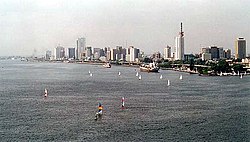
By the 15th century, the Awori people had arrived in the area, coming down the Ogun river seeking shelter from a war. Trade later drew numerous groups to the region, including the Ijebu.
Image source: Lagos
1472
% complete
In 1472, Portuguese explorer Rui de Sequeira visited the area, naming it Lago de Curamo, meaning Lake of Curamo. The Portuguese began trading in the lagoon around this time but bypassed the small island communities, going directly to Ijebu.
1500
% complete
Lagos was founded in the 16th century by the Awori people on the Bight of Benin. Trade drew numerous groups to the area, including the Binis.
1550
% complete
By the mid-16th century, the Kingdom of Benin was taking an increasing role in European trade, expanding west to control more coastal access points and cloth production centers.
Image source: History of Lagos
1600
% complete
Around 1600, a dispute broke out between the Beninese and other foreign merchants on one hand and the local Awori on the other.
1600 - 1699
% complete
In the 17th century, trade with the Portuguese began to increase, as Onim (Lagos) became a center of the Atlantic slave trade. Ashipa initiated a payment of tribute to Benin that would not be abolished until 1830, although Eko's subservience to Benin was mostly nominal by the 18th century.
Image source: Atlantic slave trade
1652
% complete
1652 saw the first recorded purchase of slaves at Lagos by English slavers, marking the beginning of English involvement in the city's slave trade.
1775
% complete
Oba Akinsemoyin died circa 1775. He was briefly succeeded by Eletu Kekere, and then by Ologun Kutere around 1780.
Image source: Oba of Lagos
1780 - 1830
% complete
The slave trade grew prodigiously in the 1780s, and then further with Dahomey's wars against Porto Novo and the chaotic collapse of the Oyo Empire in the early 19th century.
1800
% complete
Around the dawn of the 19th century, the death of Ologun Kutere led to a succession dispute between two of his sons, Osinlokun and Adele Ajosun.
1821 - 1835
% complete
Adele Ajosun continued to raid Lagos from 1821 to 1835 after losing his throne, but was unable to regain it.
1829
% complete
Upon Osinlokun's death in 1829, his son Idewu Ojulari succeeded him as Oba of Lagos.
1808 - 1867
% complete
In Britain's early 19th-century fight against the transatlantic slave trade, its West Africa Squadron pursued Portuguese, American, French, and Cuban slave ships and imposed anti-slavery treaties with West African coastal chiefs, creating a strong presence from Sierra Leone to the Niger Delta and Congo.
Image source: West Africa Squadron
1849 - 1854
% complete
In 1849, Britain appointed John Beecroft Consul of the Bights of Benin and Biafra, a position he held along with his governorship of Fernando Po until his death in 1854.
1851
% complete
In 1851, under pressure from liberated slaves who now wielded political and business influence, Britain intervened in Lagos in what is now known as the Bombardment of Lagos or Capture of Lagos, resulting in the installation of Oba Akitoye and the ouster of Oba Kosoko.
Image source: Reduction of Lagos
1852
% complete
The signing of the 1852 treaty ushered in the Consular Period in Lagos's history, wherein Britain provided military protection for Lagos.
1855
% complete
In 1855, Spain claimed the port of Lagos for itself amid competing European interests in the region.
1861
% complete
Following threats from Kosoko and the French positioned at Whydah, Lord Palmerston noted in 1861 the expediency of assuming the formal Protectorate of Lagos without delay.
Image source: Lagos Colony
Jul 30, 1861
% complete
William McCoskry, the Acting Consul in Lagos, with Commander Bedingfield convened a meeting with Oba Dosunmu aboard HMS Prometheus where Britain's intent was explained and a response to the terms was required by August 1861.
Aug 6, 1861
% complete
Dosunmu resisted the terms of the treaty but under the threat of a bombardment on Lagos by Commander Bedingfield, he relented and signed the Lagos Treaty of Cession on 6 August 1861.
Mar 5, 1862
% complete
Lagos was declared a colony on 5 March 1862 but was governed from the Gold Coast, modern day Ghana.
1869
% complete
In 1869, the Cathedral Church of Christ was established in Lagos, becoming a landmark of the growing Christian community in the city.
Image source: Cathedral Church of Christ, Lagos
1886
% complete
By 1886, telegraph cables connecting Lagos to London had been established, greatly improving communications between the colony and Britain.
1886
% complete
In 1886, Lagos became a separate colony from the Gold Coast under Governor Cornelius Alfred Moloney. Since the 19th century, Lagos gradually transformed into a cosmopolitan melting pot of Africans and Latin Americans.
1896
% complete
The Lagos Government Railway began construction of a Cape Gauge railway line from Lagos to Ibadan in 1896, which was opened on 4 March 1901. The line was later extended to Nguru via several cities, reaching about 1360 km.
Image source: Nigerian Railway Corporation
Sep 19, 1898
% complete
Electrification was implemented in Lagos on 19 September 1898, 17 years after its introduction in England, making Lagos one of the earliest electrified cities in Africa.
1899
% complete
The Orange Order established its first lodge in Africa, known as the Lagos Fine Blues Loyal Orange Lodge No 801, formed at the end of the 19th century.
Image source: Orange Order
1901
% complete
In 1901, the first bridge was built between Lagos Island and the mainland, the Carter Bridge, named after the governor who served from 1891 to 1898.
Image source: Carter Bridge
1902
% complete
From 1902, the Lagos Government Railway also operated the Lagos steam tramway, providing urban transport within the city.
1906
% complete
In 1906, Lagos was merged with the Protectorate of Southern Nigeria and became its capital. General Lugard advanced far north with British troops after 1900 and made Lagos the capital of the south and later of the entire country.
Image source: Southern Nigeria Protectorate
1908
% complete
In Lekki, near Lagos, the Nigerian Bitumen Corporation under businessman John Simon Bergheim found oil during test drilling in 1908.
Image source: History of Nigeria
1913
% complete
In 1913, the Lagos Port was commissioned, establishing the city as a major maritime gateway for Nigeria.
Image source: Lagos
Jan 1, 1914
% complete
On January 1, 1914, Northern Nigeria and Southern Nigeria were united into a single state, the 'Colony and Protectorate of Nigeria', and Lagos became the capital. In the north, 'indirect rule' left traditional ruling structures largely intact.
Image source: Northern Nigeria Protectorate
Feb 1, 1914
% complete
Since 1 February 1914, a regular mailboat service ran between Lagos and Great Britain (Liverpool). The contact of the colony of Nigeria with Great Britain was mainly maintained by such mail ships before the beginning of air transport in 1945.
Image source: Elder Dempster Lines
1922
% complete
This included the 'Nigerian Council' of the Clifford Constitution of 1922, a kind of parliament with 46 representatives among whom were four locals, including three from Lagos.
Image source: Colonial Nigeria
1924 - 1931
% complete
An epidemic which began in 1924 and lasted until 1931 caused a total of 1,947 cases and 1,813 deaths, corresponding to a mortality rate of 94.02%.
1935
% complete
In 1935, the railway network in colonial Nigeria reached its maximum expansion. In 1916, a 550 m railway bridge over the Niger River and in 1932 (or 1934) a bridge over the Benue River had connected the three parts of the rail network.
Image source: Rail transport in Nigeria
1942
% complete
In 1942, British special agents posted on Spanish-controlled Bioko used the ports in Lagos to house Italian and German supply ships captured as part of Operation Postmaster.
Image source: Operation Postmaster
1960
% complete
Lagos maintained its status as capital when Nigeria obtained its independence from Britain in 1960.
May 27, 1967
% complete
Before 27 May 1967, Lagos had been administered directly by the Federal Government as a Federal Territory through the Federal Ministry of Lagos Affairs, while the Lagos City Council governed the city.
Image source: Lagos State
Aug 1973 - Oct 1973
% complete
Paul McCartney recorded the album 'Band on the Run' with his band Wings at the EMI studio on Wharf Road in Apapa, Lagos, from August to October 1973. It is still McCartney's most successful album and is praised by critics.
Image source: Band on the Run
1974
% complete
Due to corruption and incompetence of the central government under General Gowon, hundreds of ships with ordered cement deliveries - half of the world supply - lay outside the port in 1974, causing chaotic scenes.
Image source: Nigerian Ports Authority
Mar 21, 1975
% complete
Volkswagen of Nigeria began assembling the VW 1300 in Lagos on 21 March 1975. In 1976, it produced over 16,000 vehicles, including the Passat and the Audi 100.
1976
% complete
Lagos played the dual role of being the State and Federal Capital until 1976 when the state capital was moved to Ikeja.
Image source: Ikeja
Jan 15, 1977 - Feb 12, 1977
% complete
From January to February 1977, the Second World Black and African Festival of Arts and Culture (FESTAC) took place in Lagos and Kaduna. FESTAC 77 is believed to be the largest cultural event held in Africa in the 20th century.
Image source: FESTAC 77
Mar 31, 1977 - Apr 3, 1977
% complete
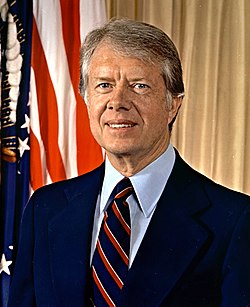
From 31 March to 3 April 1977, US President Jimmy Carter visited Lagos. To date, it is the only visit by a US president to the city (as of 2023).
Image source: Jimmy Carter
1982
% complete
In 1982, the Shagari government reacted to Nigeria's lack of foreign currency by imposing import restrictions, which hampered production in Lagos throughout the 1980s.
Image source: Shehu Shagari
Mar 1990 - 1994
% complete
In March 1990, the Volkswagen Group decided to withdraw from the Nigeria business. Negotiations on a sale to a Nigerian group of companies, begun in 1992, failed due to internal political power struggles. In 1994, Volkswagen withdrew the last German employees.
1991
% complete
In 1991, Ibrahim Babangida, the Military President, and other government functions moved to the newly built capital Abuja, ending Lagos's role as national capital.
Image source: Abuja
2000
% complete
After 2000, the centre of the Nigerian film industry, commonly referred to as Nollywood, developed in the Surulere district. This has led to ever new records in box office takings in Nigeria: 'The Figurine' (2009), 'Half of a Yellow Sun' (2013), and 'The Wedding Party' (2016).
Image source: Cinema of Nigeria
Jan 27, 2002
% complete
On 27 January 2002, explosions occurred at a barracks site in the city, causing significant destruction and loss of life.
Image source: 2002 Lagos armoury explosion
Jun 3, 2012
% complete
In 2012, 163 people were killed when a McDonnell Douglas MD-83 crashed into a local furniture works and printing press building in Lagos.
Image source: Dana Air Flight 0992
May 6, 2016
% complete
The 2016 film 'Captain America: Civil War' contains a scene set in Lagos. Other productions using Lagos as a filming location include 'La unidad' (2020-2023), 'The Last Tree' (2019), and 'The Way, Chapter 2'.
Image source: Captain America: Civil War
Aug 30, 2016
% complete
On 30 August 2016, Mark Zuckerberg visited tech startups in the Yaba district, particularly CcHUB and IT instructor Andela, highlighting Lagos's growing tech scene.
Image source: Co-Creation Hub
Oct 2017
% complete
In October 2017, Facebook established the first African SME Council in Nigeria to support small and medium-sized enterprises.
Image source: Facebook
Jun 10, 2021
% complete
On 10 June 2021, Lagos received a standard gauge railway link with Nigeria's third largest city, Ibadan, including the modern central station Mobolaji Johnson. In 2022, the Nigerian Railway Corporation reported profitable operation despite COVID restrictions.
Nov 1, 2021
% complete
On 1 November 2021, a 21-storey high-rise building under construction in the affluent Ikoyi district collapsed. It is the largest construction disaster of its kind in Lagos as of 2023.
Jan 2023
% complete
In January 2023, the new deep-sea port of Lekki was opened to relieve traffic at the more centrally located but congested and shallower ports of Apapa and Tin Can Island.
Image source: Lekki Port
Sep 4, 2023
% complete
On 4 September 2023, the first section, the blue line, of the Lagos suburban railway went into operation.
Image source: Lagos Rail Mass Transit
Feb 14, 2024 - Feb 29, 2024
% complete
On 14 February 2024, Governor Sanwo-Olu announced that the Red Line of the Lagos suburban railway between Agbado and Oyingbo would be inaugurated on 29 February 2024 in the presence of Nigerian President Tinubu.
Feb 24, 2024
% complete
On 24 February 2024, the foundation stone was laid on Victoria Island for a 12,000-seat multi-purpose arena for the booming entertainment industry. Live Nation, Oak View Group, Persianas Group and NSIA formed a consortium to build it, expected to be completed in December 2025.
Image source: Victoria Island, Lagos
Or browse the full history timeline directory, with more than 2,000 topics.
This History of Lagos timeline was generated with the help of AI, using information found on the internet.
We work hard to keep these timelines accurate, but mistakes do get through. If you spot one, email us at [email protected] and we'll fix it for future visitors.
Generate yours with AI or build it from scratch, for free.
Export your timeline, add your own events, edit or remove AI-generated events, and much more
No credit card required.
Cancel anytime.
Cancel anytime.
You can create an unlimited number of timelines with up to 10 events on each one, customize how they look, export them to PDF, PNG, PowerPoint, CSV, and Excel, and share them with a link. Paid plans raise the event limit and add features like spreadsheet imports and collaborators.
Yes. You can cancel your subscription from your account page at any time, and you will not be charged again. Your subscription stays active for the rest of the period you already paid for.
Yes. We will email you a reminder before the annual renewal, and we will also email you a receipt.
Yes. You can email us within 15 days of any payment, and we will issue you a full refund.
Check out our pricing docs or send us an email anytime: [email protected].