-
Use Cases
-
Resources
-
Pricing
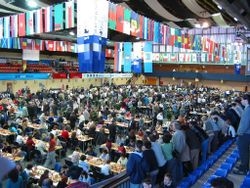
Chess is a strategic board game that originated in India around the 6th century as chaturanga, spread to Persia and the Arab world, evolved into its modern form in Europe by the 15th century, and grew into a global competitive sport with official world championships, computer engines, and millions of players worldwide. More Less
600
% complete
Chaturanga, widely regarded as the earliest ancestor of chess, emerged in India around the 6th century. The game featured four divisions of the army: infantry, cavalry, elephants, and chariots, which evolved into the modern pawn, knight, bishop, and rook.
Image source: Chaturanga
600
% complete
The game spread from India to Sassanid Persia, where it became known as chatrang. Persian literature, including the Karnamak-i Ardeshir-i Papakan, references the game, marking its establishment in the Middle East.
650
% complete
Following the Muslim conquest of Persia, the game was adopted by the Arab world as shatranj. It flourished under Islamic rule, with players developing systematic openings and endgame studies that laid groundwork for chess theory.
Image source: Shatranj
840
% complete
The Arab player al-Adli authored one of the earliest known treatises on shatranj, analyzing openings and composing mansubat (problems), establishing some of the first recorded chess theory in history.
800
% complete
Chess entered Europe via the Iberian Peninsula and Sicily as Muslims expanded into these regions. By the year 1000 it had spread across Europe, becoming a popular pastime among nobility.
Image source: History of chess
850
% complete
Early European references to chess appear in Carolingian-era texts, including a poem attributed to Einhard about a match between two Frankish nobles, showing the game's arrival among the elite of Western Europe.
1061
% complete
Cardinal Damiani condemned bishops for playing chess, and several church councils over subsequent centuries restricted or banned clergy from playing, reflecting concerns about gambling and idleness associated with the game.
1150
% complete
The famous Lewis chessmen, carved from walrus ivory, were created in Norway around the mid-12th century. Discovered on the Isle of Lewis in Scotland in 1831, they are among the best-preserved medieval chess sets in existence.
Image source: Lewis chessmen
1475
% complete
In southern Europe, major rule changes transformed the game: the queen gained her powerful modern movement and the bishop its long diagonal range. This faster, more dynamic version became known as 'queen's chess' or scacchi de la donna.
Image source: Queen (chess)
1497
% complete
Lucena's 'Repetición de amores y arte de axedrez' included the earliest surviving printed analysis of the new rules, featuring opening lines and endgames such as the famous Lucena position in rook endings.
Image source: Luis Ramírez de Lucena
1561
% complete
Spanish priest Ruy López de Segura published 'Libro de la invención liberal y arte del juego del axedrez', one of the first serious theoretical works, and lent his name to the Ruy López opening still played today.
Image source: Ruy López de Segura
1620
% complete
Italian player Gioachino Greco recorded numerous games demonstrating tactical brilliancies and traps. His manuscripts circulated widely across Europe and influenced generations of attacking players.
Image source: Gioachino Greco
1740
% complete
The Café de la Régence in Paris became the world's leading chess center, hosting greats like Philidor, Morphy, and later Capablanca, and serving as the epicenter of European chess culture for over a century.
Image source: Café de la Régence
1749
% complete
François-André Danican Philidor's landmark work declared 'pawns are the soul of chess', pioneering positional understanding and pawn structure theory that shaped strategic play for centuries.
Image source: François-André Danican Philidor
1770
% complete
Wolfgang von Kempelen unveiled the Mechanical Turk, an automaton that appeared to play chess autonomously. It toured Europe and America for decades, defeating Napoleon and other notables, before being exposed as a hoax with a hidden human player.
Image source: Mechanical Turk
1849
% complete
Designed by Nathaniel Cooke and endorsed by Howard Staunton, the Staunton pattern became the standard tournament chess piece design, replacing ornate regional styles and enabling universal recognition of pieces.
Image source: Staunton chess set
May 11, 1997
% complete
IBM's Deep Blue computer defeated reigning World Champion Garry Kasparov in a six-game match, marking the first time a computer beat a world champion under standard tournament conditions and heralding the era of computer chess.
Image source: Deep Blue versus Garry Kasparov
Mar 2020
% complete
Lockdowns and streaming platforms like Twitch fueled explosive growth in online chess, with sites reporting record membership surges and celebrities playing the game, bringing millions of new players worldwide.
Image source: Chess.com
Oct 23, 2020
% complete
Netflix's miniseries 'The Queen's Gambit' became a global phenomenon, driving record sales of chess sets and books and a massive influx of new players to online platforms, cementing a cultural chess renaissance.
Image source: The Queen's Gambit (miniseries)
Jun 1851
% complete
Held alongside the Great Exhibition, the London 1851 tournament was the first international chess competition. Adolf Anderssen won, defeating Lionel Kieseritzky in the legendary 'Immortal Game' during a casual match at the event.
Image source: London 1851 chess tournament
Jun 21, 1851
% complete
Anderssen sacrificed both rooks, his queen, and more to deliver checkmate with minor pieces, producing one of the most celebrated games in chess history and exemplifying the romantic era of attacking play.
Image source: Immortal Game
1857 - 1859
% complete
American prodigy Paul Morphy won the 1857 First American Chess Congress, then toured Europe crushing all comers. His principled open play and rapid development set new standards before he retired from chess in 1859.
Image source: Paul Morphy
1886
% complete
Wilhelm Steinitz defeated Johannes Zukertort in 1886 in what is recognized as the first official World Chess Championship match. Steinitz pioneered scientific, positional chess and defended his title until 1894.
Image source: Wilhelm Steinitz
May 26, 1894
% complete
Emanuel Lasker defeated Steinitz to become World Champion, holding the title for 27 years—the longest reign in history—while contributing deeply to chess psychology and mathematical game theory.
Image source: Emanuel Lasker
1921
% complete
José Raúl Capablanca dethroned Lasker in Havana in 1921. Known as the 'chess machine' for his flawless technique, he went eight years without losing a game and dominated the era until 1927.
Image source: José Raúl Capablanca
Jul 18, 1924
% complete
The inaugural team championship of nations took place in Paris during the Olympic Games, launching the tradition of national teams competing in what became the biennial Chess Olympiad.
Image source: Chess Olympiad
Jul 20, 1924
% complete
The Fédération Internationale des Échecs (FIDE) was established in Paris to govern international chess. It later assumed administration of the World Championship and standardized rules worldwide.
Image source: FIDE
1927
% complete
Alexander Alekhine stunned the chess world by defeating Capablanca in their 1927 match, winning six games to none. His fierce attacking style contrasted sharply with Capablanca's precision, and he held the title until 1935 and again from 1937 until his death in 1946.
Image source: Alexander Alekhine
1948
% complete
After Alekhine's death, FIDE organized a 1948 tournament in Moscow and The Hague to determine a new champion. Mikhail Botvinnik won decisively, beginning the Soviet dominance of world chess that lasted decades.
Image source: Mikhail Botvinnik
1970
% complete
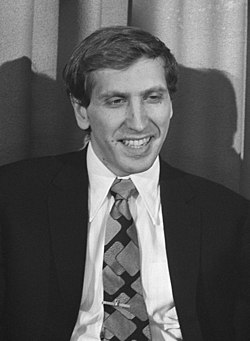
Bobby Fischer led the United States team to victory over the heavily favored Soviet squad at the 1970 Chess Olympiad in Siegen, foreshadowing his historic run to the world title three years later.
Image source: Bobby Fischer
Jul 11, 1972 - Sep 1, 1972
% complete
Bobby Fischer beat Boris Spassky in Reykjavík at the height of the Cold War, becoming the first American-born World Champion. The match captivated global audiences and sparked a massive surge in chess popularity in the West.
Image source: World Chess Championship 1972
Apr 3, 1975
% complete
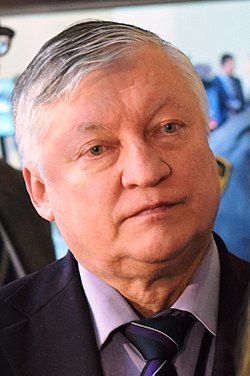
When Bobby Fischer refused FIDE's conditions for defending his title, the championship passed by default to challenger Anatoly Karpov, who then dominated the 1970s and engaged in legendary rivalry with Garry Kasparov.
Image source: Anatoly Karpov
Nov 9, 1985
% complete
At age 22, Garry Kasparov defeated Anatoly Karpov to become the youngest World Champion in history. He dominated chess for 15 years, holding the top rating until his retirement in 2005.
Image source: Garry Kasparov
Oct 13, 2006
% complete
Vladimir Kramnik defeated Veselin Topalov in a reunification match in Elista, ending the split caused by Kasparov's 1993 breakaway Professional Chess Association and restoring a single undisputed World Champion.
Image source: World Chess Championship 2006
Nov 22, 2013
% complete
Norwegian Magnus Carlsen defeated Viswanathan Anand in Chennai to become World Champion. Renowned for his endgame mastery and universal style, he achieved the highest rating in history and reigned for a decade.
Image source: Magnus Carlsen
Or browse the full history timeline directory, with more than 2,000 topics.
This History of Chess timeline was generated with the help of AI, using information found on the internet.
We work hard to keep these timelines accurate, but mistakes do get through. If you spot one, email us at [email protected] and we'll fix it for future visitors.
Generate yours with AI or build it from scratch, for free.
Export your timeline, add your own events, edit or remove AI-generated events, and much more
No credit card required.
Cancel anytime.
Cancel anytime.
You can create an unlimited number of timelines with up to 10 events on each one, customize how they look, export them to PDF, PNG, PowerPoint, CSV, and Excel, and share them with a link. Paid plans raise the event limit and add features like spreadsheet imports and collaborators.
Yes. You can cancel your subscription from your account page at any time, and you will not be charged again. Your subscription stays active for the rest of the period you already paid for.
Yes. We will email you a reminder before the annual renewal, and we will also email you a receipt.
Yes. You can email us within 15 days of any payment, and we will issue you a full refund.
Check out our pricing docs or send us an email anytime: [email protected].