-
Use Cases
-
Resources
-
Pricing
The history of climatology traces humanity's efforts to understand Earth's climate system. Beginning with ancient observations of weather patterns by Greek philosophers like Aristotle, the field evolved through centuries of instrument development, systematic record-keeping, and scientific breakthroughs. Key milestones include the invention of the thermometer and barometer, the establishment of meteorological networks, the discovery of the greenhouse effect by Joseph Fourier and John Tyndall, Guy Stewart Callendar's early evidence of human-caused warming, and the modern era of computer climate models and international assessments by the IPCC that confirm anthropogenic climate change. More Less
400 BC
% complete
Ancient Greek scholars conceived of a zonal model of climate, dividing Earth into torrid, temperate, and frigid zones — an early framework that influenced climate classification for centuries.
Image source: Geographical zone
1080
% complete
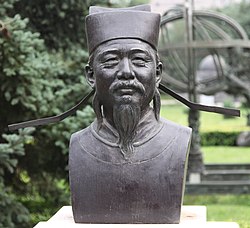
Chinese scientist Shen Kuo observed petrified bamboos found underground near Yanzhou (modern Yan'an, Shaanxi province), a dry-climate area unsuitable at that time for the growth of bamboo.
Image source: Shen Kuo
1080
% complete
From his observation of petrified bamboo in an arid region, Shen Kuo (1031–1095) inferred that climates naturally shifted over an enormous span of time, an early insight into long-term climate change.
Image source: Paleoclimatology
1640 - 1642
% complete
With new instruments like thermometers and barometers available, systematic recordkeeping of weather observations began as early as 1640–1642 in England.
Image source: Meteorology
1640 - 1642
% complete
The invention of thermometers during the Scientific Revolution allowed for systematic recordkeeping of temperature, laying the instrumental foundation for modern climatology.
Image source: Thermometer
1640
% complete
The availability of thermometers and barometers allowed for the accumulation of long-term instrumental records, transforming climate study from speculation into quantitative science.
Image source: Climatology
1643
% complete
The barometer, invented during the Scientific Revolution, enabled measurement of atmospheric pressure, allowing scientists to systematically record weather data for climatological study.
Image source: Barometer
1686
% complete
Edmund Halley undertook observations following a voyage to the southern hemisphere, gathering the data he would use to chart global wind patterns.
Image source: Edmond Halley
1686
% complete
Edmund Halley published a map of the trade winds in 1686, one of the earliest attempts to explain and visualize large-scale atmospheric circulation patterns.
Image source: Trade winds
1686
% complete
Halley's work on the trade winds helped establish early ideas about atmospheric circulation, connecting solar heating to persistent wind systems across the globe.
Image source: Atmospheric circulation
1760 - 1790
% complete
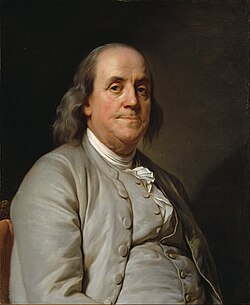
Benjamin Franklin (1706–1790) conducted pioneering investigations of Atlantic weather and ocean phenomena, contributing to the emerging science of climatology.
Image source: Benjamin Franklin
1768
% complete
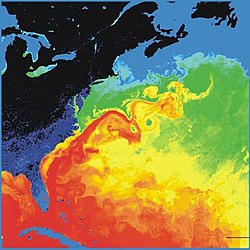
Benjamin Franklin first mapped the course of the Gulf Stream for use in sending mail from North America to Europe, revealing how ocean currents influence transatlantic travel and climate.
Image source: Gulf Stream
1768
% complete
Franklin's mapping of the Gulf Stream had practical value: by routing ships along the current, mail from North America could be delivered to Europe faster, showing the utility of climatological knowledge.
1770
% complete
Following Franklin's Gulf Stream work, ocean currents came to be understood as integral components of the climate system, linking sea temperatures with regional weather patterns.
Image source: Ocean current
1800 - 1900
% complete
Throughout the nineteenth century, much climatological effort focused on describing the characteristics of regional climates around the world, compiling observations into comprehensive regional accounts.
1884
% complete
The most widely used classification system, the Köppen climate classification, was developed during the late nineteenth century, building on earlier Greek and later schemes.
Image source: Köppen climate classification
1884
% complete
The Köppen climate classification is based on vegetation, using plant distribution as an indicator of climate zones — an approach that made it broadly applicable and enduringly popular.
1884 - 1936
% complete
Wladimir Köppen refined his vegetation-based climate classification over several decades, producing updated versions that remain the most widely used climate classification today.
1900
% complete
Different climate classifications have been developed over the centuries, and the twentieth century saw numerous alternative systems proposed alongside the dominant Köppen scheme.
Image source: Köppen climate classification
2000
% complete
Modern scholarship acknowledges the long lineage of climate classification, from the first schemes of Ancient Greece through Köppen's vegetation-based system developed in the late nineteenth century.
1860
% complete
Francis Galton (1822–1911) began influential research on weather patterns, contributing to the scientific analysis of atmospheric systems in the late nineteenth century.
Image source: Francis Galton
1863
% complete
Francis Galton invented the term 'anticyclone,' providing a name for high-pressure weather systems and enriching the vocabulary used to describe atmospheric circulation.
Image source: High-pressure area
1900 - 1950
% complete
During the early 20th century, climatology mostly emphasized the description of regional climates, cataloguing temperature, precipitation, and seasonal patterns for different areas.
1906
% complete
Helmut Landsberg (1906–1985) was born in Frankfurt, Germany. He would go on to become one of the most influential climatologists of the twentieth century.
Image source: Helmut Landsberg
1940 - 1985
% complete
Helmut Landsberg fostered the use of statistical analysis in climatology, helping transform the field from purely descriptive regional accounts into a quantitative, data-driven science.
1945
% complete
Through Landsberg's advocacy, statistical techniques became central to analyzing climate data, enabling rigorous detection of trends, variability, and anomalies in climate records.
1950
% complete
By mid-century, aided by statistical methods championed by Landsberg and others, climatology matured into a quantitative physical science rather than a descriptive geography subfield.
1999
% complete
Robinson and Ann Henderson-Sellers published their 1999 work on contemporary climatology, reflecting the modern synthesis of statistical, physical, and regional approaches in the field.
2000
% complete
Contemporary publications, including scholarly works with identifiers such as ISBN 978-953-51-0095-9, document and preserve the foundational history of climatology for future researchers.
Or browse the full history timeline directory, with more than 2,000 topics.
This History of Climatology timeline was generated with the help of AI, using information found on the internet.
We work hard to keep these timelines accurate, but mistakes do get through. If you spot one, email us at [email protected] and we'll fix it for future visitors.
Generate yours with AI or build it from scratch, for free.
Export your timeline, add your own events, edit or remove AI-generated events, and much more
No credit card required.
Cancel anytime.
Cancel anytime.
You can create an unlimited number of timelines with up to 10 events on each one, customize how they look, export them to PDF, PNG, PowerPoint, CSV, and Excel, and share them with a link. Paid plans raise the event limit and add features like spreadsheet imports and collaborators.
Yes. You can cancel your subscription from your account page at any time, and you will not be charged again. Your subscription stays active for the rest of the period you already paid for.
Yes. We will email you a reminder before the annual renewal, and we will also email you a receipt.
Yes. You can email us within 15 days of any payment, and we will issue you a full refund.
Check out our pricing docs or send us an email anytime: [email protected].