-
Use Cases
-
Resources
-
Pricing
Superconductivity is the phenomenon in which certain materials conduct electricity with zero electrical resistance when cooled below a critical temperature. Discovered in 1911 by Heike Kamerlingh Onnes, it has evolved through decades of theoretical breakthroughs—such as the BCS theory—and experimental advances like high-temperature superconductors, enabling technologies including MRI machines, maglev trains, and particle accelerators. More Less
Mar 21, 1900
% complete
On March 21, 1900, Nikola Tesla was granted a patent for the means for increasing the intensity of electrical oscillations by lowering the temperature, which was caused by lowered resistance.
Image source: Nikola Tesla
Jul 10, 1908
% complete
A milestone was achieved on July 10, 1908, when Heike Kamerlingh Onnes at Leiden University in the Netherlands produced, for the first time, liquefied helium, which has a boiling point of 4.2 K (−269 °C) at atmospheric pressure.
Image source: Heike Kamerlingh Onnes
Jan 1, 1911
% complete
Onnes disclosed his research in a paper titled "On the Sudden Rate at Which the Resistance of Mercury Disappears." He stated that the "specific resistance" became thousands of times less than that of the best conductor at ordinary temperature.
Apr 8, 1911
% complete
On April 8, 1911, at 16:00 hours Onnes noted "Kwik nagenoeg nul", which translates as "[Resistance of] mercury almost zero." At the temperature of 4.19 K, he observed that the resistivity abruptly disappeared, marking the discovery of superconductivity.
Image source: Superconductivity
Jan 1, 1913
% complete
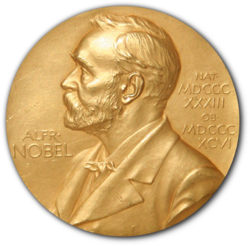
Initially, Onnes called the phenomenon "supraconductivity" and only later adopted the term "superconductivity." For his research, he was awarded the Nobel Prize in Physics in 1913.
Image source: Nobel Prize in Physics
Jan 1, 1912
% complete
In 1912, Onnes conducted an experiment on the usability of superconductivity, exploring practical uses of the newly discovered phenomenon.
Jan 1, 1913
% complete
Soon after discovering superconductivity, Kamerlingh Onnes attempted to make an electromagnet with superconducting windings but found that relatively low magnetic fields destroyed superconductivity in the materials he investigated.
Image source: Superconducting magnet
Jan 1, 1955
% complete
George Yntema succeeded in constructing a small 0.7-tesla iron-core electromagnet with superconducting niobium wire windings, decades after Onnes's failed early attempts.
Jan 1, 1962
% complete
Ted Berlincourt and Richard Hake discovered that less brittle alloys of niobium and titanium are suitable for applications up to 10 teslas, paving the way for practical superconducting magnets.
Image source: Niobium–titanium
Jan 1, 2014
% complete
Conectus, a European consortium for superconductivity, estimated that global economic activity for which superconductivity was indispensable amounted to about five billion euros, with MRI systems accounting for about 80% of that total.
Image source: Magnetic resonance imaging
Jan 1, 1913
% complete
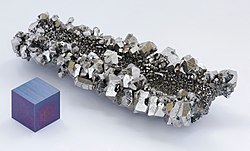
In subsequent decades, superconductivity was found in several other materials besides mercury. In 1913, lead was discovered to be superconducting at 7 K.
Image source: Lead
Jan 1, 1930 - Dec 31, 1939
% complete
During the 1930s, niobium was found to be superconducting at 10 K, expanding the family of known superconducting elements.
Image source: Niobium
Jan 1, 1937
% complete
Lev Shubnikov discovered a new type of superconductors, later called type-II superconductors, which presented a mixed phase between ordinary and superconductive properties.
Image source: Type-II superconductor
Jan 1, 1941
% complete
In 1941, niobium nitride was found to be superconducting at 16 K, pushing the known critical temperature higher.
Image source: Niobium nitride
Jan 1, 1954
% complete
Based on his experience finding new superconductors, Bernd Matthias came up with Matthias' rules, a set of empirical guidelines on how to find new types of superconductors.
Image source: Bernd T. Matthias
Jan 1, 1973
% complete
Nb3Ge was found to have a transition temperature (Tc) of 23 K, which remained the highest ambient-pressure Tc until the discovery of the cuprate high-temperature superconductors in 1986.
Jan 1, 1979
% complete
Organic superconductors were discovered, the second of two new classes of superconductors that could not be explained by conventional BCS theory.
Image source: Organic superconductor
Jan 1, 1979
% complete
One of two new classes of superconductors discovered that could not be explained by BCS theory: heavy fermion superconductors, whose electrons behave as if they have very large effective masses.
Jan 1, 1986
% complete
Alex Müller (with Georg Bednorz) discovered superconductivity in a lanthanum-based cuprate perovskite material with a transition temperature of 35 K—the first of the high-temperature superconductors.
Image source: High-temperature superconductivity
Jan 1, 1987
% complete
For the discovery of superconductivity in a lanthanum-based cuprate perovskite material, Alex Müller shared the Nobel Prize in Physics in 1987.
Image source: K. Alex Müller
Mar 1, 2001
% complete
Superconductivity of magnesium diboride (MgB2) was found with Tc = 39 K, a surprisingly high transition temperature for a simple compound.
Image source: Magnesium diboride
Jan 1, 2008
% complete
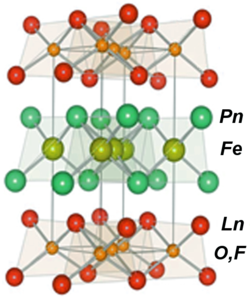
The oxypnictide or iron-based superconductors were discovered, leading to a flurry of work in the hope that studying them would provide insights into a theory of the cuprate superconductors.
Image source: Iron-based superconductor
Jan 1, 2013
% complete
Room-temperature superconductivity was attained in YBCO for picoseconds, using short pulses of infrared laser light to deform the material's crystal structure.
Image source: Yttrium barium copper oxide
Jan 1, 1933
% complete
Walther Meissner and Robert Ochsenfeld discovered that superconductors expelled applied magnetic fields, a phenomenon that has come to be known as the Meissner effect.
Image source: Meissner effect
Jan 1, 1935
% complete
Brothers Fritz London and Heinz London showed that the Meissner effect was a consequence of the minimization of the electromagnetic free energy carried by superconducting current.
Jan 1, 1950
% complete
The phenomenological Ginzburg–Landau theory of superconductivity was devised by Lev Landau and Vitaly Ginzburg, providing a powerful framework for describing superconducting phenomena.
Image source: Ginzburg–Landau theory
May 15, 1950
% complete
Emanuel Maxwell and, almost simultaneously, C.A. Reynolds discovered the isotope effect in superconductors, showing that the critical temperature depends on isotopic mass—a key clue toward the microscopic mechanism of superconductivity.
Image source: Kinetic isotope effect
Jan 1, 1957
% complete
The complete microscopic theory of superconductivity was finally proposed in 1957 by John Bardeen, Leon N. Cooper, and John Robert Schrieffer, explaining superconductivity through Cooper pairing of electrons.
Image source: BCS theory
Jan 1, 1958
% complete
Nikolay Bogolyubov showed that the BCS wavefunction, originally derived from a variational argument, could be obtained using a canonical transformation of the electronic Hamiltonian.
Image source: Nikolay Bogolyubov
Jan 1, 1959
% complete
Lev Gor'kov showed that the BCS theory reduced to the Ginzburg–Landau theory close to the critical temperature, unifying the two major theoretical approaches.
Jan 1, 1962
% complete
The Little–Parks effect was discovered in experiments with empty and thin-walled superconducting cylinders subjected to a parallel magnetic field, demonstrating flux quantization.
Image source: Little–Parks effect
Jan 1, 1962
% complete
Brian Josephson made the important theoretical prediction that a supercurrent can flow between two pieces of superconductor separated by a thin layer of insulator—the basis of the Josephson junction.
Image source: Brian Josephson
Jan 1, 1972
% complete
For their work on the BCS theory, John Bardeen, Leon Cooper, and John Schrieffer were awarded the Nobel Prize in Physics in 1972.
Image source: John Bardeen
Jan 1, 1973
% complete
Brian Josephson was awarded the Nobel Prize in Physics for his prediction of the supercurrent tunneling through an insulating barrier between superconductors.
Image source: Josephson effect
Jan 1, 2003
% complete
Alexei Abrikosov and Vitaly Ginzburg were awarded the 2003 Nobel Prize in Physics for their pioneering work on superconductivity theory (Lev Landau having died in 1968).
Image source: Vitaly Ginzburg
Or browse the full history timeline directory, with more than 2,000 topics.
This History of Superconductivity timeline was generated with the help of AI, using information found on the internet.
We work hard to keep these timelines accurate, but mistakes do get through. If you spot one, email us at [email protected] and we'll fix it for future visitors.
Generate yours with AI or build it from scratch, for free.
Export your timeline, add your own events, edit or remove AI-generated events, and much more
No credit card required.
Cancel anytime.
Cancel anytime.
You can create an unlimited number of timelines with up to 10 events on each one, customize how they look, export them to PDF, PNG, PowerPoint, CSV, and Excel, and share them with a link. Paid plans raise the event limit and add features like spreadsheet imports and collaborators.
Yes. You can cancel your subscription from your account page at any time, and you will not be charged again. Your subscription stays active for the rest of the period you already paid for.
Yes. We will email you a reminder before the annual renewal, and we will also email you a receipt.
Yes. You can email us within 15 days of any payment, and we will issue you a full refund.
Check out our pricing docs or send us an email anytime: [email protected].