
-
Use Cases
-
Resources
-
Pricing
The history of semiconductors traces the scientific discoveries, inventions, and industrial breakthroughs that transformed materials like silicon into the foundation of modern electronics. Beginning with early studies of material conductivity in the 1800s, the field advanced through the invention of the transistor in 1947, the integrated circuit in 1958, and the relentless miniaturization described by Moore's Law, ultimately enabling computers, smartphones, and countless digital technologies. More Less
1821
% complete
Thomas Johann Seebeck was the first to notice that semiconductors exhibit special features, observing that experiments concerning the Seebeck effect produced much stronger results when applying semiconductor materials rather than metals.
Image source: Thomas Johann Seebeck
1833
% complete
In 1833, Michael Faraday reported that the resistance of specimens of silver sulfide decreases when they are heated, an unusual property contrasting with metals, and one of the earliest documented observations of semiconductor behavior.
Image source: Michael Faraday
1835
% complete
Peter Munck af Rosenschöld discovered rectification in metallic sulfides, writing for the Annalen der Physik und Chemie in 1835. His findings were largely ignored at the time, and the effect was later rediscovered by Karl Ferdinand Braun.
Image source: Karl Ferdinand Braun
1839
% complete
In 1839, Alexandre Edmond Becquerel reported observation of a voltage between a solid and a liquid electrolyte when struck by light — the photovoltaic effect — laying early groundwork for solar energy technology.
Image source: Photovoltaic effect
1873
% complete
In 1873, Willoughby Smith observed that selenium resistors exhibit decreasing resistance when light falls on them, a discovery of photoconductivity that enabled early light-sensing technologies.
Image source: Willoughby Smith
1874
% complete
In 1874, Karl Ferdinand Braun observed conduction and rectification in metallic sulfides, building on earlier ignored findings by Peter Munck af Rosenschöld from 1835. This work underpinned the development of crystal detectors.
1874
% complete
Also in 1874, Arthur Schuster found that a copper oxide layer on wires had rectification properties that ceased when the wires were cleaned, another early demonstration of semiconductor rectifying behavior.
Image source: Arthur Schuster
1876
% complete
William Grylls Adams and Richard Evans Day observed the photovoltaic effect in selenium in 1876, demonstrating that light could generate electricity in a solid material without moving parts or chemistry.
Image source: William Grylls Adams
1878
% complete
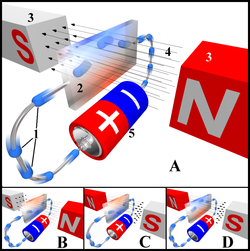
In 1878, Edwin Herbert Hall demonstrated the deflection of flowing charge carriers by an applied magnetic field, known as the Hall effect, which later became a key tool for studying charge carriers in semiconductors.
Image source: Hall effect
1922
% complete
Oleg Losev observed light emission from semiconductor junctions in 1922, an early observation of electroluminescence, but at the time the effect had no practical use; it would later inspire LED development.
Image source: Oleg Losev
1874
% complete
The first semiconductor devices used galena, including German physicist Ferdinand Braun's crystal detector in 1874, which exploited the rectifying contact between a metal whisker and a semiconductor crystal.
Image source: Crystal detector
1880
% complete
Alexander Graham Bell used the light-sensitive property of selenium to transmit sound over a beam of light in 1880 with his photophone, an early practical exploitation of a semiconductor's optical properties.
Image source: Alexander Graham Bell
1883
% complete
In 1883, Charles Fritts constructed a working solar cell of low efficiency using a metal plate coated with selenium and a thin layer of gold. The device became commercially useful in photographic light meters in the 1930s.
1901
% complete
Indian physicist Jagadish Chandra Bose developed a radio crystal detector in 1901 using galena, among the first practical applications of semiconductor devices for wireless communication.
Image source: Jagadish Chandra Bose
1904
% complete
Point-contact microwave detector rectifiers made of lead sulfide were used by Jagadish Chandra Bose in 1904, while the cat's-whisker detector became a common device in the development of radio.
1904
% complete
The first practical application of semiconductors in electronics was the 1904 development of the cat's-whisker detector, a primitive semiconductor diode used in early radio receivers to demodulate signals.
1922
% complete
In 1922, Oleg Losev developed two-terminal negative resistance amplifiers for radio, but he died in the Siege of Leningrad after successful completion of his work, before it could be widely recognized.
1926
% complete
In 1926, Julius Edgar Lilienfeld patented a device resembling a field-effect transistor, but it was not practical, predating by two decades the first working transistors at Bell Labs.
Image source: Julius Edgar Lilienfeld
1938
% complete
Pohl demonstrated a solid-state amplifier in 1938 using a structure resembling the control grid of a vacuum tube; although it displayed power gain, its cut-off frequency of one cycle per second was too low for practical use.
Image source: Semiconductor
1938
% complete
Holden started investigating solid-state amplifiers in 1938, part of growing pre-war research interest in replacing bulky vacuum tubes with semiconductor devices.
1897
% complete
J. J. Thomson's discovery of the electron in 1897 prompted theories of electron-based conduction in solids, providing a foundation for understanding how electricity flows through materials like semiconductors.
Image source: J. J. Thomson
1914
% complete
Johan Koenigsberger classified solid materials like metals, insulators, and 'variable conductors' in 1914, although his student Josef Weiss had already introduced the term Halbleiter (semiconductor) in its modern meaning.
Image source: Semiconductor
1928
% complete
In 1928, Felix Bloch published a theory of the movement of electrons through atomic lattices, a cornerstone of quantum solid-state physics that explained electronic behavior in crystalline materials.
Image source: Felix Bloch
1930
% complete
In 1930, Bernhard Gudden stated that conductivity in semiconductors was due to minor concentrations of impurities, establishing the crucial concept of doping that underlies all modern semiconductor technology.
1931
% complete
By 1931, the band theory of conduction had been established by Alan Herries Wilson and the concept of band gaps had been developed, giving a unified explanation of the difference between metals, insulators, and semiconductors.
Image source: Alan Herries Wilson
1938
% complete
By 1938, Boris Davydov had developed a theory of the copper-oxide rectifier, identifying the effect of the p–n junction and the importance of minority carriers and surface states.
1941
% complete
The first p–n junction in silicon was observed by Russell Ohl about 1941 when a specimen was found to be light-sensitive, with a sharp boundary between p-type impurity at one end and n-type at the other.
1947
% complete
The first working transistor was a point-contact transistor invented by John Bardeen, Walter Houser Brattain, and William Shockley at Bell Labs in 1947, a breakthrough made possible by advances in quantum physics and solid-state theory.
Image source: John Bardeen
1954
% complete
In 1954, physical chemist Morris Tanenbaum fabricated the first silicon junction transistor at Bell Labs, opening the way to silicon's dominance in the electronics industry.
1958
% complete
Developments in quantum physics led in turn to the invention of the integrated circuit in 1958, following the 1947 transistor, enabling many components to be fabricated together and transforming modern electronics.
Image source: Integrated circuit
Or browse the full history timeline directory, with more than 2,000 topics.
This History of Semiconductors timeline was generated with the help of AI, using information found on the internet.
We work hard to keep these timelines accurate, but mistakes do get through. If you spot one, email us at [email protected] and we'll fix it for future visitors.
Generate yours with AI or build it from scratch, for free.
Export your timeline, add your own events, edit or remove AI-generated events, and much more
No credit card required.
Cancel anytime.
Cancel anytime.
You can create an unlimited number of timelines with up to 10 events on each one, customize how they look, export them to PDF, PNG, PowerPoint, CSV, and Excel, and share them with a link. Paid plans raise the event limit and add features like spreadsheet imports and collaborators.
Yes. You can cancel your subscription from your account page at any time, and you will not be charged again. Your subscription stays active for the rest of the period you already paid for.
Yes. We will email you a reminder before the annual renewal, and we will also email you a receipt.
Yes. You can email us within 15 days of any payment, and we will issue you a full refund.
Check out our pricing docs or send us an email anytime: [email protected].