-
Use Cases
-
Resources
-
Pricing
The history of laptops traces the evolution of portable computing from early briefcase-sized machines like the Osborne 1 to today's lightweight ultrabooks, convertible 2-in-1s, and powerful gaming notebooks. Key milestones include the first clamshell laptop designs, the introduction of lithium-ion batteries, Wi-Fi connectivity, and the rise of thin-and-light form factors powered by energy-efficient processors. More Less
1980
The Portal was based on an Intel 8085 processor, 8-bit, clocked at 2 MHz, making it one of the earliest portable microcomputers.
Image source: Portal (video game)

Sep 1980
The portable microcomputer 'Portal', of the French company R2E Micral CCMC, officially appeared in September 1980 at the Sicob show in Paris. It was designed and marketed by the studies and developments department of R2E Micral at the request of CCMC, a company specializing in payroll and accounting.
1981
The Osborne 1 weighed close to 11 kg (24 lb) and was priced at US$1,795 (equivalent to $6,357 in 2025), bundling software that made it a popular early portable.
Image source: Osborne 1

1981
The first significant development towards laptop computing was announced in 1981: the 8/16-bit Epson HX-20, a battery-powered handheld computer with a built-in printer.
Image source: Epson HX-20

Apr 3, 1981
Adam Osborne founded Osborne Computer and produced the Osborne 1 on April 3, 1981, launching one of the first commercially successful portable computers.
Image source: Osborne Computer Corporation

1982
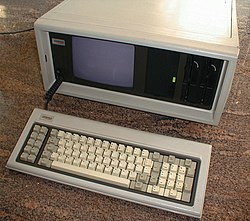
The Compaq Portable was the first PC-compatible portable computer, created in 1982 by Compaq Computer Corporation.
Image source: Compaq Portable
Jul 1982
The Epson HX-20 was sold from July 1982 and is widely regarded as an important precursor to modern laptop computers.
1983
The year 1983 also saw the launch of what was probably the biggest-selling early laptop, the 8-bit Kyocera Kyotronic 85, owing much to the design of the previous Epson HX-20.
Image source: TRS-80 Model 100

1983
Although at first a slow seller in Japan, the Kyotronic 85 was quickly licensed by Tandy Corporation, Olivetti, and NEC, who marketed it respectively as the TRS-80 Model 100 line (or Tandy 100), Olivetti M-10, and NEC PC-8201.
Mar 1983
The Compaq Portable's first shipment was in March 1983 and it was priced at US$2,995 (equivalent to $9,992 in 2025).
This History of Laptops timeline was generated with the help of AI, using information found on the internet.
We work hard to keep these timelines accurate, but mistakes do get through. If you spot one, email us at [email protected] and we'll fix it for future visitors.
Generate yours with AI or build it from scratch, for free.