-
Use Cases
-
Resources
-
Pricing
The history of microprocessors traces the evolution of the integrated circuits that serve as the central processing units of computers. Beginning with Intel's 4004 in 1971, microprocessors rapidly advanced from handling thousands of instructions per second to billions, driving the personal computer revolution, mobile devices, and modern computing through continuous improvements in transistor density, architecture, and manufacturing processes as described by Moore's Law. More Less
Dec 23, 1947
% complete
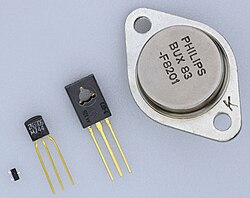
John Bardeen, Walter Brattain, and William Shockley of Bell Labs demonstrated the first working point-contact transistor. This solid-state device replaced bulky vacuum tubes, enabling smaller, more reliable, and more energy-efficient electronics and laying the essential groundwork for all future integrated circuits and microprocessors.
Image source: Transistor
Sep 12, 1958
% complete
While working at Texas Instruments, Jack Kilby built the first working integrated circuit, a germanium-based oscillator with components connected on a single piece of semiconductor material. Kilby's invention allowed multiple electronic components to be fabricated together, a critical precursor to the microprocessor.
Image source: Integrated circuit
Jan 1959 - Jul 30, 1959
% complete
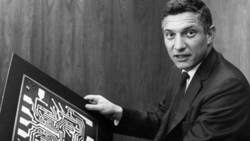
Robert Noyce at Fairchild Semiconductor independently invented a practical planar silicon integrated circuit using Jean Hoerni's planar process. Silicon ICs proved far easier to manufacture in volume than Kilby's germanium approach, making mass-produced complex chips feasible.
Image source: Robert Noyce
Apr 19, 1965
% complete
Gordon Moore published a paper in Electronics magazine observing that the number of transistors on an integrated circuit doubled roughly every two years while costs fell. This empirical prediction became both a roadmap and a self-fulfilling prophecy that guided the semiconductor industry for decades.
Image source: Moore's law
Jul 18, 1968
% complete
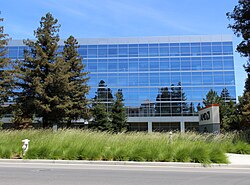
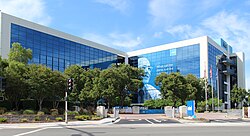
Gordon Moore and Robert Noyce left Fairchild Semiconductor to found Intel (Integrated Electronics) in Mountain View, California. Joined soon after by Andy Grove, the company initially focused on semiconductor memory but would go on to invent the first commercial microprocessor.
Image source: Intel
Nov 15, 1971
% complete
Developed by Federico Faggin, Ted Hoff, and Stanley Mazor for Japanese calculator maker Busicom, the Intel 4004 was a complete CPU on a single chip. It packed 2,300 transistors running at 740 kHz on a 10-micron process, proving that general-purpose processors could be built from integrated circuits.
Image source: Intel 4004
Apr 1972
% complete
The Intel 8008 extended the microprocessor concept to 8-bit words and 16 KB of addressable memory. Originally commissioned by Computer Terminal Corporation for its Datapoint 2200 terminal, it opened the door to more capable embedded systems and early computers.
Image source: Intel 8008
Mar 1974
% complete
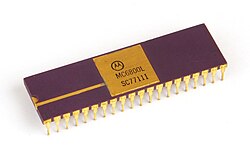
Designed by a team including Chuck Peddle and Bill Mensch, the Motorola 6800 was an 8-bit processor notable for requiring only a single power supply. It competed directly with the Intel 8080 and spawned a family of peripheral chips used in industrial and consumer products.
Image source: Motorola 6800
Apr 1974
% complete
The Intel 8080, designed under Federico Faggin's leadership, ran at 2 MHz and required only a single 5-volt power supply. It became the workhorse of early hobbyist computers, including the pioneering Altair 8800, and established the 8080 instruction set as a de facto standard.
Image source: Intel 8080
Sep 1975
% complete
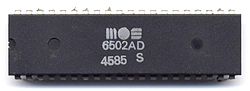
Chuck Peddle's team at MOS Technology introduced the 6502 at $25, dramatically undercutting competitors like the 8080 and 6800. Its low cost powered iconic machines such as the Apple II, Commodore 64, Atari 2600, and Nintendo Entertainment System.
Image source: MOS Technology 6502
Jul 1976
% complete
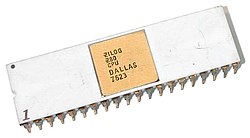
Federico Faggin, after leaving Intel, co-founded Zilog and created the Z80, an enhanced, software-compatible successor to the 8080. Widely adopted in CP/M business computers, arcade games, and embedded systems, the Z80 remained in production for decades.
Image source: Zilog Z80
Jul 1976
% complete
Steve Wozniak designed the Apple I single-board computer using the inexpensive MOS Technology 6502. Sold through Steve Jobs' new company Apple Computer, it demonstrated how affordable microprocessors could democratize personal computing.
Image source: Apple I
Jun 1977
% complete
The Apple II, built around a 1 MHz 6502, combined color graphics, expansion slots, and a plastic case into one of the first highly successful mass-market microcomputers. It brought microprocessor-driven computing into homes, schools, and small businesses.
Image source: Apple II
Jun 8, 1978
% complete
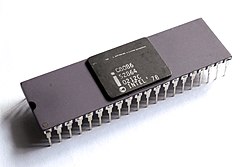
The Intel 8086 was a 16-bit processor whose architecture became the foundation of the x86 instruction set. Alongside its cheaper 8-bit bus sibling, the 8088, it would dominate personal computing after IBM's landmark adoption the following year.
Image source: Intel 8086
Aug 12, 1981
% complete
IBM's Model 5150 personal computer used the Intel 8088 running at 4.77 MHz. The machine's open architecture and IBM's brand legitimacy made MS-DOS and x86-compatible processors the industry standard, cementing Intel's dominance for decades.
Image source: IBM Personal Computer
Feb 1982
% complete
The 80286 added protected-mode memory management and up to 16 MB of addressable space, features enabling multitasking operating systems. It powered the IBM PC/AT and became ubiquitous in business computing during the mid-1980s.
Image source: Intel 80286
Nov 1982
% complete
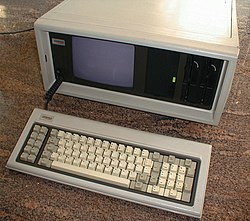
The Compaq Portable was the first fully IBM-compatible portable computer, achieved through clean-room reverse engineering of the BIOS. Clones like this vastly expanded the market for x86 microprocessors and eroded IBM's control over PC standards.
Image source: Compaq Portable
Oct 17, 1985
% complete
The Intel 80386 was the first 32-bit x86 processor, offering flat memory addressing and hardware virtualization support via paging. With 275,000 transistors, it enabled advanced operating systems like Windows and Linux on commodity hardware.
Image source: I386
Nov 26, 1985
% complete
Acorn's ARM1, developed by Sophie Wilson and Steve Furber, was the first commercial RISC microprocessor, prized for its simplicity and exceptional power efficiency. ARM designs later came to dominate mobile phones, tablets, and embedded devices worldwide.
Image source: ARM architecture family
Jun 22, 1989
% complete
Sun's scalable SPARC architecture embodied Berkeley RISC research and powered powerful UNIX workstations and servers. SPARC demonstrated that RISC designs could outperform contemporary CISC chips, influencing processor design across the industry.
Image source: SPARC
Nov 6, 1989
% complete
The i486 integrated a math coprocessor, cache, and pipelined execution on a single die containing 1.2 million transistors. It delivered roughly double the performance of the 386 and marked the transition to fully integrated modern CPU design.
Image source: I486
Mar 1993
% complete
Long-running litigation between AMD and Intel over rights to manufacture x86-compatible processors shaped the competitive landscape. Court rulings ultimately preserved second-source competition, allowing AMD to become a durable rival in PC processors.
Image source: AMD
Mar 22, 1993
% complete
Intel's Pentium, with 3.1 million transistors, featured dual pipelined execution units capable of executing two instructions per clock. It brought mainstream superscalar performance to desktops, though an early floating-point bug briefly tarnished its launch.
Image source: Pentium
Nov 1, 1995
% complete
The Pentium Pro translated x86 instructions into internal micro-operations and executed them out of order, dramatically boosting performance. Its integrated L2 cache package foreshadowed modern multi-chip module designs, though it excelled mainly with 32-bit software.
Image source: Pentium Pro
Jan 8, 1997
% complete
Intel's MMX added SIMD integer instructions to accelerate graphics, audio, and video processing. It began an era of increasingly specialized instruction-set extensions, followed by SSE, AVX, and others aimed at multimedia and scientific workloads.
Image source: MMX (instruction set)
Jun 23, 1999
% complete
AMD's original Athlon was the first processor to beat the Pentium III in performance. Its success, capped by the Athlon 64's introduction of consumer 64-bit x86 extensions in 2003, ended Intel's uncontested leadership and forced industry-wide innovation.
Image source: Athlon
Jan 19, 2000
% complete
Transmeta's Crusoe used code morphing software atop a simple VLIW core to execute x86 programs with remarkably low power consumption. Though commercially limited, it influenced mobile processor design and highlighted the growing importance of energy efficiency.
Aug 2000 - May 14, 2002
% complete
Built on the NetBurst architecture, the Pentium 4 pursued extremely high clock frequencies with a deep pipeline, eventually exceeding 3 GHz. Its escalating heat and power demands ultimately exposed the limits of frequency scaling and prompted a pivot toward multicore designs.
Image source: Pentium 4
Apr 22, 2003
% complete
AMD's Opteron server chip and Athlon 64 desktop chip introduced backward-compatible 64-bit computing to the x86 world. Intel adopted compatible extensions shortly thereafter, making AMD64/EM64T the universal 64-bit standard for PCs and servers.
Image source: X86-64
Apr 21, 2005
% complete
With single-core clock scaling stalling, Intel shipped the Pentium D and AMD launched the dual-core Athlon 64 X2 within weeks of each other. Multicore designs became the primary path to performance gains, reshaping software development toward parallelism.
Image source: Multi-core processor
Jul 27, 2006
% complete
After abandoning NetBurst, Intel returned to a shorter-pipeline, energy-efficient design derived partly from the Pentium M laptop chip. The Core architecture restored Intel's performance-per-watt leadership and set the template for subsequent generations.
Image source: Intel Core (microarchitecture)
Oct 2008
% complete
The Cortex-A8, used in Apple's A4 and many other system-on-chips, delivered high performance at smartphone-appropriate power levels. Combined with licensees like Qualcomm, Samsung, and Apple, ARM cores made mobile devices the largest processor market on earth.
Image source: ARM Cortex-A8
Jan 9, 2011
% complete
Sandy Bridge merged CPU cores, graphics, and cache on a single die with a ring interconnect, introducing AVX vector instructions. This integration defined the modern system-on-chip style PC processor, reducing cost and improving graphics performance dramatically.
Image source: Sandy Bridge
Nov 10, 2020
% complete
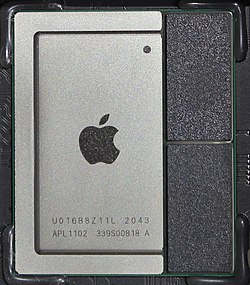
Apple's M1 system-on-a-chip, built on TSMC's 5-nanometer process, replaced Intel processors in the MacBook Air, MacBook Pro, and Mac mini. Its combination of performance, battery life, and unified memory validated ARM architectures even in traditional desktop-class computing.
Image source: Apple M1
Or browse the full history timeline directory, with more than 2,000 topics.
This History of Microprocessors timeline was generated with the help of AI, using information found on the internet.
We work hard to keep these timelines accurate, but mistakes do get through. If you spot one, email us at [email protected] and we'll fix it for future visitors.
Generate yours with AI or build it from scratch, for free.
Export your timeline, add your own events, edit or remove AI-generated events, and much more
No credit card required.
Cancel anytime.
Cancel anytime.
You can create an unlimited number of timelines with up to 10 events on each one, customize how they look, export them to PDF, PNG, PowerPoint, CSV, and Excel, and share them with a link. Paid plans raise the event limit and add features like spreadsheet imports and collaborators.
Yes. You can cancel your subscription from your account page at any time, and you will not be charged again. Your subscription stays active for the rest of the period you already paid for.
Yes. We will email you a reminder before the annual renewal, and we will also email you a receipt.
Yes. You can email us within 15 days of any payment, and we will issue you a full refund.
Check out our pricing docs or send us an email anytime: [email protected].