
-
Use Cases
-
Resources
-
Pricing
The history of transistors traces the development of the semiconductor devices that replaced vacuum tubes and made modern electronics possible. From the first point-contact transistor at Bell Labs in 1947 through the bipolar junction transistor, the planar process, integrated circuits, and today's billions-strong nanoscale transistors on a single chip, this timeline highlights the breakthroughs that launched the digital age. More Less
1925
% complete
Austrian-Hungarian physicist Julius Edgar Lilienfeld proposed the principle of a field-effect transistor in 1925. He filed a patent for it in Canada on October 22, 1925, but published no research articles about his devices, and his work was ignored by industry.
Image source: Field-effect transistor
Oct 22, 1925
% complete
The first patent for the field-effect transistor principle was filed in Canada by Austrian-Hungarian physicist Julius Edgar Lilienfeld on October 22, 1925. Because he published no research articles about his devices, industry overlooked his pioneering work.
Image source: Julius Edgar Lilienfeld
1934
% complete
In 1934, German physicist Dr. Oskar Heil further developed early work on field-effect devices, building on the concepts first proposed by Julius Edgar Lilienfeld nearly a decade earlier.
1942
% complete
Herbert Mataré (1912–2011) had conducted experiments at Telefunken with what he called a 'Duodiode' (double diode) from 1942, when he first observed transconductance effects with silicon diodes manufactured for German radar equipment during World War II.
Image source: Herbert Mataré
Nov 1943
% complete
Ralph Bray joined the germanium effort at Purdue University in November 1943 and was given the tricky task of measuring the spreading resistance at the metal–semiconductor contact, work whose significance would remain unappreciated for years.
Image source: Jack McBrayer
1944
% complete
During his Purdue research, Ralph Bray observed an anomalous effect that remained a mystery because nobody realized until 1948 that Bray had observed minority-carrier injection — the effect identified by William Shockley at Bell Labs that made the transistor a reality.
Image source: Schottky barrier
Dec 15, 1947
% complete
From Walter Brattain's laboratory notebook entry of December 15, 1947: 'When the points were very close together got voltage amp about 2 but not power amp.' The following day, December 16, contact was made to a germanium surface with evaporated gold spots, marking key steps toward a working transistor.
Image source: Walter Brattain
Dec 23, 1947
% complete
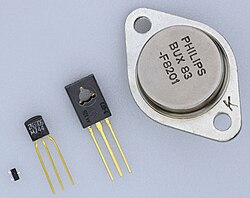
John Bardeen, Walter Brattain and William Shockley invented the first working transistors at Bell Labs, the point-contact transistor in 1947. The device was successfully demonstrated on December 23, 1947, at Bell Laboratories in Murray Hill, New Jersey — often cited as the birth date of the transistor.
Image source: Transistor
1948
% complete
Shockley introduced the improved bipolar junction transistor in 1948, which entered production in the early 1950s and led to the first widespread use of transistors. In 1950 he developed this radically different type of solid-state amplifier working on a completely different principle than the point-contact transistor.
1948
% complete
Matters became complicated when Bell Labs lawyers found that some of Shockley's own writings on the transistor were close enough to those of an earlier 1925 patent by Julius Edgar Lilienfeld that they thought it best that his name be left off the patent application.
1956
% complete
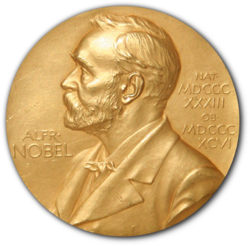
In 1956, John Bardeen, Walter Houser Brattain, and William Bradford Shockley were honored with the Nobel Prize in Physics 'for their researches on semiconductors and their discovery of the transistor effect'.
Image source: Nobel Prize in Physics
1948
% complete
In 1948, Bardeen and Brattain patented at Bell Labs an insulated-gate transistor (IGFET) with an inversion layer; this concept forms the basis of CMOS technology today.
Image source: CMOS
1955 - 1957
% complete
Carl Frosch and Lincoln Derick at Bell Labs accidentally grew a layer of silicon dioxide over a silicon wafer between 1955 and 1957, observing surface passivation effects — the process by which a semiconductor surface is rendered inert and does not change properties through interaction with air or other materials.
Image source: Passivation (chemistry)
1957
% complete
By 1957 Frosch and Derick, using masking and predeposition, were able to manufacture the first planar transistors, in which drain and source were adjacent at the same surface. Both p-channel and n-channel types were developed by Frosch and Derrick in 1957 at Bell Labs.
Image source: Planar process
1959
% complete
Taking advantage of silicon dioxide's passivating effect on the silicon surface, Jean Hoerni proposed making transistors protected by a layer of silicon dioxide and issued a first patent in 1959 while working at Fairchild Semiconductor.
1959
% complete
Following Frosch and Derick's passivation research, Mohamed Atalla and Dawon Kahng proposed a silicon MOS transistor in 1959, laying the groundwork for the metal-oxide-semiconductor field-effect transistor.
Image source: Mohamed M. Atalla
1960
% complete
The MOSFET was invented at Bell Labs between 1955 and 1960, after Frosch and Derick discovered surface passivation by silicon dioxide and used their finding to create the first planar transistors. Atalla and Kahng successfully demonstrated a working MOS device with their Bell Labs team in 1960.
Image source: MOSFET
Feb 1963
% complete
A new type of MOSFET logic, CMOS (complementary MOS), was invented by Chih-Tang Sah and Frank Wanlass at Fairchild Semiconductor, and in February 1963 they published the invention in a research paper. CMOS would go on to dominate digital electronics.
1964
% complete
General Microelectronics introduced the first commercial MOS integrated circuits in 1964, consisting of 120 p-channel transistors, launching the MOS IC industry.
Image source: Integrated circuit
1965
% complete
The first modern memory cells were introduced in 1965, when John Schmidt designed the first 64-bit MOS SRAM (static RAM), establishing the foundation for MOS semiconductor memory.
Image source: Static random-access memory
1965
% complete
In 1965, the Victor 3900 desktop calculator was the first MOS LSI calculator, incorporating 29 MOS LSI chips and showcasing the potential of large-scale integration in consumer products.
Image source: Calculator
1966
% complete
The first gallium-arsenide Schottky-gate field-effect transistor (MESFET) was made by Carver Mead and reported in 1966, extending transistor technology into high-speed compound-semiconductor applications.
Image source: MESFET
1967
% complete
In 1967 the Texas Instruments Cal-Tech was the first prototype electronic handheld calculator, with three MOS LSI chips. It was later released as the Canon Pocketronic in 1970.
1967
% complete
The first report of a floating-gate MOSFET (FGMOS) was made by Dawon Kahng and Simon Sze in 1967, creating the foundation for non-volatile memory technologies such as EPROM and flash memory.
Image source: Floating-gate MOSFET
1967
% complete
The self-aligned gate (silicon-gate) MOSFET transistor was invented by Robert Kerwin, Donald Klein and John Sarace at Bell Labs in 1967. Fairchild researchers Federico Faggin and Tom Klein then used it to develop the first silicon-gate MOS IC.
Image source: Self-aligned gate
1969 - 1970
% complete
The first multi-chip microprocessors were developed with multiple MOS LSI chips: the Four-Phase Systems AL1 in 1969 and the Garrett AiResearch MP944 in 1970, predating single-chip designs.
Image source: Microprocessor
1969
% complete
The Sharp QT-8D desktop calculator was the first mass-produced LSI MOS calculator in 1969. The follow-up Sharp EL-8, using four MOS LSI chips, became the first commercial electronic handheld calculator in 1970.
Image source: Sharp Corporation
1971
% complete
The first commercial single-chip microprocessor, the Intel 4004, was developed by Federico Faggin, using his silicon-gate MOS IC technology, with Intel engineers Marcian Hoff and Stan Mazor, and Busicom engineer Masatoshi Shima. The Busicom LE-120A HANDY LE, released the same year with a single MOS LSI chip from Mostek, was the first true electronic pocket calculator.
Image source: Intel 4004
1972
% complete
By 1972, MOS LSI (large-scale integration) circuits were commercialized for numerous applications, including automobiles, trucks, home appliances, business machines, electronic musical instruments, computer peripherals, cash registers, calculators, data transmission and telecommunication equipment.
Image source: Very-large-scale integration
1975
% complete
With the arrival of CMOS microprocessors in 1975, the term 'MOS microprocessors' began to refer to chips fabricated entirely from PMOS logic or entirely from NMOS logic, contrasted with 'CMOS microprocessors' and 'bipolar bit-slice processors'.
2013
% complete
By 2013, billions of MOS transistors were being manufactured every day, reflecting the extraordinary scale of the semiconductor industry built upon the MOSFET.
2018 - 2020
% complete
As of 2018, an estimated total of 13 sextillion (1.3×10²²) MOS transistors have been manufactured. In 2020, the MOSFET remained the dominant transistor type in use worldwide.
Apr 2023
% complete
In late April 2023, researchers at Linköping University and KTH Royal Institute of Technology successfully developed the world's first wooden transistor, potentially paving the way for more sustainable electronics and even control of electronic plants.
Image source: Organic field-effect transistor
Aug 13, 1948
% complete
On August 13, 1948, Herbert Mataré and Heinrich Welker (1912–1981), working at Compagnie des Freins et Signaux Westinghouse in Aulnay-sous-Bois, France applied for a patent on an amplifier based on the minority carrier injection process which they called the 'Transistron'. As Bell Labs did not make a public announcement before June 1948, the transistron was an independent parallel discovery.
May 18, 1949
% complete
The Transistron amplifier device developed by Herbert Mataré and Heinrich Welker was shown publicly on May 18, 1949, demonstrating that European engineers had independently developed working transistor technology.
1952
% complete
The first commercial application of transistors in telecommunication came in the fall of 1952 in tone generators for multifrequency signaling, beginning around October 1, 1951 with the point contact germanium transistor in related systems.
Jan 1, 1953 - Mar 31, 1953
% complete
The first low-cost junction transistor available to the general public was the CK722, a PNP germanium small signal unit introduced by Raytheon in early 1953 for $7.60 each, opening transistor technology to hobbyists and experimenters.
Image source: CK722
Aug 1953
% complete
A workable all-transistor radio was demonstrated in August 1953 at the Düsseldorf Radio Fair by the German firm Intermetall. It was built with four hand-made transistors based upon the 1948 invention of Herbert Mataré and Heinrich Welker.
Image source: Transistor radio
Nov 1953
% complete
The world's first transistor computer was built at the University of Manchester in November 1953, proving that solid-state electronics could power computing machines. Metropolitan Vickers Ltd rebuilt the full 200 transistor design in 1956 using junction transistors.
Image source: History of computing hardware
Oct 18, 1954
% complete
Texas Instruments had demonstrated all-transistor AM radios as early as 1952, but performance lagged vacuum tube models. The TR-1 was announced on October 18, 1954, put on sale in November 1954 for US$49.95 (about US$500 in year-2020 dollars), and sold about 150,000 units.
Image source: Regency TR-1
1955
% complete
Ibuka obtained special permission from the Japanese Ministry of Finance to pay the $50,000 license fee, and in 1955 the company introduced its own five-transistor 'coatpocket' radio, the TR-55, under the new brand name Sony. The TR-55 is often incorrectly credited as the first transistor radio.
Image source: Sony
Apr 28, 1955
% complete
In the April 28, 1955 edition of the Wall Street Journal, Chrysler and Philco announced they had developed and produced the world's first all-transistor car radio. The Mopar model 914HR became available as an option in Fall 1955 for new Chrysler and Imperial cars hitting showrooms on October 21, 1955.
Image source: Chrysler
1957
% complete
It was not until 1957 that Sony produced their ground-breaking 'TR-63' shirt pocket radio, a much more advanced design that ran on a standard 9-volt battery and could compete favorably with vacuum tube portables. It was the first mass-produced transistor radio, leading to mass-market penetration of transistor radios.
1958 - 1960
% complete
The IBM 7070 (1958), IBM 7090 (1959), and CDC 1604 (1960) were the first computers sold as commercial products that were based on transistors, ushering in second-generation computing.
Image source: IBM 7090
Or browse the full history timeline directory, with more than 2,000 topics.
This History of Transistors timeline was generated with the help of AI, using information found on the internet.
We work hard to keep these timelines accurate, but mistakes do get through. If you spot one, email us at [email protected] and we'll fix it for future visitors.
Generate yours with AI or build it from scratch, for free.
Export your timeline, add your own events, edit or remove AI-generated events, and much more
No credit card required.
Cancel anytime.
Cancel anytime.
You can create an unlimited number of timelines with up to 10 events on each one, customize how they look, export them to PDF, PNG, PowerPoint, CSV, and Excel, and share them with a link. Paid plans raise the event limit and add features like spreadsheet imports and collaborators.
Yes. You can cancel your subscription from your account page at any time, and you will not be charged again. Your subscription stays active for the rest of the period you already paid for.
Yes. We will email you a reminder before the annual renewal, and we will also email you a receipt.
Yes. You can email us within 15 days of any payment, and we will issue you a full refund.
Check out our pricing docs or send us an email anytime: [email protected].