
-
Use Cases
-
Resources
-
Pricing
Dubai's history traces its transformation from a small pearl-fishing village on the Arabian Gulf into one of the world's most dynamic cities. Key milestones include the Al Maktoum dynasty's rule beginning in 1833, the discovery of oil in 1966, the formation of the UAE in 1971, and Dubai's rise as an international center for commerce, aviation, and tourism. More Less
3000 BCE
It is thought that by about 3000 BCE, the coastline had moved seaward sufficiently towards the present-day coastline and the area became covered in sand.
2500 BCE
The date palm began to be grown locally in 2500 BCE, and was the first instance of the land being used for agricultural purposes.
500 BC
After roughly 2000–2700 years with no recorded details, likely due to desertification and the area's remoteness, the region became part of the 'Maka' satrapy of the Achaemenid Empire, followed several hundred years later in the 3rd century CE by the Sassanian Empire, the last pre-Islamic Iranian Empire.
500
Recent excavations of the Jumeirah area of Dubai have unearthed a 6th-century caravan station suggesting the area was sparsely inhabited during this period.
650
The Umayyads introduced Islam to the area in the 7th century and sparked the vitalization of the area, opening up trade routes supported by fishing and pearl diving to eastern regions such as modern-day Pakistan and India, with reports of ships travelling as far as China to trade.
1095
The earliest written mention of the area of Dubai was in 1095, by Abū 'Ubayd 'Abd Allāh al-Bakrī, in his Mojam Ma Ostojam men Asmae Al belaad wal Mawadhea, in which he describes many places of the world compiled from other accounts.
1150
The earliest written record of Dubai (Dibei) is accredited to Muhammad al-Idrisi, who mapped the coast of the UAE in the twelfth century AD.
1799
It was not until 1799 that the town of Dubai had its first record, marking its emergence into documented history.
1841
In 1841 the town was hit by a devastating smallpox outbreak which forced many residents to relocate east to the town of Deira, Dubai.
1590
Around 1580, the state jeweler of Venice, Gasparo Balbi, documented the pearling industry of Dubai and other cities in UAE territory. In 1590 he mentioned 'Dibai' in a list of places noted for the exceptional quality of their pearls.
1894
In 1894 the ruler granted full tax exemption for all foreign traders, helping establish Dubai's reputation as a free trading hub.
1894
In 1894 a fire swept through Deira, burning down most of the homes; however, perfect geographical positioning and thriving business enabled the rebuilding of the city.
Image source: Deira, Dubai

1900 - 1929
Dubai held the main entrepôt in the Persian Gulf and the busiest trading port since 1900, with commerce being the main source of revenue. Times of prosperity thanks to the pearl industry continued solidly until the Great Depression of 1929.
1903
By 1903, the Sheikh had succeeded in convincing a major British steamship line to make Dubai a port of call, boosting trade significantly.
1920 - 1945
Dubai suffered economically after 1920 due to the collapse of the pearl industry, the Great Depression of the 1930s, and the loss of extensive trade networks during World War II.
1962
Since oil exports began in 1962, the country's society and economy have been transformed.
1963
Sheikh Rashid embarked on a dredging of Dubai Creek in 1963, as the creek was too small for modern ships to dock there, a project that had previously caused severe negative economic effects.
Image source: Dubai Creek

1966
The major turning point in the history and fortunes of Dubai was the discovery of oil in 1966.
1969
Once the first shipment of oil was made in 1969, the future of Dubai as an autonomous state was secured, and its ability to dictate policy in later years to the UAE was cemented.
1973
In 1973, Dubai joined the other emirates in introducing the UAE dirham, the uniform currency of the UAE.
Image source: United Arab Emirates dirham

1979
The Jebel Ali Free Zone was introduced in 1979, providing companies with unrestricted import of labour and export of capital, which helped to jumpstart the influx of global companies seen today.
Image source: Jebel Ali Free Zone

Feb 2006
As of February 2006, Dubai (along with the rest of the United Arab Emirates) only has a reserve supply of 44 billion barrels of crude petroleum. If used properly and in conjunction with alternate fuels, the reserves will last until the end of the 21st century.
2029
The last remaining oil deposits in the United Arab Emirates will run out at the end of 2029. During the 21st century, Dubai may have to implement policies moving away from globalization toward localization to conserve energy resources, provide local jobs to citizens instead of foreigners, and maintain local decision-making authority.
1800 - 1833
In the early 19th century, the Al Abu Falasa dynasty (part of the House of Al-Falasi) of the Bani Yas tribe established Dubai, which remained a dependent of Abu Dhabi until 1833.
Jan 8, 1820
On 8 January 1820, the Sheikh of Dubai and other sheikhs in the region signed the 'General Maritime Peace Treaty' with the British government, which aimed to suppress piracy in the region and was the first formal denunciation of the Arab slave trade in Emirati history.
Image source: General Maritime Treaty of 1820

1833
In 1833 the Al Maktoum dynasty (also descendants of the House of Al-Falasi) of the Bani Yas tribe left Abu Dhabi and took over Dubai from the Abu Falasa clan without resistance, led by Maktoum bin Butti, founder of the present day al-Maktoum dynasty.
Image source: Mohammed bin Rashid Al Maktoum

Jun 9, 1833 - 1852
Sheikh Maktoum I bin Bati ibn Suhayl ruled Dubai from 9 June 1833 until his death in 1852, leading the newly established Al Maktoum dynasty.
Image source: Dubai

1853
In an attempt to further halt the endemic piracy in the region, the British signed another truce in 1853, agreeing to stay out of administration of the region in return for the sheikhs agreeing to suppress piracy.
Image source: Trucial States

1892
The success of the area led Sheikh Maktoum to sign an exclusive business deal with the British in 1892, making Dubai a British protectorate.
Nov 1912
Sheikh Saeed bin Maktoum bin Hasher Al Maktoum became Ruler in November 1912 and was the first Ruler to rule for a substantial period of time, regarded by many as one of the fathers of Dubai.
Image source: Ahmed bin Saeed Al Maktoum

Apr 15, 1929 - Sep 1958
In 1929, Sheikh Saeed II bin Maktum was briefly deposed and succeeded by Sheikh Mani bin Rashid, a relative; however, three days later he was restored to the throne and ruled until his death in September 1958.
Oct 1938 - Mar 1939
The uprising of 1938 in Dubai was the culmination of a decade of grievances and minor rebellions against the autocratic rule of Shaykh Sa'id bin Maktum (ruled 1912–58). The new government lasted only a few months before Shaykh Sa'id, with Bedouin support, overthrew it in March 1939.
1947
In 1947, a border dispute between Dubai and Abu Dhabi on their northern border erupted into war between the two states, forcing the involvement of the British government and the creation of a buffer zone resulting in a temporary ceasefire.
1949
Arbitration by the British government in 1949 resulted in the creation of a buffer frontier running south eastwards from the coast at Ras Hasian. A formal compromise between the two states was not reached until 1979, eight years after the creation of the UAE.
1956 - 1957
Tripp, the British political agent, made declarations between 1956 and 1957 defining the boundaries between Dubai and Sharjah. Although the rulers of both had agreed in 1954 to accept the rulings, Dubai's ruler declined to accept the decision.
Sep 1958
In 1958, upon the death of Saeed bin Maktoum Al Maktoum, Sheikh Rashid bin Saeed Al Maktoum became Ruler of Dubai.
Image source: Rashid bin Saeed Al Maktoum
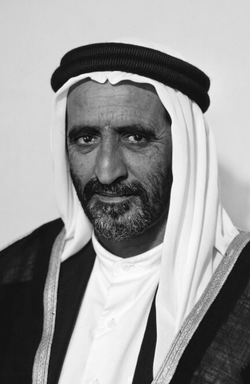
Nov 30, 1976 - 1979
Border disputes between the emirates continued even after the formation of the UAE; on 30 November 1976 Dubai and Abu Dhabi signed an arbitration compromise under the auspices of the Supreme Council of the Federation. A formal compromise ending hostilities was reached in 1979, allowing Abu Dhabi control of the rest of the UAE while leaving Dubai to rule many of its own affairs, especially trade.
Oct 7, 1990
Following the death of Sheikh Rashid II ibn Said Al Maktoum on 7 October 1990, Sheikh Maktoum III bin Rashid Al Maktoum became Ruler of Dubai.
Image source: Maktoum bin Rashid Al Maktoum

Jan 4, 2006
In 2006, upon the death of Sheikh Maktoum al-Maktoum, his brother, Sheikh Mohammed bin Rashid al-Maktoum became Emir, having been de facto ruler for a decade and credited with helping to force Dubai's rapid expansion.
1971
Britain left the Persian Gulf in the early part of 1971, having announced their intentions in 1968, causing Dubai and Abu Dhabi, in conjunction with five other emirates, to form the United Arab Emirates.
Image source: United Arab Emirates

1990
The Persian Gulf War of 1990, in which Dubai as part of the UAE provided military aid to the coalition, unsettled the economy; however, in the mid-1990s this stabilised and many foreign trading communities moved their businesses to Dubai.
Image source: Gulf War

2003
Dubai continued to foster political alignment with the western world, and during the 2003 Invasion of Iraq, they provided refueling bases to allied forces in the Jebel Ali Free Zone as they did during the Persian Gulf War.
Image source: 2003 invasion of Iraq

Feb 2026 - Mar 2026
In February and March 2026, Dubai was impacted by missile and drone strikes launched by Iran as part of a regional escalation following hostilities between the United States, Israel and Iran. On 28 February, Fairmont The Palm hotel was set ablaze after debris from an Iranian missile strike hit the area, injuring four people.
Mar 1, 2026
On March 1, 2026, Dubai's international airport and the Burj Al Arab hotel were damaged in Iranian attacks, which also caused a fire at Jebel Ali Port and resulted in four injuries at the airport, while a drone intercepted over the city caused minor damage to the hotel's facade.
Or browse the full history timeline directory, with more than 2,500 topics.
This History of Dubai timeline was generated with the help of AI, using information found on the internet.
We work hard to keep these timelines accurate, but mistakes do get through. If you spot one, email us at [email protected] and we'll fix it for future visitors.
Generate yours with AI or build it from scratch, for free.
Export your timeline, add your own events, edit or remove AI-generated events, and much more
No credit card required.
Cancel anytime.
Cancel anytime.
You can create an unlimited number of timelines with up to 10 events on each one, customize how they look, export them to PDF, PNG, PowerPoint, CSV, and Excel, and share them with a link. Paid plans raise the event limit and add features like spreadsheet imports and collaborators.
Yes. You can cancel your subscription from your account page at any time, and you will not be charged again. Your subscription stays active for the rest of the period you already paid for.
Yes. We will email you a reminder before the annual renewal, and we will also email you a receipt.
Yes. You can email us within 15 days of any payment, and we will issue you a full refund.
Check out our pricing docs or send us an email anytime: [email protected].