-
Use Cases
-
Resources
-
Pricing
The history of electronic music traces the evolution of sound created through electronic instruments and technology, beginning with early experiments in the late 19th century, developing through tape manipulation and modular synthesis in the mid-20th century, and exploding into popular culture with disco, house, techno, trance, drum and bass, and today's global EDM scene. More Less
1920
% complete
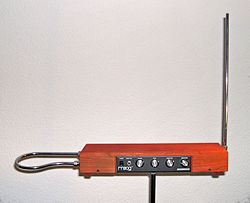
Russian physicist Léon Theremin invented the theremin, one of the first electronic instruments, played without physical contact by moving hands near two antennas. It became famous for its eerie, wavering tones in film scores and concert music.
Image source: Theremin
May 2, 1928
% complete
Maurice Martenot premiered his Ondes Martenot electronic instrument at the Paris Opera. Its expressive sliding tones were embraced by composers like Olivier Messiaen and featured prominently in orchestral and film music throughout the 20th century.
Image source: Ondes Martenot
1929
% complete
Friedrich Trautwein unveiled the Trautonium in Germany, an early electronic instrument using a resistor wire and neon lamp oscillator. Oskar Sala later refined it, famously performing on it for Alfred Hitchcock's The Birds soundtrack.
Image source: Trautonium
1944
% complete
Egyptian composer Halim El-Dabh recorded manipulated sounds of a zaar ceremony in Cairo using a wire recorder, producing some of the earliest known examples of electroacoustic and tape music years before European studios emerged.
Image source: Halim El-Dabh
1948
% complete
At Radiodiffusion Française in Paris, Pierre Schaeffer composed Études de bruits from recorded sounds like train noises, founding musique concrète. This studio-based approach to composing with recorded sound became a cornerstone of experimental electronic music.
Image source: Musique concrète
1956
% complete
Karlheinz Stockhausen's landmark work blended electronically generated tones with a boy soprano's voice, pioneering spatial audio with five loudspeaker groups. It remains a foundational piece of electronic and acousmatic music.
Image source: Gesang der Jünglinge
1958
% complete
Vladimir Ussachevsky and Otto Luening founded the Columbia-Princeton Electronic Music Center in New York, home to the RCA Mark II Sound Synthesizer. It became America's premier hub for academic electronic composition for decades.
Image source: Columbia–Princeton Electronic Music Center (album)
1964
% complete
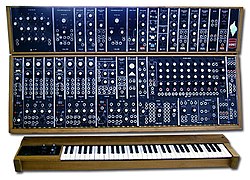
Robert Moog unveiled his voltage-controlled modular synthesizer, making synthesis practical and affordable. Adopted by artists like Wendy Carlos and Keith Emerson, the Moog transformed popular music and launched the commercial synth industry.
Image source: Moog synthesizer
1968
% complete
Wendy Carlos's album of Bach pieces performed on a Moog synthesizer became a surprise blockbuster, winning three Grammy Awards. It demonstrated that synthesizers could be serious musical instruments and ignited public fascination with electronic sound.
Image source: Switched-On Bach
1972
% complete
British company EMS released the portable Synthi A and Synthi AKS, favorites of Pink Floyd and Brian Eno. Their distinctive pin-matrix patch system enabled radical sound experimentation in progressive rock and ambient music.
Image source: EMS VCS 3
1981
% complete
Roland's TB-303 bass synthesizer and TR-909 drum machine were commercial failures but found second lives in Chicago and Detroit studios. Their squelchy acid lines and punchy drums became the sonic foundation of house and techno.
Image source: Roland TB-303
1983
% complete
The Yamaha DX7 brought affordable digital FM synthesis to musicians worldwide. Its crystalline electric piano sounds dominated 1980s pop, appearing on countless hits and becoming the best-selling synthesizer of its era.
Image source: Yamaha DX7
Nov 1974
% complete
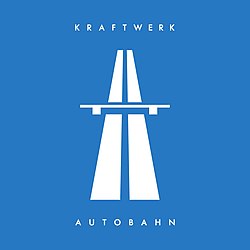
German group Kraftwerk's Autobahn LP, featuring a 22-minute title track, fused electronics with pop sensibilities. It became an international hit, establishing Kraftwerk as godfathers of synth-pop, techno, and electronic dance music.
Image source: Autobahn (album)
Apr 1977
% complete
Produced by Giorgio Moroder and Pete Bellotte in Munich, Donna Summer's I Feel Love used an entirely synthesized backing track. Its pulsing sequencer bassline revolutionized disco and laid the blueprint for electronic dance music.
Image source: I Feel Love
1984
% complete
DJs like Frankie Knuckles at Chicago's Warehouse club pioneered house music, blending disco with drum machines like the Roland TR-808 and TR-909. Tracks such as Jamie Principle's Your Love defined a genre named after the Warehouse itself.
1985
% complete
Juan Atkins, Derrick May, and Kevin Saunderson—the Belleville Three—created techno, fusing Kraftwerk-inspired machine funk with futurist vision. Tracks like No UFO's and Strings of Life gave electronic music a distinctly African American innovation story.
1992
% complete
Warp's Artificial Intelligence compilation series showcased intelligent dance music (IDM) from Aphex Twin, B12, and The Black Dog. It positioned electronic music as home-listening art, inspiring a generation of experimental producers.
Nov 9, 1992
% complete
Richard D. James's debut as Aphex Twin redefined ambient techno with lush melodies and raw analog warmth. Widely regarded as one of the greatest electronic albums ever, it influenced countless producers across IDM, techno, and beyond.
Image source: Selected Ambient Works 85–92
1993
% complete
Producers like LTJ Bukem, Goldie, and Roni Size accelerated breakbeats into jungle and drum and bass, combining reggae basslines, ragga vocals, and sub-heavy production. Labels like Metalheadz made London the epicenter of the genre.
Image source: Drum and bass
1994
% complete
Goa trance parties in India inspired a European trance boom, with labels like Harthouse and acts like Paul van Dyk and ATB crafting euphoric, melodic anthems. Trance became one of the world's most popular EDM styles through the late 1990s.
2008
% complete
Born in south London clubs like FWD>>, dubstep's half-time wobble crossed over when Skrillex and Rusko brought aggressive bro-step to American audiences. The genre topped charts and polarized fans while reshaping festival sound design.
Image source: Dubstep
1988
% complete
Phuture's Acid Tracks and imported Chicago house records fueled Britain's Second Summer of Love. Illegal warehouse parties, smiley faces, and MDMA culture exploded across the UK, forever linking acid house with British youth culture.
Image source: Second Summer of Love
1990
% complete
Massive rave events drew tens of thousands to fields, warehouses, and motorway services across Britain and Europe. Organizations like Spiral Tribe and Fantazia built a DIY party movement around hardcore, breakbeat, and early jungle sounds.
Image source: Rave
2011 - 2015
% complete
Festivals like Electric Daisy Carnival and Ultra Music Festival grew into massive spectacles headlined by DJs like Avicii and Calvin Harris. Forbes declared the 'EDM bubble' era, as electronic music became a multi-billion-dollar live industry.
Image source: Electric Daisy Carnival
2021
% complete
Chris Comstock's Anyma project pioneered cinematic, avatar-driven stage productions merging melodic techno with digital art. His immersive performances at Tomorrowland and Coachella signaled a new era of spectacle-driven electronic live shows.
Image source: Anyma
1997
% complete
The Prodigy, Chemical Brothers, and Fatboy Slim led a big beat wave that pushed electronic music onto American radio and MTV. Record labels marketed 'electronica' as rock's successor, opening the US market to dance music.
Jan 20, 1997
% complete
French duo Daft Punk's debut album Homework fused house, techno, and funk into a crossover phenomenon. Around the World and Da Funk brought French touch to global audiences and paved the way for electronic music's pop dominance.
Image source: Homework (Daft Punk album)
2001
% complete
Berlin-based Ableton released Live, a DAW designed for real-time performance and loop-based composition. Its session view revolutionized live electronic performance and laptop production, becoming an essential tool for modern producers.
Image source: Ableton Live
Or browse the full history timeline directory, with more than 2,000 topics.
This History of Electronic Music timeline was generated with the help of AI, using information found on the internet.
We work hard to keep these timelines accurate, but mistakes do get through. If you spot one, email us at [email protected] and we'll fix it for future visitors.
Generate yours with AI or build it from scratch, for free.
Export your timeline, add your own events, edit or remove AI-generated events, and much more
No credit card required.
Cancel anytime.
Cancel anytime.
You can create an unlimited number of timelines with up to 10 events on each one, customize how they look, export them to PDF, PNG, PowerPoint, CSV, and Excel, and share them with a link. Paid plans raise the event limit and add features like spreadsheet imports and collaborators.
Yes. You can cancel your subscription from your account page at any time, and you will not be charged again. Your subscription stays active for the rest of the period you already paid for.
Yes. We will email you a reminder before the annual renewal, and we will also email you a receipt.
Yes. You can email us within 15 days of any payment, and we will issue you a full refund.
Check out our pricing docs or send us an email anytime: [email protected].