-
Use Cases
-
Resources
-
Pricing
The History of Fashion traces the evolution of clothing and style across centuries, reflecting social, economic, political, and technological changes. From the elaborate dress of ancient civilizations and the sumptuary laws of medieval Europe to the rise of haute couture in 19th-century Paris, the democratization of fashion through ready-to-wear, and today's focus on sustainability and digital innovation, fashion has always served as a mirror of culture and identity. More Less
750
% complete
In eighth-century Moorish Spain, the musician Ziryab introduced to Córdoba sophisticated clothing styles based on seasonal and daily fashions from his native Baghdad, modified by his own inspiration, helping establish fashion consciousness in the region.
Image source: Ziryab

1000
% complete
Similar changes in fashion occurred in the 11th century in the Middle East following the arrival of the Turks, who introduced clothing styles from Central Asia and the Far East.
Image source: Fashion
1100 - 1300
% complete
In 12th- and 13th-century Old French, the concept of elegance begins to appear in the context of aristocratic preferences to enhance beauty and display refinement.
1201 - 1300
% complete
Cointerie, the idea of making oneself more attractive to others by style or artifice in grooming and dress, appears in a 13th-century poem by Guillaume de Lorris advising men that 'handsome clothes and handsome accessories improve a man a great deal'.
Image source: Guillaume de Lorris
1482
% complete
The French word mode, meaning 'fashion', dates as far back as 1482, while the English word denoting something 'in style' dates only to the 16th century.
1500
% complete
Cloth was used as a form of currency in trade with the Portuguese and Dutch as early as the 16th century, and locally produced cloth and cheaper European imports were assembled into new styles to accommodate the growing elite class of West Africans and resident gold and slave traders.
Image source: Textile
1279 - 1368
% complete
Mongol men of the Yuan Dynasty wore loose robes; horsemen sported shorter robes, trousers, and boots to provide ease when horseback riding.
Image source: Yuan dynasty

1400 - 1500
% complete
During the 15th century, Muslim and Hindu women wore notably different articles of clothing, reflecting distinct cultural and religious traditions in dress.
Image source: History of clothing in the Indian subcontinent
1603 - 1867
% complete
Similar changes in clothing can be seen in Japanese clothing between the Genroku period and the later centuries of the Edo period, during which clothing trends switched from flashy and expensive displays of wealth to subdued and subverted ones.
Image source: Edo period
1609
% complete
In 1609, the secretary of the Japanese shōgun bragged inaccurately to a Spanish visitor that Japanese clothing had not changed in over a thousand years.
Image source: Tokugawa shogunate
1644 - 1911
% complete
The leaders of the Qing Dynasty maintained Manchu dress while establishing new garments for officials; women of this era were expected to wear particular heels that pushed them to take on a ladylike walk.
Image source: Qing dynasty
1650
% complete
This can be seen in the clothing of some kabuki plays, where some character outfits are kept intact from designs of several centuries ago, in some cases retaining the crests of the actors considered to have 'perfected' that role.
Image source: Kabuki
1868 - 1912
% complete
For Japan, the people during the Meiji period widely incorporated Western styles into Japanese fashion, which is considered to be a remarkable transformation for the Japanese vogue.
Image source: Meiji era
1350
% complete
Historians including James Laver and Fernand Braudel date the start of Western fashion in clothing to the middle of the 14th century, though they tend to rely heavily on contemporary imagery, as illuminated manuscripts were not common before this time.
Image source: History of Western fashion
1400 - 1500
% complete
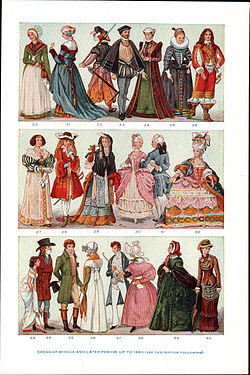
The pace of change accelerated considerably in the century following the mid-14th century, and women's and men's fashion, especially in the dressing and adorning of the hair, became equally complex.
1400 - 1500
% complete
Art historians are able to use fashion with confidence and precision to date images, often to within five years, particularly in the case of images from the 15th century.
1495
% complete
Albrecht Dürer illustrated the differences in his actual (or composite) contrast of Nuremberg and Venetian fashions at the close of the 15th century.
Image source: Albrecht Dürer
1500 - 1600
% complete
In the 16th century, national differences in fashion were at their most pronounced; ten 16th century portraits of German or Italian gentlemen may show ten entirely different hats.
Image source: 1550–1600 in European fashion
1580
% complete
The 'Spanish style' of the late 16th century began the move back to synchronicity among upper-class Europeans, and after a struggle in the mid-17th century, French styles decisively took over leadership, a process completed in the 18th century.
Image source: Fashion design
1600 - 1800
% complete
National styles remained very different until a counter-movement in the 17th to 18th centuries imposed similar styles once again, mostly originating from Ancien Régime France.
Image source: 1700–1750 in Western fashion
1800
% complete
By 1800, all Western Europeans were dressing alike (or thought they were); local variation became first a sign of provincial culture and later a badge of the conservative peasant.
1500
% complete
The looks of the French court were disseminated through prints from the 16th century on, but gained cohesive design with the development of a centralized court under King Louis XIV, which produced an identifiable style that took his name.
Image source: Louis XIV
1620
% complete
Though there had been distribution of dressed dolls from France since the 16th century, Abraham Bosse had produced engravings of fashion in the 1620s, helping spread awareness of Parisian styles.
Image source: Abraham Bosse
1780
% complete
The pace of change picked up in the 1780s with increased publication of French engravings illustrating the latest Paris styles, accelerating the spread of fashion trends across Europe.
Image source: History of fashion design
1858
% complete
Although tailors and dressmakers were responsible for many innovations, the history of fashion design is generally understood to date from 1858 when the English-born Charles Frederick Worth opened the first authentic haute couture house in Paris.
Image source: Charles Frederick Worth
1892
% complete
Vogue, founded in Manhattan in 1892, has been the longest-lasting and most successful of the hundreds of fashion magazines that have come and gone.
Image source: Vogue (magazine)
1900
% complete
By the beginning of the 20th century, with the rise of new technologies such as the sewing machine, global trade, factory production, and department stores, clothing became increasingly mass-produced in standard sizes and sold at fixed prices, ending the era when most clothing was custom-made.
Image source: Ready-to-wear
1912 - 1925
% complete
At the beginning of the 20th century, fashion magazines began to include photographs of various fashion designs. Perhaps the most famous was La Gazette du Bon Ton, founded in 1912 by Lucien Vogel and regularly published until 1925, with the exception of the war years.
Image source: Gazette du Bon Ton
2005
% complete
In 2005, the World Intellectual Property Organization held a conference calling for stricter intellectual property enforcement within the fashion industry to better protect small and medium businesses and promote competitiveness within the textile and clothing industries.
Image source: World Intellectual Property Organization
2017
% complete
Although the fashion industry developed first in Europe and America, as of 2017 it is an international and highly globalized industry, with clothing often designed in one country, manufactured in another, and sold worldwide. It has long been one of the largest employers in the United States.
1800 - 1900
% complete
In the 19th century, Europeans described China as 'lacking in fashion' among many other things, deliberately placing themselves in a superior position when comparing themselves to China and other Asian countries; this myth was tied to Western imperialism and Orientalism at its height.
Image source: Orientalism
1964
% complete
In 1964, the leg-baring mini-skirt was introduced and became a white-hot trend, symbolizing a dramatic shift in modern fashion and youth culture.
Image source: Miniskirt
2010
% complete
A few days after the 2010 Fall Fashion Week in New York City came to a close, The New Islander's Fashion Editor Genevieve Tax criticized the fashion industry for running on a seasonal schedule of its own, largely at the expense of real-world consumers.
Image source: New York Fashion Week
2017
% complete
Considering the U.S.'s political climate around the 2016 presidential election, during 2017 fashion weeks in London, Milan, New York, Paris and São Paulo amongst others, many designers took political stances leveraging their platforms and influence to reach their customers.
Image source: Fashion week
2023
% complete
Continuing on from the maximalist and 1980s influences of the early 2020s, vibrant coloured clothing made a comeback for women in America, France, China, Korea, and Ukraine by the spring of 2023. In 2023, the predominant colors in the United States, Britain, and France were red, white, and blue.
Image source: 2020s in fashion
Or browse the full history timeline directory, with more than 2,000 topics.
This History of Fashion timeline was generated with the help of AI, using information found on the internet.
We work hard to keep these timelines accurate, but mistakes do get through. If you spot one, email us at [email protected] and we'll fix it for future visitors.
Generate yours with AI or build it from scratch, for free.
Export your timeline, add your own events, edit or remove AI-generated events, and much more
No credit card required.
Cancel anytime.
Cancel anytime.
You can create an unlimited number of timelines with up to 10 events on each one, customize how they look, export them to PDF, PNG, PowerPoint, CSV, and Excel, and share them with a link. Paid plans raise the event limit and add features like spreadsheet imports and collaborators.
Yes. You can cancel your subscription from your account page at any time, and you will not be charged again. Your subscription stays active for the rest of the period you already paid for.
Yes. We will email you a reminder before the annual renewal, and we will also email you a receipt.
Yes. You can email us within 15 days of any payment, and we will issue you a full refund.
Check out our pricing docs or send us an email anytime: [email protected].